



E470: properties, uses, pros, cons, safety
E470 (salts of fatty acids) is a family of food additives made up of salts of fatty acids, used mainly as anti-caking agents and flow aids/lubricants in powders and dry blends. Practical performance depends on the cation (sodium, potassium, calcium, or magnesium), the fatty-acid profile of the starting material, and the commercial grade (particle size, purity, contaminants).
Definition
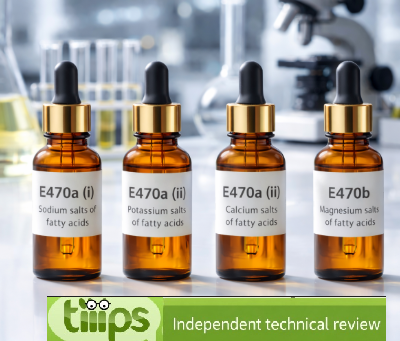
E470 is not a single molecule: it is a set of salts derived from fatty acids (typically present as mixtures). The family includes:
E470a (i): Sodium salts of fatty acids.
E470a (ii): Potassium salts of fatty acids.
E470a (iii): Calcium salts of fatty acids.
E470b: Magnesium salts of fatty acids.
In industrial practice, key drivers are: the salt type (Na/K/Ca/Mg), fatty-acid distribution (e.g., C16–C18 and others), physical characteristics (fineness/flow), and compliance with applicable purity specifications.
Main uses
Food.
Typical use as an anti-caking agent and flow aid in powdered ingredients and products (improves dosing, reduces lumping), and as a release agent/lubricant in certain processes (reduces sticking and friction on surfaces and equipment).
Cosmetics.
Not applicable: E470 is a food-additive classification, not an INCI designation.
Industrial use.
Processing aid to improve flow and reduce caking in powders, with attention to batch consistency and contaminant control.
Key constituents
The chemical core consists of salts of fatty acids (fatty-acid moiety + cation). Common profiles include fractions attributable to fatty acids such as palmitic and stearic acids, often alongside other fatty acids present in the feedstock. Cation choice (Na/K/Ca/Mg) affects powder behaviour, flowability, and tendency to compact or interact with moisture.
Nutritional use note and bioactive compounds
It is not a “nutritional” ingredient intended to deliver bioactive compounds: it is a technological additive. At typical use levels, the nutritional contribution is generally marginal relative to total dietary fat and salt intake.
Energy (calories)
Indicative theoretical value: the “fatty acid” component has an energy potential comparable to lipids (about 9 kcal/g). In practice, at technological additive levels, the caloric contribution to the finished product is generally negligible.
Identification data and specifications
| Characteristic | |
|---|---|
| Name / E-number | E470 (salts of fatty acids) |
| Subclasses | E470a (i) sodium salts; E470a (ii) potassium salts; E470a (iii) calcium salts; E470b magnesium salts |
| Technological function (typical use) | anti-caking; flow aid; release agent/lubricant; in some uses support to dispersion/stability |
| Feedstock origin | fatty acids from vegetable and/or animal oils/fats (supplier-dependent) |
| Molecular formula | not applicable as a single value (mixture of salts) |
| Molecular weight | not applicable as a single value (mixture of salts) |
| Specifications | defined by applicable standards/regulations and the supplier’s technical sheet |
Indicative physico-chemical properties
| Indicative value | Note | |
|---|---|---|
| Chemical nature | salts of fatty acids | depends on E470a (i–iii) or E470b |
| Appearance | powder or granules | grade-dependent |
| Water solubility | generally low | may vary with cation and composition |
| Main functionality | reduces caking and improves flow | relevant in powders and premixes |
| Moisture sensitivity | possible compaction | manage packaging and storage conditions |
| Critical parameters | particle size, flow, purity, contaminants | determine performance and repeatability |
Functional role and practical mechanism of action
The anti-caking/flow effect is linked to the ability of fatty-acid salts to reduce particle-to-particle adhesion and the formation of bridges (moisture/fat) in powders, improving flowability and dosing. As release agents/lubricants they reduce friction and sticking on process surfaces, supporting yield and repeatability.
Formulation compatibility
In powders, compatibility is generally good, but key points to manage include: system moisture, synergy with other anti-caking agents, and sensory impact (opacity or a “waxy” mouthfeel in certain matrices). In semi-moist or fatty systems, salt choice (Na/K/Ca/Mg) can influence dispersion and rheology; grade quality (fineness, purity) is often the main driver.
Use guidelines
Dose levels and permitted categories depend on the regulatory framework for the specific product and food category. Operationally, it is useful to define measurable targets: flowability, reduction of lumping over time, stability under thermo-hygrometric cycles, and sensory compatibility, also verifying packaging and storage conditions.
Quality, grades, and specifications
Typical controls include: compliance with destination-market specifications, contaminant limits (e.g., metals), fatty-acid profile, process consistency, and traceability of origin (vegetable/animal if relevant for requirements or claims). Adoption of GMP and HACCP supports supply-chain robustness and repeatability: GMP (good manufacturing practice; benefit: improves process control and reduces contamination/variability) and HACCP (hazard analysis and critical control points; benefit: identifies and controls food-safety risks through critical control points).
Safety, regulatory, and environment
Safety must be assessed on the finished product considering use level and expected consumption. In general, as salts of fatty acids, the safety rationale is grounded in the nature of the constituents (fatty acids and cations) and in the purity/contaminant specifications of the grade. For some additives, a numerical ADI (acceptable daily intake; benefit: provides a quantitative safety benchmark for long-term intake, but may be considered unnecessary for certain substances under specific use conditions) may not be required; practical management focuses on category-compliant use and adherence to purity specifications.
Allergen.
It is not typically classified as an allergen. Origin (vegetable/animal) can be relevant for ethical requirements or voluntary labelling and should be managed through supplier declarations and documentation.
Contraindications (brief).
Generally no specific contraindications at technological dose levels. In clinical contexts with strict control of sodium/potassium/magnesium intake, relevance should be evaluated on the finished product and overall consumption.
Formulation troubleshooting
Lumping despite the additive.
Action: verify moisture, optimize dose and particle size, improve barrier packaging and storage conditions.
Undesired sensory impact or opacity.
Action: reduce dose, change particle size/grade, evaluate switching between E470a (i–iii) and E470b based on the matrix.
Batch-to-batch variability.
Action: tighten specifications (flow, fineness, purity), introduce incoming controls, and qualify alternative suppliers.
Conclusion
E470 is a family of food additives based on salts of fatty acids that includes E470a (i) sodium, E470a (ii) potassium, E470a (iii) calcium, and E470b magnesium salts. Use is mainly technological (anti-caking/flow aid and release agent/lubricant). Performance and compliance depend on salt type, fatty-acid profile, grade quality, and correct management of moisture, packaging, and purity specifications.

