



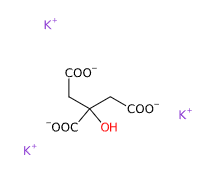
E332 (Potassium citrate) is a chemical compound, inorganic salt of citric acid (α and β-hydroxytricarboxylic acid).
The name 'potassium citrate' can be broken down as follows:
- Potassium refers to the potassium ions (K+) present in the compound. Potassium is an essential mineral for heart function and plays a key role in skeletal and smooth muscle contraction, making it important for normal digestive and muscle function.
- Citrate refers to the citrate ion (C6H5O73-), which is a derivative of citric acid. Citric acid is a weak organic acid that occurs naturally in citrus fruits.
Potassium citrate synthesis can be achieved by neutralising citric acid with potassium hydroxide in different steps:
- Neutralisation. Citric acid is combined with potassium hydroxide. Citric acid reacts with potassium hydroxide to form potassium citrate and water. The chemical equation for this reaction is: 3 KOH + C6H8O7 → K3C6H5O7 + 3 H2O
- Crystallisation. The resulting solution is then cooled, which causes the potassium citrate to crystallise.
- Filtration and drying. The crystals are then filtered from the solution and dried to obtain pure potassium citrate.
The industrial production of citric acid takes place by mycological fermentation of raw sugar from Aspergillus niger and subsequent crystallisation with alkaline solutions.
It appears as an odourless white crystalline powder with a slightly saline taste. Slightly hygroscopic, easily soluble in water, slow to dissolve in glycerine, insoluble in alcohol and ethanol.

What it is used for and where
Medical
In addition to its main function as a preservative, Potassium Citrate is also a decent antimicrobial, although inferior to Potassium Acetate (1). Potassium citrate is used to improve bone mineral density and to prevent metabolic acidosis in kidney disease (2) and has enhanced the beneficial effects of calcium and vitamin D in osteopenic women with a documented potassium and citrate deficiency and a metabolic profile compatible with low-grade acidosis (3). It has been shown that potassium citrate can increase urine pH values and dissolve kidney stones (4) and that alkaline therapy increases bone mineral density and corrects abnormal bone cell function.
Some improvement has been achieved in the treatment of dehydration by potassium citrate supplementation.
It has been observed that potassium citrate, with its alkanising action, can alleviate the discomfort of cystitis caused by lower urinary tract infections (5).
Indicated in the treatment of potassium deficiency.
Studies have shown its efficacy in strengthening bones and thus being less prone to fractures and osteoporosis.
Dentistry
The inclusion of potassium citrate in toothpastes reduced tooth sensitivity after 3 weeks (6) and has an antibacterial function.
Food
It is labelled E332 on the European food additives list as an acidity regulator, but also has antiseptic properties. Emulsifier in cheese.
Cosmetics
Chelating and buffering agent in cosmetic products with preservative properties.
- Buffering agent. Iingredient that can bring an alkaline or acid solution to a certain pH level and prevent it from changing, in practice a pH stabiliser that can effectively resist instability and pH change.
- Chelating agent. It has the function of preventing unstable reactions and improving the bioavailability of chemical components within a product, and removes calcium and magnesium cations that can cause cloudiness in clear liquids.
Typical commercial product characteristics Potassium Citrate
| Appearance | White powder |
| pH | 7.5-9.0 |
| Boiling Point | 309.6ºC at 760 mmHg |
| Flash Point | 155.2ºC |
| Density | 1.187 |
| PSA | 140.62000 |
| Chlorides | 0.005% |
| Sulphate | 0.015% |
| Oxalate | 0.03% |
| Heavy Metal | ≤10ppm |
| As | ≤2ppm |
| Loss on drying | 3.0-6.0 (180°C, 4h) |
| Fe | ≤5mg/kg |
| Pb | ≤2ppm |
| Ca | ≤0.02% |
| Hg | ≤0.1ppm |
| Cd | ≤1ppm |
| Shelf Life | 2 Years |
 |  |
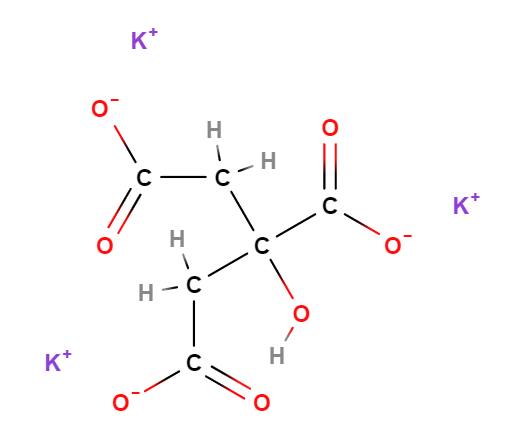 | 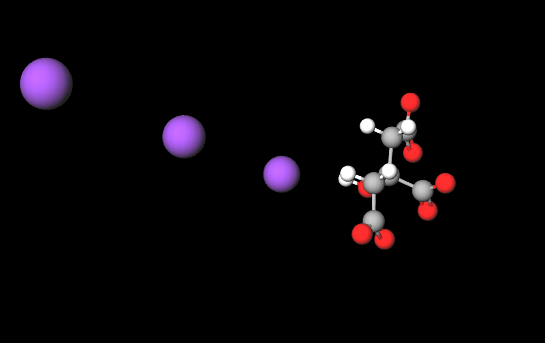 |
- Molecular Formula K3C6H5O7 C6H5K3O7 C6H5O7K3·H2O
- Linear Formula HOC(COOK)(CH2COOK)2 · H2O
- Molecular Weight 306.394 g/mol
- Exact Mass 305.894653
- CAS 866-84-2 7778-49-6
- EC Number 212-755-5 612-062-1
- UNII 86R1NVR0HW
- DSSTox Substance ID DTXSID8027325 DTXSID0041222
- IUPAC tripotassium;2-hydroxypropane-1,2,3-tricarboxylate
- InChl=1S/C6H8O7.3K/c7-3(8)1-6(13,5(11)12)2-4(9)10;;;/h13H,1-2H2,(H,7,8)(H,9,10)(H,11,12);;;/q;3*+1/p-3
- InChl Key QEEAPRPFLLJWCF-UHFFFAOYSA-K
- SMILES C(C(=O)[O-])C(CC(=O)[O-])(C(=O)[O-])O.[K+].[K+].[K+]
- MDL number MFCD00150442
- PubChem Substance ID 329750903
- ChEBI 64733
- NCI C29372
- RXCUI 1374802
- Beilstein 3924344
- HS Code 2918150000
Synonyms:
- Tripotassium citrate
- Potassium citrate anhydrous
- Citric acid, tripotassium salt
- 1,2,3-Propanetricarboxylic acid, 2-hydroxy-, tripotassium salt
- Potassium tribasic citrate

