



Hazelnut cream and cocoa: properties, uses, advantages, disadvantages, safety
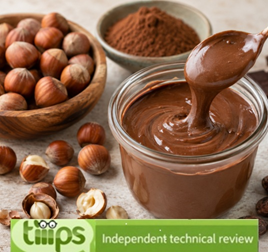
Hazelnut cream and cocoa is a compound food ingredient obtained by combining processed hazelnuts with cocoa or cocoa-derived products.
It does not identify a single chemical substance or a universally standardised recipe. The actual composition can vary considerably between manufacturers: in addition to hazelnuts and cocoa, a commercial cream may contain sugar, vegetable oils or fats, milk or milk derivatives, emulsifiers, flavourings and other ingredients.
Therefore, when a label simply states “Hazelnut cream and cocoa”, it is not technically correct to assign a specific percentage of hazelnuts, cocoa, sugar or fat unless the manufacturer's specification or complete sub-ingredient declaration is available.
Description
The main characterising ingredient is hazelnut, generally Corylus avellana, processed by roasting and grinding until a paste or cream is obtained from the naturally oil-rich kernels.
The second characterising ingredient is cocoa, derived from the seeds of Theobroma cacao. Depending on the formulation, it may be added as:
cocoa powder;
reduced-fat cocoa powder;
cocoa mass;
chocolate;
other cocoa preparations.
Under EU legislation, cocoa powder is the product obtained by converting cleaned, shelled and roasted cocoa beans into powder, containing at least 20% cocoa butter on a dry-matter basis and no more than 9% water. Reduced-fat cocoa powder contains less than 20% cocoa butter on a dry-matter basis.
The generic term “hazelnut cream and cocoa” should not automatically be treated as equivalent to “gianduja”. Under EU rules, the designation Gianduja chocolate is linked to specific chocolate composition requirements and to the presence of 20–40 g of finely ground hazelnuts per 100 g of product. Unless those conditions are documented, the product should not automatically be classified as Gianduja.
Production process
Production depends on the specific formulation but normally begins with hazelnut processing.
Typical stages may include:
selection and cleaning of hazelnuts;
roasting;
optional removal of the skins;
grinding;
progressive release of the naturally occurring hazelnut oil;
formation of hazelnut paste;
addition of the cocoa component;
optional addition of sugar;
optional addition of vegetable oils or fats;
optional incorporation of milk powder or other ingredients;
refining;
mixing or homogenisation;
optional heat treatment;
cooling;
packaging.
During grinding, hazelnuts do not simply become a dry powder. Their high natural fat content progressively produces an oily paste, which forms the basis of hazelnut creams.
Roasting plays an important role in developing the characteristic hazelnut aroma and also modifies colour, moisture and sensory properties.
Cocoa is then dispersed through the fat phase of the cream. Particle size and degree of refining strongly influence whether the final product feels smooth or gritty.
Main substances contained
Because this is a compound ingredient, the substances present depend on the relative amounts of hazelnuts, cocoa and any additional ingredients.
Hazelnuts
Hazelnuts mainly provide:
lipids, predominantly unsaturated fatty acids;
proteins;
dietary fibre;
moderate amounts of carbohydrates;
vitamin E;
minerals;
phenolic compounds;
phytosterols.
The oil naturally present in hazelnuts often represents an important part of the cream's fat phase.
Cocoa
The cocoa component may contribute:
cocoa solids;
cocoa butter, depending on the cocoa ingredient used;
dietary fibre;
proteins;
minerals;
polyphenols;
theobromine;
small amounts of caffeine.
Theobromine and caffeine are methylxanthines naturally present in cocoa, but their amount in the finished cream depends strongly on the type and percentage of cocoa material used.
Possible additional ingredients
A commercial cream may also contain:
sugar, often in a quantitatively significant amount;
vegetable oils;
additional cocoa butter;
milk powder;
whey;
lecithins;
flavourings;
salt;
other technological ingredients.
These ingredients must not automatically be assumed to be present from the name “Hazelnut cream and cocoa” alone. They must be confirmed from the specification of the actual cream used.
Identification data and characteristics
| Characteristic | Value | Note |
|---|---|---|
| Name | Hazelnut cream and cocoa | compound food ingredient |
| Category | Compound food ingredient | not a single substance |
| Main characterising ingredient | Hazelnut | normally Corylus avellana |
| Second characterising ingredient | Cocoa/cocoa product | from Theobroma cacao |
| Physical structure | Predominantly fat-based paste/emulsion | depends on formulation |
| Main natural components | Lipids, proteins, fibre and cocoa solids | variable amounts |
| Added sugar | Possible and often present in sweet creams | cannot be inferred from the name alone |
| Added vegetable oils | Possible | formulation-dependent |
| Milk | Possible | must be declared if present |
| Soy | Possible, for example through soy lecithin | not necessarily present |
| Certain allergen | Hazelnuts | tree nut |
| Gluten | Not intrinsic to hazelnuts or cocoa | formulation and cross-contact must be checked |
| Molecular formula | Not applicable | complex food mixture |
| CAS number | Not applicable | not a single chemical substance |
| E-number | None for the cream as a whole | individual additives may have their own E-numbers |
Hazelnuts (Corylus avellana) and hazelnut products are specifically included among regulated tree-nut allergens under EU food-information legislation.
In the United States, hazelnut is likewise considered a major food allergen as a tree nut, while UK allergen rules also require hazelnuts to be clearly declared and emphasised when present as an ingredient.
Indicative nutritional profile
It is not technically correct to assign universal nutritional values to Hazelnut cream and cocoa, because a cream containing, for example, 40% hazelnuts and little sugar will differ greatly from one containing 10% hazelnuts and large amounts of sugar and added oil.
| Nutrient/component | General tendency | Main source |
|---|---|---|
| Energy | generally high | hazelnut fat and, if present, added sugar |
| Fat | generally significant | mainly hazelnuts; possibly added oils and cocoa butter |
| Saturated fat | highly variable | cocoa butter and any added fats |
| Unsaturated fat | significant when hazelnut content is high | natural hazelnut oil |
| Carbohydrates | highly variable | mainly added sugar when present |
| Sugars | from low to very high | depends largely on formulation |
| Protein | present | mainly hazelnuts |
| Fibre | present | hazelnuts and cocoa |
| Vitamin E | naturally present | hazelnuts |
| Theobromine | present in variable amounts | cocoa |
| Caffeine | normally present in small amounts | cocoa |
| Salt | generally low unless added | formulation-dependent |
For a specific ingredient, nutritional evaluation should therefore rely on the nutrition declaration or technical specification supplied by the manufacturer, rather than estimates based only on the ingredient name.
Technological properties
Hazelnut cream and cocoa has technological properties largely determined by its fat phase.
Hazelnut oil and cocoa butter, where present, allow uniform dispersion of:
cocoa particles;
finely milled sugar;
milk solids;
flavourings;
other fat-soluble components.
Texture depends strongly on:
percentage of hazelnuts;
total fat content;
type of fats used;
sugar concentration;
particle size;
temperature;
presence of emulsifiers.
A cream with a high hazelnut percentage may be relatively fluid because of the natural oil released during grinding.
Conversely, fats with a higher melting point may be used to obtain a more firm and stable texture at room temperature.
Food uses
Hazelnut cream and cocoa may be used as:
biscuit filling;
wafer filling;
croissant filling;
bakery cream;
praline filling;
chocolate-centre ingredient;
ice-cream ingredient;
cake filling;
spread;
dessert component;
ingredient in bars and snacks.
When it appears as a compound ingredient within another food, its evaluation should also consider the percentage actually used in the finished product.
For example, a sugar-rich cream used at 10% in a biscuit contributes differently to the final food than a high-hazelnut cream used at 40%.
Advantages
Contains hazelnuts, naturally rich in predominantly unsaturated fats.
Hazelnuts provide protein, fibre, vitamin E and various micronutrients.
Cocoa contributes characteristic aromatic compounds.
Cocoa naturally provides polyphenols and methylxanthines.
The hazelnut-cocoa combination has a highly appreciated flavour profile.
It is a technologically versatile ingredient.
It can provide flavour, fat, texture and structure simultaneously.
Formulations with a high hazelnut content may rely largely on the fat naturally present in hazelnuts.
Added vegetable fats are not necessarily required; their presence depends on the formulation.
Gluten is not an intrinsic component of either pure hazelnuts or pure cocoa.
Disadvantages
The designation “Hazelnut cream and cocoa” does not reveal the actual nutritional quality.
Hazelnut percentage may vary substantially.
Cocoa content may also vary widely.
Many commercial creams contain high amounts of added sugar.
Some formulations contain substantial quantities of added vegetable oils or fats.
High energy density may result from both fat and sugar.
A cream containing a low percentage of hazelnuts does not necessarily have the same nutritional profile as whole hazelnuts.
Cocoa naturally contains theobromine and small amounts of caffeine.
The product necessarily contains hazelnuts, which are an important allergen.
Additional allergens, particularly milk and soy, may be present depending on the formulation.
The nutritional benefits of hazelnuts or cocoa should not automatically be attributed to the finished cream without considering their actual percentages and the complete formulation.
Safety and allergens
Hazelnuts
The main safety consideration is hazelnut allergy.
Hazelnuts are a regulated tree-nut allergen in the European Union and United Kingdom and a major food allergen in the United States.
Processing into a cream, roasting and grinding do not reliably eliminate allergenicity.
A hazelnut cream must therefore continue to be treated as an ingredient containing the allergen HAZELNUTS.
Milk and soy
Milk and soy are not necessarily present.
However, they may be introduced through ingredients such as:
milk powder;
whey;
milk proteins;
lactose-containing ingredients;
soy lecithin;
other soy derivatives.
If present, they must be considered separately under applicable EU, UK and US allergen-labelling rules.
Cocoa
Cocoa itself is not one of the standard major food allergens requiring mandatory declaration under EU or UK legislation, nor is it one of the major allergens defined under US federal allergen law.
This does not exclude the possibility of individual reactions, but its regulatory status differs from that of hazelnuts, milk or soy.
Aflatoxins
Hazelnuts can be contaminated by aflatoxins, mycotoxins produced by certain moulds.
Selection of raw materials, appropriate storage and analytical controls are therefore important.
EU contaminant legislation establishes maximum levels for aflatoxins in hazelnuts intended for direct human consumption or use as a food ingredient.
For such hazelnuts, current EU limits include:
5.0 µg/kg for aflatoxin B₁;
10.0 µg/kg for the sum of B₁ + B₂ + G₁ + G₂.
Different limits apply to hazelnuts intended to undergo sorting or other physical treatment before consumption or use as an ingredient.
In the United States and United Kingdom, aflatoxin controls are also relevant to nuts and nut-derived foods, although the legal frameworks and numerical limits are not identical to those of the EU.
For a compound ingredient such as hazelnut cream and cocoa, the applicable contaminant assessment must take into account the composition and the rules governing processed or compound foods.
Cocoa and safety
Cocoa normally undergoes:
fermentation;
drying;
roasting;
shell removal;
grinding;
optional pressing;
optional alkalisation;
optional conversion into powder.
Roasting contributes to flavour development and to reduction of microbial contamination, but cocoa quality must already be controlled at raw-material level.
Depending on the ingredient used, the cocoa component may contribute theobromine and caffeine, but their amounts are generally much lower than would be obtained from consuming a highly caffeinated beverage.
Sugar and nutritional quality
One of the factors that most strongly determines the nutritional quality of a hazelnut-and-cocoa cream is the amount of added sugar.
Two apparently similar creams can have completely different formulations.
Cream A
high percentage of hazelnuts;
cocoa;
little sugar;
no added oil.
Cream B
sugar as the predominant ingredient;
vegetable oil;
relatively low hazelnut percentage;
modest cocoa content.
Both may be described generically as “Hazelnut cream and cocoa”, but nutritionally they are very different products.
Assessment should therefore focus on:
hazelnut percentage;
cocoa percentage;
sugar content;
type and amount of added fats;
possible milk content;
additives;
amount used in the finished food.
Storage
The cream should be protected particularly from:
heat;
oxygen;
light;
moisture;
microbial contamination;
excessive temperature fluctuations.
Hazelnut fat contains a high proportion of unsaturated fatty acids and can therefore undergo oxidation and rancidity.
Appropriate formulation, packaging that limits oxygen exposure and suitable storage temperatures help preserve aroma and quality.
Temperature fluctuations can also alter fat crystallisation and cause:
oil separation;
changes in texture;
fat crystallisation defects;
loss of homogeneity.
The manufacturer's storage instructions should therefore be followed for the specific commercial product.
Environment
The environmental impact depends heavily on the actual formulation.
Relevant supply chains include:
hazelnut cultivation;
cocoa production;
sugar production where used;
vegetable oils where used;
milk production where present;
industrial processing;
roasting;
refining;
packaging;
transport.
It is therefore not possible to assign one universal environmental profile to the generic ingredient Hazelnut cream and cocoa.
A formulation consisting mainly of hazelnuts and cocoa can have a very different environmental profile from one in which sugar and added vegetable oil represent most of the product.
Conclusion
Hazelnut cream and cocoa is a compound food ingredient, not a single chemical substance or a standardised universal formulation.
Its two characterising raw materials are hazelnuts, normally Corylus avellana, and cocoa derived from Theobroma cacao. Hazelnuts mainly contribute fat, protein, fibre and micronutrients, while cocoa contributes cocoa solids, fibre, characteristic flavour compounds, polyphenols and methylxanthines such as theobromine and small amounts of caffeine.
However, a commercial cream may also contain sugar, vegetable oils, milk ingredients, emulsifiers, flavourings and other components. Their presence and quantity cannot be inferred from the generic designation “Hazelnut cream and cocoa”.
For this reason, universal nutritional values cannot be assigned without knowing the actual formulation. Hazelnut percentage, cocoa content, sugar level and added fats largely determine the nutritional profile.
The most important safety consideration is the certain presence of hazelnuts, a regulated tree-nut allergen in the EU and UK and a major food allergen in the USA. Roasting and grinding do not reliably remove this allergenic potential.
Hazelnuts also require appropriate control for aflatoxins, while the possible presence of milk, soy or other allergens must be assessed from the complete formulation and supplier documentation.
Finally, “hazelnut cream and cocoa” should not automatically be equated with “Gianduja” or “hazelnut chocolate”, because those names may be linked to specific compositional requirements. Under EU rules, for example, Gianduja chocolate must meet defined chocolate requirements and contain 20–40 g of finely ground hazelnuts per 100 g of product.
A correct evaluation of Hazelnut cream and cocoa should therefore be based on the actual manufacturer's formulation, with particular attention to hazelnut percentage, cocoa content, added sugar, added fats, allergens, contaminant controls and the amount used in the finished food.

