



Candelilla wax hydrocarbons: properties, uses, pros, cons, safety
(from Euphorbia antisyphilitica / Euphorbia cerifera)
Candelilla wax hydrocarbons is the hydrocarbon fraction obtained from candelilla wax (a vegetable wax) derived from Euphorbia shrubs (notably Euphorbia antisyphilitica and Euphorbia cerifera, family Euphorbiaceae), typical of arid areas of Northern Mexico. In formulations it is used mainly as a film former and a viscosity/consistency controller, helping provide structure, stability, and “body” to sticks, waxy systems, anhydrous products, and oily matrices.
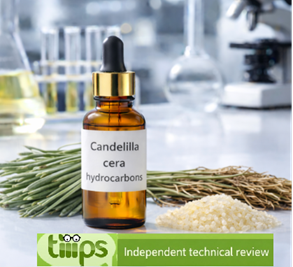
Definition
Candelilla wax hydrocarbons is not a single molecule: it is a complex mixture of long-chain saturated hydrocarbons (predominantly n-alkanes) separated from the original wax matrix. Candelilla wax itself is a natural mixture composed largely of hydrocarbons and, secondarily, wax esters and resinous fractions; the term “hydrocarbons” indicates a focus on the hydrocarbon component, useful as a structurant and film former in lipophilic systems.
For more information: CANDELILLA
Main uses
Food.
Candelilla wax is used as a food additive (E902, “glazing agent”) and as a processing aid for surface coatings: it helps form a hydrophobic layer that reduces moisture loss and improves surface protection of certain foods. Practical applications include coatings for fruit and glossy surface finishing in confectionery; the specific use depends on applicable regulations and grade (food grade).
Cosmetics.
Film-forming agent and viscosity controller. In lip products, sticks/waxes, mascara, and anhydrous or W/O systems, it improves film cohesion, surface resistance, and a “hold” feel, also contributing to structural stability (reduced dripping/softening and improved consistency).
INCI functions.
Film-forming agent. It produces a continuous ultra-thin film with an optimal balance of cohesion, adhesion and stickiness on the skin or hair to counteract or limit damage from external phenomena such as chemicals, UV rays and pollution.
Surfactant - Suspending agent. Cosmetic or pharmaceutical suspensions are known to be thermodynamically unstable and it is therefore essential to include in the formulation a suspending agent capable of dispersing any sedimented particulates and reducing the rate of sedimentation. The presence of this agent increases the consistency of the suspension medium and exerts a protective colloidal action with a surfactant action.
Technical note on “surfactant/suspending agent.”
Strictly speaking, it is not a typical surfactant (it is not a “classic” amphiphilic molecule). Any “suspending” effect observed in practice is more correctly linked to its contribution to rheology and structuring of the oil phase (increased consistency), which can slow sedimentation in dispersed systems.
Pharmaceutical.
Can be relevant as an excipient/structurant in semi-solid and stick dosage forms, with requirements depending on pharmacopeia and grade quality.
Industrial use.
Vegetable waxes and related fractions are used as finishing agents, protectives, and consistency modifiers in various matrices (inks, coatings, hot-melts, etc.), where melting point, hardness, and system compatibility are critical.
Key constituents
The “hydrocarbons” fraction is dominated by long-chain saturated n-alkanes (typically in the C29–C33 range, with certain chains prevailing). In a commercial material, smaller amounts of other wax-derived fractions may be present depending on separation/refining; the actual profile depends on the extraction method and the grade (refined, decolorized, standardized).
Identification data and specifications
| Characteristic | Value |
|---|---|
| INCI name | Candelilla wax hydrocarbons |
| Origin | hydrocarbon fraction derived from candelilla wax (vegetable origin) |
| Botanical source | Euphorbia antisyphilitica / Euphorbia cerifera (family Euphorbiaceae) |
| Technical synonyms (raw material context) | candelilla wax; “hydrocarbon fraction of candelilla wax” |
| CAS number / EC number (specific) | not always assigned as unique identifiers for the “hydrocarbons” fraction |
| Useful reference (raw material: candelilla wax) | CAS 8006-44-8; EC 232-347-0 (for the wax, not necessarily for the fraction) |
| Functions (cosmetics) | film forming; viscosity controlling |
| Food note (raw material: wax) | uses as glazing agent (E 902) and in coating applications, depending on regulations and grade |
Physico-chemical properties (indicative)
| Characteristic | Indicative value | Note |
|---|---|---|
| Chemical nature | mixture of long-chain saturated hydrocarbons | typically predominant n-alkanes C29–C33 |
| Physical state | waxy solid | often flakes/pastilles depending on grade |
| Color | light to yellow/brown | depends on refining/decolorization |
| Odor | mild, waxy | more noticeable when warmed |
| Melting range (reference: candelilla wax) | ~68–73 °C | useful as an order-of-magnitude thermal reference |
| Water solubility | insoluble | typical of waxes |
| Solubility in organic solvents | generally soluble in selected nonpolar solvents | behavior depends on the system |
| Rheological function | increases consistency/structure in the oil phase | useful for sticks and anhydrous systems |
Functional role and mechanism of action (practical)
In cosmetics, the hydrocarbon fraction acts as an oil-phase structurant and film former: upon solidification it contributes to a wax network that increases hardness, softening point, and mechanical stability. The continuous film improves adhesion and surface resistance, benefiting protection and performance (wear, controlled slip, reduced transfer in some cases). In food (with reference to the wax), the role is mainly a hydrophobic surface barrier and glossing agent.
Formulation compatibility
Compatibility is generally good in anhydrous and oily systems; in W/O emulsions it can contribute to the external-phase structure. Typical critical points are: balancing with other lipids/waxes (synergies or excessive rigidity), crystallization management (long-term stability and thermal cycles), and compatibility with fragrances/oils (changes in hardness and apparent melting behavior).
Use guidelines
Define the target (hardness, glide, payoff, heat stability) and adjust dosage based on: lipid base type, presence of other waxes/butters, and the storage temperature range. In manufacturing, control melting/mixing temperature and cooling profile to minimize defects (graininess, oil weeping/syneresis, surface bloom).
Quality, grades, and specifications
Performance depends strongly on the grade: refinement level, color, compositional profile (hydrocarbon share vs residual fractions), and batch-to-batch consistency. For food uses (referring to candelilla wax), food-grade specifications and compliance with relevant monographs/standards are critical. In cosmetics, supplier qualification and incoming QC (melting point, color, odor, impurities) are key to repeatability.
Safety, regulation, and environment
Candelilla wax has a long history of food use; in the USA it is treated in regulatory contexts as an allowed substance for specific uses and is commonly described as GRAS for certain applications. Safety assessment should nonetheless be referenced to: grade, impurities, use level, and the final matrix.
Allergen.
It is not typically classified as an allergen. Individual reactions are rare but not impossible, especially in subjects sensitized to specific natural components or to impurities.
Contraindications (brief).
Generally well tolerated at normal use concentrations. For very reactive skin or dermatological conditions, assessment should be based on the finished product and use context (occlusivity/film).
Formulation troubleshooting
Stick too hard or excessive drag during application.
Reduce the wax/hydrocarbon fraction level; balance with lower-viscosity emollients or with waxes having a more plastic profile.
Oil weeping/syneresis over time.
Reassess the wax-to-oil ratio and the cooling profile; consider synergies with other structurants (e.g., other waxes) to stabilize the network.
Graininess or perceptible crystals.
Optimize the thermal profile (complete melting, controlled cooling) and check compatibility with butters rich in saturated triglycerides (possible competitive crystallization).
Conclusion
Candelilla wax hydrocarbons is a vegetable wax-derived hydrocarbon fraction useful as a film former and viscosity controller in cosmetics, where it increases structure and stability of lipophilic systems and sticks. The food reference mainly concerns candelilla wax (E 902) as a glazing/coating agent; in both areas, performance depends on grade, compositional consistency, and formulation process management (temperature and crystallization).
Mini-glossary
INCI. International nomenclature of cosmetic ingredients; standard for naming cosmetic ingredients on labels. Benefit: consistency and traceability across markets.
GRAS. Generally recognized as safe; US category for substances considered safe for specific uses. Benefit: reduces the need for premarket approval for covered uses.
FDA. Food and drug administration (USA); authority regulating, among other things, safety/use aspects for substances in food and consumer contexts. Benefit: regulatory reference for the US market.
E 902. EU code for the additive “candelilla wax” as a glazing/coating agent. Benefit: regulatory identification of food use.

