



Lactulose: properties, uses, pros, cons, safety
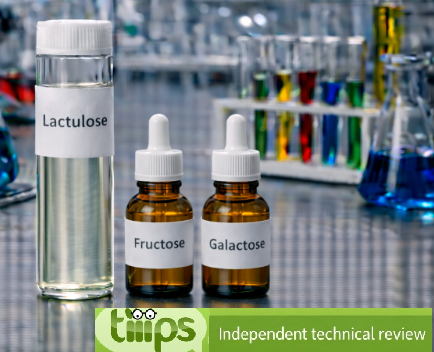
Lactulose – synthetic disaccharide made of galactose and fructose (galactosyl-fructose), obtained by isomerization of lactose
Synonyms: 4-O-β-D-galactopyranosyl-D-fructose; 4-O-β-D-galactopyranosyl-D-fructofuranose (descriptive variants); lactulose (EN)
Definition
Lactulose is a non-digestible disaccharide (for humans) composed of galactose and fructose. In practical terms, it passes through the small intestine with minimal absorption and reaches the colon, where it is fermented by the microbiota with production of organic acids (including short-chain fatty acids) and a consequent decrease in luminal pH. This dynamic explains both its use as an osmotic laxative (water is drawn into the lumen, softening stools) and the interest in it as a prebiotic at low doses in foods/supplements.
From a substance standpoint, lactulose is defined as 4-O-(β-D-galactopyranosyl)-D-arabino-hex-2-ulofuranose; industrially it may be marketed as a powder or, more commonly, as a syrup/solution, where residual sugars may be present depending on the synthesis route and the supplier’s purity specifications.
Main uses
Food.
In foods and supplements, lactulose is used as a functional carbohydrate with a prebiotic positioning and support for intestinal transit regularity, with careful management of dose and tolerability. In the EU there is an authorized health claim for acceleration of intestinal transit under specific conditions of use (relevant for supplements/foods). In food formulation it may also be considered as an ingredient with lower relative sweetness than sucrose and a reduced energy value compared with fully digestible carbohydrates, due to partial fermentation.
Cosmetics.
Skin conditioning agent - Humectant. Humectants are hygroscopic substances used to minimise water loss in the skin and to prevent it from drying out by facilitating faster and greater absorption of water into the stratum corneum of the epidermis. The epidermis is the most superficial of the three layers that make up the human skin (epidermis, dermis and hypodermis) and is the layer that maintains hydration in all three layers. In turn, the epidermis is composed of five layers: corneum, the most superficial, lucidum, granulosum, spinosum and basale. Humectants have the ability to retain in the stratum corneum the water they attract from the air and have the function of moisturising the skin. It is better to use them before emollients that are oil-based.
CAS: 4618-18-2
Medicine.
Used as an osmotic laxative (1) and, in clinical settings, as support in the management of hyperammonemia/hepatic encephalopathy (2) through colonic acidification and “trapping” of ammonia in ionic form (pharmacological rationale). Here, these references describe the mechanism of use and do not replace medical indication or prescription.
Pharmaceutical.
A well-established active in multiple oral forms (typically syrup/solution or powder for solution). The product profile strongly depends on: purity, related sugars (lactose/galactose and isomers), microbiological control, and indications/contraindications in the medicinal product dossier.
Industrial use.
Beyond food and pharma, it may be used as a standard/reagent in analytical and laboratory contexts (e.g., as a substrate or reference in carbohydrate chemistry). Industrial attention often focuses on thermal stability in aqueous matrices, browning tendency under harsh processing, and quality management in syrups (crystallization and viscosity changes).
Calories (energy value)
| Characteristic | Value |
|---|---|
| Energy value (powder, indicative) | ~2 kcal/g (≈9 kJ/g) |
| Practical note | The value can vary depending on labeling criteria and commercial form (powder vs syrup). In medicinal solutions, related/residual sugars may also contribute. |
Identification data and specifications
| Characteristic | Value |
|---|---|
| Common name | Lactulose |
| English name | Lactulose |
| Molecular formula | C12H22O11 |
| Molar mass | 342.30 g/mol |
| CAS number | 4618-18-2 |
| EC/EINECS number | 225-027-7 |
| Typical commercial appearance | white/crystalline powder or syrup/solution (grade-dependent) |
Chemical-physical properties (indicative)
| Characteristic | Value | Note |
|---|---|---|
| Water solubility | high | supports use in syrups and solutions |
| Melting point | ~168–169 °C | typical specification value (grade-dependent) |
| Specific optical rotation | approx. −46 to −50 (anhydrous) | identity/quality parameter for carbohydrates |
| pH (solution, typical spec) | ~3.0–7.0 | depends on concentration and grade |
Functional role and practical mechanism
| Characteristic | What it does “in practice” | Technical note |
|---|---|---|
| Osmotic laxative | draws water into the intestinal lumen, softening stools and promoting peristalsis | effect is dose-dependent and may take time to stabilize |
| Colonic fermentation | metabolized by microbiota with organic acid production and pH decrease | may increase gas/bloating in sensitive individuals |
| Support in hyperammonemia | colonic acidification promotes NH3→NH4+ conversion and reduces reabsorption | clinical concept; always medically managed |
| Prebiotic (low doses) | may selectively favor “beneficial” bacteria and metabolites (SCFA) | individual tolerability is a practical constraint |
Formulation compatibility
In aqueous matrices, lactulose is generally easy to handle due to solubility, but it requires attention to:
Thermal processing: heat/pH conditions can increase degradation, browning, or organoleptic changes (a typical carbohydrate-processing topic in foods).
Commercial form: syrups may contain fractions of related sugars; this impacts sweetness, carbohydrate profile, claim management, and—in pharma—warnings for sugar intolerances.
Microbiological regime: in aqueous solutions a preservation strategy (or aseptic processing) and packaging stability are essential, especially for long shelf-life products.
Use guidelines (indicative)
| Application | Typical range | Technical note |
|---|---|---|
| Foods/supplements (EU transit claim) | 10 g in a single portion/day | condition of use for the authorized claim (details in EU register) |
| Prebiotic use (foods/supplements, general) | ~2–10 g/day | tolerability (gas/bloating) guides dose selection |
| Pharmaceutical (constipation, indicative) | ~10–30 g/day (or equivalent in mL of syrup) | dose and schedule depend on the medicinal product; titrate to response and tolerability |
| Pharmaceutical (hepatic encephalopathy, indicative) | higher and/or split dosing | clinical management; monitor hydration/electrolytes if diarrhea occurs |
Quality, grades, and specifications
| Characteristic | What to check |
|---|---|
| Identity | CAS/EC alignment, optical profile (rotation), chromatographic fingerprint |
| Assay/purity | lactulose content and related sugars (lactose/galactose/isomers) |
| Moisture and physical behavior | hygroscopicity, powder flow, caking tendency |
| Appearance and color | variation due to degradation/thermal history; lot and shelf-life control |
| Microbiology | stricter requirements for syrups/solutions and for pharmaceutical use |
| Stability | thermal stress and packaging tests (viscosity, crystallization, color) |
Safety, regulatory, and environment
In practical use, the most common criticality is gastrointestinal tolerability (bloating, cramps, diarrhea at higher doses), with potential electrolyte imbalance in cases of persistent diarrhea or misuse (especially relevant in elderly or fragile patients). In the pharmaceutical context, attention extends to warnings for sugar intolerances and possible interactions related to colonic pH changes or potassium loss in diarrhea.
Regulatorily, lactulose typically falls under two frameworks:
foods/supplements, with strict rules on claims and conditions of use (and labeling management);
medicinal product, with quality specifications and use defined by the product dossier.
At process and quality level, application of GMP (Good manufacturing practice; benefit: reduces variability and contamination) and, where relevant, a HACCP approach (Hazard analysis and critical control points; benefit: strengthens preventive control of critical points) supports repeatability and risk control across the production chain.
Formulation troubleshooting
| Problem | Possible cause | Recommended intervention |
|---|---|---|
| Browning/“cooked” note | thermal stress, non-optimal pH, long processing times | reduce thermal severity, optimize pH, shorten residence time, reassess process |
| Crystallization in syrup | supersaturation, storage temperature, related-sugar profile | retune concentration, manage thermal profile, control related sugars |
| Viscosity instability | compositional drift, degradation, free water | tighten specs, accelerated stability testing, suitable packaging |
| Poor consumer tolerability | dose too high or rapid escalation | split dose, reduce and re-titrate, communicate correct use |
| Label/claim issues | non-alignment with conditions of use or wording | align formulation and serving size to claim conditions and regulatory framework |
Conclusion
Lactulose is a synthetic, non-digestible disaccharide with consolidated pharmaceutical use as an osmotic laxative and relevance in foods/supplements as a functional ingredient (prebiotic and transit support under defined conditions of use). For formulators, the key points are: managing stability (thermal and in solution), controlling related sugars, ensuring labeling/dose consistency, and addressing individual tolerability, which is often the true application constraint.
Mini-glossary
Disaccharide: carbohydrate made of two monosaccharides linked together.
Osmosis: movement of water driven by solute concentration differences.
SCFA: short-chain fatty acids produced by bacterial fermentation (e.g., acetate, propionate, butyrate).
GMP: Good manufacturing practice; benefit: improves quality control and reduces contamination.
HACCP: Hazard analysis and critical control points; benefit: strengthens prevention and control at critical process points.

