



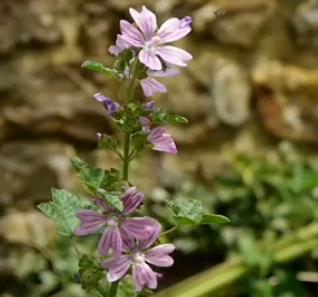
Mallow (Malva sylvestris L.), a plant belonging to the Malvaceae family, is found in Europe, Asia and North Africa.
What it is used for and where
Medical
Due to its wide use and medicinal importance, many studies have been carried out; however, the information in the literature is many and very scattered, making it difficult to use (1).
In Mallow there are powerful antioxidants (phenols, flavonoids, carotenoids and tocopherols), unsaturated fatty acids (e.g. alpha-linolenic acid) (2), and 143 volatile compounds have been catalogued including Hexadecanoic acid, Linalool, Limonene, Menthol, Eugenol, Tocopherol (3), Scopoletin, Chloroform, Malvidin.
The aim of this study was to study the in vitro anti-inflammatory activity of Malva sylvestris extract and fractions in a co-culture model of cells infected with Aggregatibacter actinomycetemcomitans. The chloroform fraction was the most effective in reducing bacterial colonization. Mallow sylvestris and its chloroform fraction minimized Aggregatibacter actinomycetemcomitans infection and inflammation processes in oral human cells (4).
The leaves have topical anti-inflammatory activity, the compound 3-glucoside malvidin seems to be primarily responsible for this effect, with the participation of other anti-inflammatory compounds in the extract, such as Scopolamin and Malvidin and therefore mallow can be used as a future treatment for skin disorders (5).
This study confirms the cardioprotective effects of MS in reducing oxidative stress and inflammatory response in this study confirms the cardioprotective effects of Malva sylvestris L. in reducing oxidative stress and inflammatory response in ischemia/reperfusion rats (6).
Cosmetics
Mallow extract is derived from flowers and leaves and contains flavonoids, tannins and mucilage which have a moisturising and emollient effect and a soothing effect on dry skin.


