



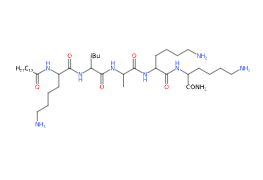
Myristoyl pentapeptide-17 is a rather small chemical compound, protein 5-peptide, which belongs to the class of peptides (proteins), a synthetic peptide used in cosmetics and skincare products.
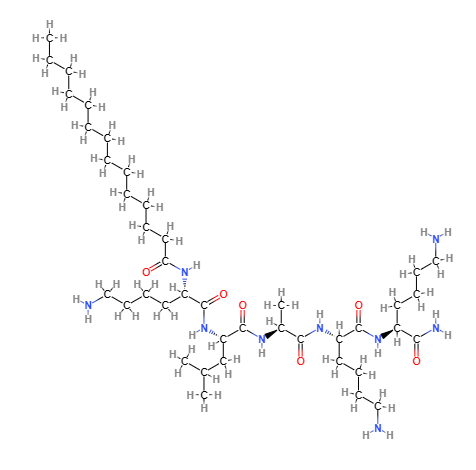
The name describes the structure of the molecule:
- Myristoyl refers to myristic acid, a type of fatty acid. In this context, it indicates that the peptide chain is attached to a myristic acid molecule. Myristoylation is a form of lipid modification that can affect the biological activity and solubility of peptides.
- Pentapeptide-17 indicates that the compound is a peptide consisting of five amino acids (pentapeptide). The number 17 is a specific designation for this particular sequence of amino acids. Peptides are short chains of amino acids that are the building blocks of proteins. In skincare, they are known for their ability to communicate with and direct skin cells to behave in certain beneficial ways, such as stimulating collagen production or repairing skin.
Description of Raw Materials and Their Functions
Myristic acid. A saturated fatty acid used as the lipophilic component in myristoyl pentapeptide-17. It provides the hydrophobic part of the peptide, enhancing its affinity for lipid structures.
Pentapeptide-17. A short chain of five amino acids that forms the peptide structure of the compound. These peptides are known for their bioactive properties, including stimulating hair and eyelash growth.
Reagents for Peptide Synthesis. Used to bond the amino acids and form the pentapeptide, and subsequently to attach the myristic group to the peptide.
Industrial Chemical Synthesis of Myristoyl Pentapeptide-17
- Preparation. The synthesis begins with the formation of pentapeptide-17 through peptide synthesis, which involves the sequential bonding of amino acids.
- Myristoylation. After the peptide is formed, the myristic group is attached to the peptide chain, forming myristoyl pentapeptide-17.
- Reaction Control. The reaction is monitored to ensure that the myristoylation occurs correctly and that the final product has the desired properties.
- Purification. After synthesis, the product is purified to remove impurities and by-products.
- Quality Control and Packaging. Myristoyl pentapeptide-17 undergoes quality checks and is then packaged for use in cosmetic products, particularly those aimed at hair and eyelash care.
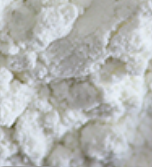
It appears in the form of a white, water-soluble powder.
What it is used for and where
Myristoyl Pentapeptide-17 is often used in cosmetic formulations for its potential benefits in enhancing the appearance of skin and hair. It is particularly noted for its use in eyelash-enhancing products, where it is believed to help improve the length and thickness of eyelashes.
Cosmetics
Skin conditioning agent. It is the mainstay of topical skin treatment as it has the function of restoring, increasing or improving skin tolerance to external factors, including melanocyte tolerance. The most important function of the conditioning agent is to prevent skin dehydration, but the subject is rather complex and involves emollients and humectants that can be added in the formulation.
It directly activates the keratin gene and contributes to eyelash growth and hair growth at the hair follicle by aiding scalp microcirculation. It reduces follicle ageing and follicle atrophy caused by dihydrotestosterone.
It is included in formulations of anti-ageing products.
Use: 0,01% -0,03%
For more information: Myristoyl pentapeptide-17 studies
| Appearance | White powder |
| pH | 4-6 |
| Boiling Point | 1071.6±65.0°C at 760 mmHg |
| Flash Point | 601.9±34.3 °C |
| Density | 1.1±0.1 g/cm3 |
| PSA | 266.65000 |
| Vapor Pressure | 0.0±0.3 mmHg at 25°C |
| Refraction Index | 1.510 |
| LogP | 3.89 |
| Storage | -20°C |
 |  |
 | 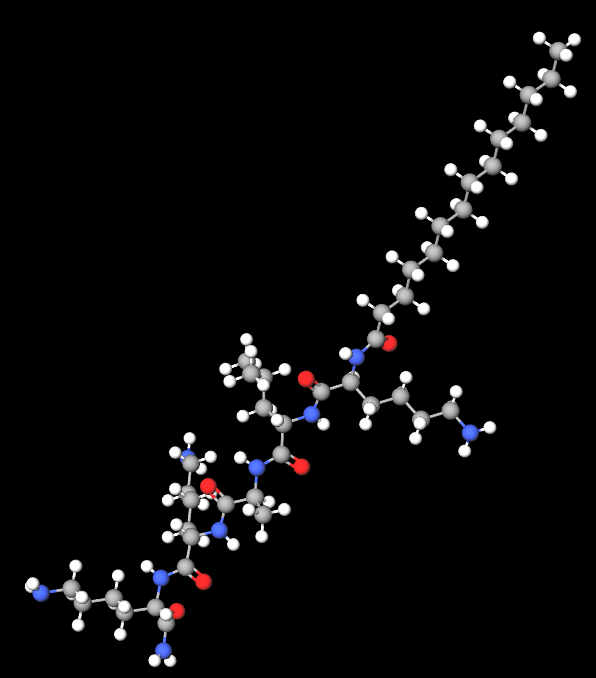 |
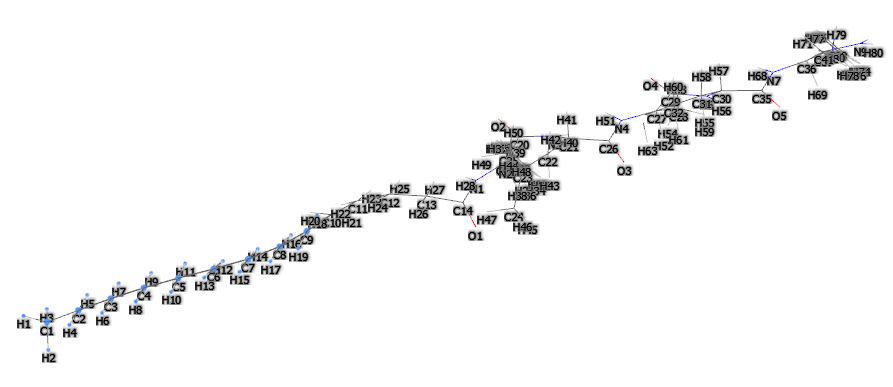
- Molecular Formula C41H81N9O6
- Molecular Weight 796.1
- Exact Mass 795.630981
- CAS 959610-30-1
- UNII
- EC Number
- DSSTox Substance ID
- IUPAC N-[(2S)-6-amino-1-[[(2S)-1-[[(2S)-1-[[(2S)-6-amino-1-[[(2S)-1,6-diamino-1-oxohexan-2-yl]amino]-1-oxohexan-2-yl]amino]-1-oxopropan-2-yl]amino]-4-methyl-1-oxopentan-2-yl]amino]-1-oxohexan-2-yl]tetradecanamide
- InChI=1S/C41H81N9O6/c1-5-6-7-8-9-10-11-12-13-14-15-25-36(51)47-33(23-17-20-27-43)39(54)50-35(29-30(2)3)41(56)46-31(4)38(53)49-34(24-18-21-28-44)40(55)48-32(37(45)52)22-16-19-26-42/h30-35H,5-29,42-44H2,1-4H3,(H2,45,52)(H,46,56)(H,47,51)(H,48,55)(H,49,53)(H,50,54)/t31-,32-,33-,34-,35-/m0/s1
- InChl Key NFPWMUOQSJXGGZ-ZZTWKDBPSA-N
- SMILES CCCCCCCCCCCCCC(=O)NC(CCCCN)C(=O)NC(CC(C)C)C(=O)NC(C)C(=O)NC(CCCCN)C(=O)NC(CCCCN)C(=O)N
- MDL number
- PubChem Substance ID
Synonyms
- N-((5S,8S,11S,14S,17S)-1,21-diamino-8-(4-aminobutyl)-5-carbamoyl-14-isobutyl-11-methyl-7,10,13,16-tetraoxo-6,9,12,15-tetraazahenicosan-17-yl)tetradecanamide
- Myr-Lys-Leu-Ala-Lys-Lys-NH2
- N-Tetradecanoyl-L-lysyl-L-leucyl-L-alanyl-L-lysyl-L-lysinamide
- L-Lysinamide, N-(1-oxotetradecyl)-L-lysyl-L-leucyl-L-alanyl-L-lysyl-
- N2-(1-Oxotetradecyl)-L-lysyl-L-leucyl-L-alanyl-L-lysyl-L-lysinamide

