



Xylitylglucoside is a chemical, carbohydrate-derived compound, industrially produced by fermentation of grain, wood or plant sugars. In particular, xylitol and glucose are used.
The name describes the structure of the molecule
- "Xylityl" is derived from "xylitol", an alditol (a type of sugar alcohol) found in many plants and used as a sweetener.
- "Glucoside" refers to a glycoside derived from glucose. Glycosides are compounds formed from the reaction between a sugar and another non-sugar molecule.
Description of raw materials used in production
- Xylitol - A sugar alcohol obtained from birch bark and other wood sources.
- Glucoside - A glycoside obtained from glucose.
Step-by-step summary of industrial chemical synthesis process
- Extraction - Xylitol is extracted from natural sources like birch bark.
- Reaction - Xylitol reacts with glucoside in the presence of a catalyst and under controlled temperature and pressure conditions.
- Purification - The reacted mixture is purified to remove impurities and get pure xylitylglucoside.
- Crystallization - The purified solution is cooled to form xylitylglucoside crystals.
- Filtration - The crystals are separated from the solution through filtration.
- Drying - The crystals are then dried to remove residual moisture.
It is presented in a light yellow liquid form.

What it is used for and where
Cosmetics
It is included in creams and personal care products as a humectant and moisturising agent that maintains the water content of a cosmetic both in the packaging and on the skin.
Humectant. Hygroscopic compound used to minimise water loss in the skin and to prevent it from drying out by facilitating faster and greater absorption of water into the stratum corneum of the epidermis. The epidermis is the most superficial of the three layers that make up human skin (epidermis, dermis and hypodermis) and is the layer that maintains hydration in all three layers. In turn, the epidermis is composed of five layers: horny, the most superficial, granular, spinous, shiny, and basal. Humectants have the ability to retain the water they attract from the air in the stratum corneum and have the function of moisturising the skin. They are best used before emollients, which are oil-based.
Skin conditioning agent. It is the mainstay of topical skin treatment as it has the function of restoring, increasing or improving skin tolerance to external factors, including melanocyte tolerance. The most important function of the conditioning agent is to prevent skin dehydration, but the subject is rather complex and involves emollients and humectants that can be added in the formulation.
Usage: 1%-3%.
Datasheet STD1422 Public Report.docx (industrialchemicals.gov.au)
Commercial Applications
Cosmetics and Skincare. Used as a moisturizing agent to enhance the skin's ability to retain water, thereby improving its hydration.
Anti-aging Products. As it can boost skin moisture and elasticity, it's often included in products aiming to reduce wrinkles and other signs of aging.
Hair Care Products. Can be used in conditioners and hair masks to increase moisture and improve hair texture.
Studies
Xylitylglucoside is effective as a moisturizing agent and on skin barrier function to an extent at least equal to glycerin (1).
Typical commercial product characteristics Xylitylglucoside
| Appearance | Liquid |
| Boiling Point | 315°C at 101.3 kPa |
| Flash Point | 244°C at 101.3 kPa |
| Density | 1435 kg/m3 at 20°C |
| Melting Point | <50°C |
| Vapour Pressure | 3.6 x 10⁻⁷ kPa at 25°C |
| Water Solubility | 674 g/L at 20°C |
| Autoignition | > 423°C |
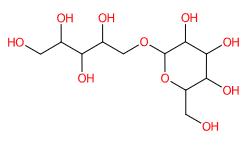 |  |
- Molecular Formula C11H22O10
- Molecular Weight 314.29
- Exact Mass 314.12100
- CAS 1095751-96-4
- UNII O0IEZ166FB
- EC Number
- DSSTox Substance ID
- IUPAC (2S,3R,4R)-5-[(2R,3R,4S,5S,6R)-3,4,5-trihydroxy-6-(hydroxymethyl)oxan-2-yl]oxypentane-1,2,3,4-tetrol
- InChI=1S/C11H22O10/c12-1-4(14)7(16)5(15)3-20-11-10(19)9(18)8(17)6(2-13)21-11/h4-19H,1-3H2/t4-,5+,6+,7+,8+,9-,10+,11+/m0/s1
- InChl Key LTBAFRQKFIMYQK-DLWPFLMGSA-N
- SMILES C(C1C(C(C(C(O1)OCC(C(C(CO)O)O)O)O)O)O)O
- MDL number
- PubChem Substance ID
- RXCUI 1314249
Synonyms:
- D-Xylitol, 5-O-beta-D-glucopyranosyl-
- (2S,3R,4R)-5-[(2R,3R,4S,5S,6R)-3,4,5-trihydroxy-6-(hydroxymethyl)oxan-2-yl]oxypentane-1,2,3,4-tetrol

