



Boswellia serrata
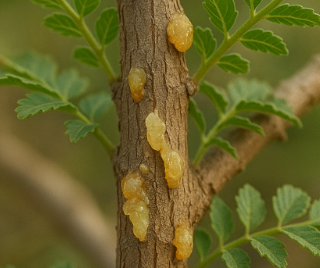
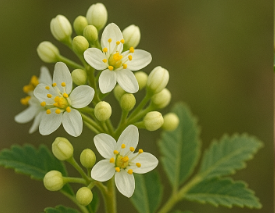
Boswellia serrata is a tree native to the arid regions of India, belonging to the family Burseraceae, and it is best known for the precious aromatic resin it produces. Its appearance is modest yet resilient: a pale, sometimes flaky trunk, knotty branches, and compound leaves of a soft green, slightly serrated along the edges. During the warm season, the tree bears small, pale flowers, while the sap that seeps out from incisions in the bark slowly solidifies, forming hard, fragrant drops with yellowish to amber tones.
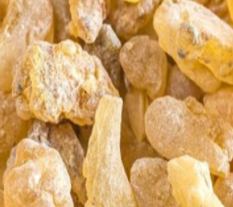
The true identity of Boswellia serrata lies in this resin, appreciated for its balsamic, warm, resinous scent, with gentle woody nuances and a faintly spicy background. Traditionally, it was collected and left to dry in the open air, taking on irregular shapes and a brittle texture. When broken or gently warmed, it releases an intense, penetrating fragrance that evokes sacred spaces, ancient fumigations, and traditional rituals.
Within the resin are characteristic components such as boswellic acids, together with other aromatic and resinous molecules that contribute to its olfactory profile and its dense, slightly sticky consistency. The tree grows in rocky, poor soils, where its roots wedge into dry crevices in search of minimal moisture. It thrives in strong sunlight and high temperatures, developing irregular, robust forms shaped by drought and wind.
The scent of Boswellia serrata resin—deep, enveloping, almost meditative—still calls to mind images of old trade routes, ritual exchanges, and spiritual atmospheres. As a tree of few demands but strong character, it remains a quiet, striking presence in the dry landscapes of India, guardian of a resin that has crossed centuries while preserving its unmistakable identity.
There are 17 genera and about 600 species in tropical regions.
The most important species are:
- Boswellia sacra Flueck
- Boswellia serrata
Resins, essential oils, gums used for a long time in Ayurvedic medicine are obtained from this tree.
 |  |
Botanical Classification:
- Kingdom: Plantae
- Order: Sapindales
- Family: Burseraceae
- Genus: Boswellia
- Species: Boswellia serrata
Plant Characteristics: Boswellia serrata is characterized by:
- Size: A small to medium-sized tree that typically grows up to 8-12 meters in height. It has a sparse, irregular crown with thin, wrinkled bark.
- Leaves: Pinnate leaves with 8-12 pairs of leaflets, which are elliptical and have a glossy green appearance.
- Flowers: Small, white to pale yellow flowers that form in dense clusters on the tree. The flowers are not particularly showy but are part of the tree's reproductive process.
- Resin: The tree produces a resin that is harvested by making incisions in the bark. The resin exudes as a gummy substance and hardens into a brittle, aromatic material.
Chemical Composition and Structure: The resin of Boswellia serrata contains a complex mixture of compounds, including:
- Boswellic Acids: Key active components, such as beta-boswellic acid, acetyl-11-keto-beta-boswellic acid (AKBA), and alpha-boswellic acid, are noted for their anti-inflammatory and analgesic properties.
- Essential Oils: Contains compounds such as limonene, alpha-pinene, and beta-caryophyllene, contributing to its characteristic aroma.
- Other Phytochemicals: Includes a variety of terpenes and sesquiterpenes, which add to the resin's therapeutic and aromatic qualities.
Uses and Benefits:
- Medicinal: Widely used in traditional medicine for its anti-inflammatory, analgesic, and anti-arthritic properties. It is commonly used in the treatment of osteoarthritis, rheumatoid arthritis, and other inflammatory conditions. Scientific studies support some of these uses, particularly for Boswellic acids in reducing inflammation.
- Aromatic: The resin is used in incense and perfumes for its pleasant and distinctive fragrance, often utilized in religious ceremonies and aromatherapy.
- Cosmetic: Extracts are used in skincare products for their anti-inflammatory and soothing effects, making them beneficial for conditions such as acne and eczema.
- Culinary: While not commonly used in cooking, the resin has been historically employed as a flavoring agent in certain traditional dishes.
Applications:
- Medicinal: Used in supplements and herbal remedies for its anti-inflammatory and pain-relieving effects. Commonly available in capsule, tablet, and topical forms.
- Aromatic: Incorporated into incense and perfumes for its distinctive, aromatic properties.
- Cosmetics: Added to skincare products such as creams, lotions, and serums for its soothing and anti-inflammatory benefits.
- INCI Functions:
Skin conditioning agent. It is the mainstay of topical skin treatment as it has the function of restoring, increasing or improving skin tolerance to external factors, including melanocyte tolerance. The most important function of the conditioning agent is to prevent skin dehydration, but the subject is rather complex and involves emollients and humectants that can be added in the formulation.
Fragrance. It plays a very important role in the formulation of cosmetic products as it provides the possibility of enhancing, masking or adding fragrance to the final product, increasing its marketability. It is able to create a perceptible pleasant odour, masking a bad smell. The consumer always expects to find a pleasant or distinctive scent in a cosmetic product.
CAS 97952-72-2
EC number 308-366-6
- Culinary: Rarely used in modern culinary practices but historically used in some traditional cuisines.
Environmental and Safety Considerations:
- Environmental Impact: Boswellia serrata is a slow-growing tree and requires careful management to avoid overharvesting. Sustainable harvesting practices are important to ensure the tree's conservation.
- Safety: Generally safe for use, but high doses or prolonged use may cause gastrointestinal upset in some individuals. It is advisable to consult a healthcare provider before using Boswellia serrata for medicinal purposes, especially in the case of pregnancy, breastfeeding, or pre-existing health conditions.
Studies
The main components of these trees are (1):
- monoterpenes: α-thujene
- diterpenic alcohol: serratol
- triterpenes: β-amirine, α-amirine
- pentacyclic triterpenic acid: boswellic acid
This study established that the crude methanolic extract and pure compound of Boswellia serrata are capable of natural anti-inflammatory activity at sites of chronic inflammation by switching off cytokines and pro-inflammatory mediators, which initiate the process (2).
The biologically active constituents ofBoswellia serrata, namely 3-acetyl-11-keto-β-boswellic acid and β-boswellic acid, act synergistically to exert anti-inflammatory/anti-arthritic activity showing improvement in physical and functional capacity and reducing pain and stiffness in the management of knee osteoarthritis (3).
Aminosalicylates, corticosteroids, and immunosuppressants are currently the treatment choices in inflammatory bowel disease, however, with limited remission and often serious side effects. Boswellia serrata is a traditional Ayurvedic remedy with anti-inflammatory properties of interest for its utility in inflammatory bowel disease. This study elucidates the pharmacological mechanisms mediated by Boswellia serrata, in protecting the intestinal epithelial barrier from inflammatory damage and supports its use as a safe adjuvant in patients with inflammatory bowel disease (4).
The most relevant studies on this ingredient have been selected with a summary of their contents:

