



Behenyl alcohol: properties, uses, pros, cons, safety
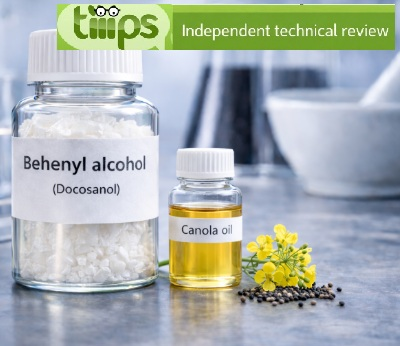
Behenyl alcohol also known as docosanol is a saturated long-chain aliphatic alcohol with 22 carbon atoms. In food use it has the ability to solidify and structure oil in fats.
The name describes the structure of the molecule:
- Behenyl comes from 'behenic acid', the name of the fatty acid from which behenyl alcohol is derived. The term 'behenic' is derived from 'Ben', a word of Persian origin referring to a type of tree (Moringa oleifera) whose seeds contain a high amount of behenic acid.
- Alcohol indicates the presence of a hydroxyl group (-OH) in the molecule, which is characteristic of all alcohols. In the case of behenyl alcohol, this -OH group is linked to a long carbon chain.
The synthesis process takes place in different steps:
- Preparation of behenic acid. Behenic acid, a fatty acid with 22 carbon chains, is often derived from natural sources such as rapeseed oil or canola oil.
- Reduction. The carboxylic acid group (-COOH) of behenic acid is reduced to an alcohol group (-OH) using a reducing agent. This can be done using hydrogen gas in the presence of a catalyst (a process known as hydrogenation), or using other chemical reducing agents.
Safety
From a safety point of view, studies published so far have not revealed any hazards (1).
What it is for and where
Cosmetics
It is used as a surfactant in cosmetic products (2) and acts as follows INCI:
Binder agent. Ingredient that is used in cosmetic, food and pharmaceutical products as an anti-caking agent with the function of making the product in which it is incorporated silky, compact and homogenous. The binder, either natural such as mucilage, gums and starches or chemical, may be in the form of a powder or liquid.
Skin conditioning agent - Emollient. Emollients have the characteristic of enhancing the skin barrier through a source of exogenous lipids that adhere to the skin, improving barrier properties by filling gaps in intercorneocyte clusters to improve hydration while protecting against inflammation. In practice, they have the ability to create a barrier that prevents transepidermal water loss. Emollients are described as degreasing or refreshing additives that improve the lipid content of the upper layers of the skin by preventing degreasing and drying of the skin. The problem with emollients is that many have a strong lipophilic character and are identified as occlusive ingredients; they are oily and fatty materials that remain on the skin surface and reduce transepidermal water loss. In cosmetics, emollients and moisturisers are often considered synonymous with humectants and occlusives.
Emulsion stabiliser. Emulsions are thermodynamically unstable. Emulsion stabilisers improve the formation and stability of single and double emulsions. as well as their shelf-life. It should be noted that in the structure-function relationship, the molar mass of the ingredient used plays an important role.
Viscosity control agent. It controls and adapts, Increasing or decreasing, viscosity to the required level for optimal chemical and physical stability of the product and dosage in gels, suspensions, emulsions, solutions.
Medical
Docosanol (chemically behenyl alcohol, typically in a 10% cream) has been evaluated in clinical studies as a topical treatment for recurrent cold sores and is generally well tolerated, with possible mild local effects (e.g., irritation). It is known for being the first topical antiviral approved for over-the-counter (OTC) use for recurrent cold sores (e.g., docosanol-based products such as Abreva). In practice, the aim is to shorten lesion and symptom duration if applied early (at the very first signs) (3).

- Molecular Formula: C22H46O
- Molecular Weight: 326.6 g/mol
- CAS: 661-19-8
- UNII 9G1OE216XY
- EC Number: 211-546-6
- DSSTox Substance ID: DTXSID4027286
- MDL number MFCD00002939
- Beilstein/REAXYS Number: 1770470
- NSC 759235
Sinonimi:
- Docosanol
- Behenic alcohol
Lanette 22
Lidavol
- Lidakol
- Stenol 1822
- Tadenan

