



Potassium bitartrate (cream of tartar)
(KC₄H₅O₆; also called potassium hydrogen tartrate / acid potassium tartrate; food additive E336(i))
Description
• Acid salt of tartaric acid from winemaking: white crystals that naturally precipitate during wine maturation (“wine tartrates”).
• Used as acidulant, acidity regulator, and leavening acid (with bicarbonate); stabilizes egg-white foams, helps prevent sugar crystallization in syrups/caramels, and serves in wine cold stabilization as a seeding crystal.
• Practically insoluble in alcohol; sparingly soluble in water; delivers a clean, neutral acidity without added aroma.
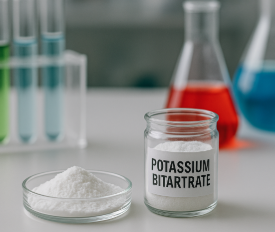
Indicative nutrition values (per 100 g; not intended for direct consumption — typical use is pinches/grams)
• Energy: ~0–10 kcal (negligible)
• Carbohydrate, protein, fat: negligible
• Total potassium: ~20–21 g/100 g (≈ 200–210 mg K per 1 g product)
• Sodium: 0 g
• Note: Technological ingredient, not a nutritional fortifier.
Chemical composition and structure
• Formula: KC₄H₅O₆ (acid salt of 2,3-dihydroxybutanedioic acid).
• Molar mass: ~188.18 g/mol.
• Monobasic nature (one residual acidic function) → acidifying behavior in water.
• Stereochemistry: typically L(+)-tartaric origin (grape/wine derived).
Physical properties
• Appearance: white powder/crystals, odorless, acid taste.
• Water solubility (20 °C): ~0.5–1.0 g/100 mL (rises with temperature).
• pH (1% w/v solution): ~3.5–3.7.
• Bulk density: particle-size dependent; moderately hygroscopic (prone to caking).
• Stability: solid stable at ambient; decomposes on strong heating to tartrate/carbonate products.
Production process
• Enological origin: collection of tartrates (“argol”) from casks/tanks → washing and purification (filtration, decolorization).
• Neutralization/recrystallization: adjust acid/salt balance (from tartaric acid and K bases) → selective recrystallization of bitartrate.
• Drying and milling: set particle size, reduce insolubles, sieve to spec.
• Packed under controlled conditions per GMP/HACCP.
Sensory and technological properties
• Clean acidulant profile with no off-aroma.
• Leavening acid: releases CO₂ with sodium bicarbonate (DIY baking powder).
• Foam stabilizer (egg whites, meringues): chelates ions, lowers pH, strengthens protein network.
• Anti-crystallizing aid in sugarwork (fondant, caramel, toffee).
• Winemaking: promotes tartrate stability during cold conditioning.
Food applications
• Bakery/pastry: meringues, angel food cake, sponge cakes; home baking powders (often 1 part cream of tartar : 2 parts baking soda).
• Sugars/syrups: limits sucrose crystallization in fondants and caramels.
• Beverages & wine: seeding for tartrate precipitation; fine acidity adjustments.
• Savory/culinary: stabilizes whips (e.g., aquafaba), fruits in light acidic syrups.
Nutrition & health
Potassium bitartrate is not meant as a nutrient source, but its high potassium content (~20%) can contribute measurably when used at gram-level doses. Individuals with impaired kidney function, on potassium-sparing diuretics, or at risk of hyperkalemia should limit use and follow clinical advice.
At very high intakes, its acidity may cause gastrointestinal discomfort. In baking, typical amounts are small (pinches/grams per recipe), yielding neutral nutritional impact with clear technological benefits (leavening, foam stability). It contains no gluten or priority allergens; only cross-contact controls apply.
Portion note: In recipes, 0.5–3 g per 100 g flour (pastry) or about 1 part cream of tartar with 2 parts baking soda for a basic instant leavener; for egg white foams: ~1–2 g per 100 g egg white.
Quality and specifications (typical topics)
• Assay: ≥99.0–99.7% KC₄H₅O₆ (food grade).
• Heavy metals (Pb, As, Cd, Hg): within legal limits; total K in spec.
• Moisture/insolubles: low; sulfates/oxalates absent or limited.
• Color/organoleptics: white, no atypical odor/taste.
• Particle size: tailored for baking (fine) vs enology (coarser).
• Microbiology: does not support growth; low APC; pathogens absent.
Storage and shelf-life
• Store cool, dry, and dark (RH <65%) in well-sealed barrier containers.
• Avoid moisture pickup (caking risk) and contact with strong bases/alkalis.
• Typical shelf-life: 24–36 months unopened.
Safety and regulatory
• EU: additive E336(i) (acidifier/acidity regulator), usually at QS (quantum satis) under good manufacturing practice.
• US/other: permitted as GRAS for specified uses.
• Enology: compliant for tartrate stabilization with contaminant limits.
• Produced under GMP/HACCP; lot traceability and SDS available.
Labeling
• Names: “cream of tartar”, “potassium bitartrate”, or “E336(i)”.
• For leavening blends, declare ratios and presence of bicarbonate/anti-caking agents.
• Optionally state enological origin where value-adding; include lot, best-by, and storage conditions.
Troubleshooting
• Weak rise: off-ratio with bicarbonate or moisture uptake → recalibrate stoichiometry, use barrier packs/desiccants.
• Unstable meringues: under-dosage or fat contamination → increase to 1–2% of egg white, degrease tools.
• Sugar crystallization in syrups: dose too low or pH too high → add slightly more or adjust acidity.
• Tartrate haze in wine: insufficient cold time/temperature or supersaturation → extend cold stabilization, refresh seed crystals, check conductivity.
Sustainability and supply chain
• Upcycling of winery tartrates reduces process waste.
• Plant operations: water/energy recovery, wastewater managed toward BOD/COD targets; lightweight, recyclable packaging.
• Supplier qualification, impurity control, and traceability under GMP systems.
INCI functions (cosmetics)
• Potassium Bitartrate: buffer/pH-adjuster, viscosity-controlling, mild abrasive (oral care/scrubs). Usage subject to cosmetic regulations and irritancy assessment.
Conclusion
Potassium bitartrate is a clean, multifunctional acid that optimizes leavening, foams, and sugarwork in pastry and supports tartrate stability in wine. Consistent performance depends on high purity, appropriate particle size, tight moisture control, and correct stoichiometry with bases.
Mini-glossary
• QS (quantum satis): Regulatory principle allowing “as needed” use to achieve the technological effect under good practice.
• GMP/HACCP: Good manufacturing practice / hazard analysis and critical control points — Preventive hygiene and process-control systems.
• BOD/COD: Biochemical/chemical oxygen demand — Wastewater impact metrics guiding treatment and discharge limits.
• SDS: Safety data sheet — Product safety document with handling, storage, and hazard information.
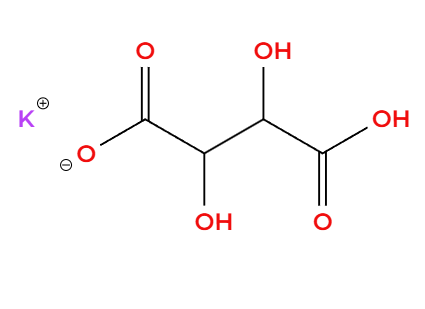 | 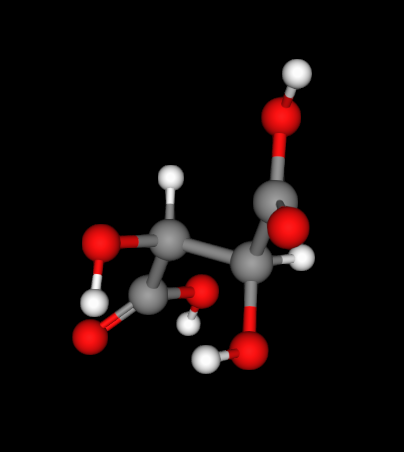 |
Molecular Formula: C4H5KO6
Molecular Weight: 188.18
CAS: 868-14-4
EC Number: 212-769-1
Synonyms:
- L(+)-Potassium hydrogen tartrate
- Potassium hydrogen tartrate
- potassium d-tartrate
- 1-Potassium hydrogentartrate
- potassium hydrogentartrate
- kaliumtartrat
- Monopotassium tartrate
- rel-Potassium (2S,3S)-2,3-dihydroxysuccinate(1:1)
- POTASSIUM 3-CARBOXY-2,3-DIHYDROXYPROPANOATE
- KSC657E1T
- NSC155080

