



Durum wheat semolina (Triticum durum – family Poaceae)
Description
Durum wheat semolina is a cereal product obtained from the milling of durum wheat (Triticum durum), a wheat species characterized by hard, vitreous kernels and a relatively high protein content. Unlike soft wheat flour, semolina has a coarser particle size and a distinctive amber-yellow color, which is linked to the natural presence of carotenoids.
Step-by-step summary of industrial production process.
- Cultivation and Harvesting. Durum wheat must be grown, harvested, and cleaned.
- Milling. The wheat grains are then milled to produce semolina.
- Sifting. The semolina is sifted to ensure a uniform texture and to separate the finer semolina used to make "00" flour.
The production process involves cleaning, milling, and sieving of the grain, with separation of bran fractions and selection of suitable granules. Semolina quality is influenced by several factors, including protein level, gluten strength, and overall kernel hardness, all of which affect processing performance.
Form and color.
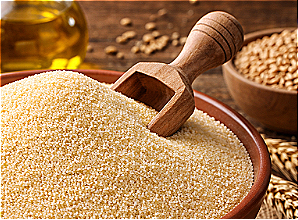
Durum wheat semolina has a granular consistency and a golden yellow color, which can vary in intensity depending on the specific variety of wheat used.
From a technological standpoint, durum wheat semolina is valued for its water absorption capacity and its ability to form a firm and elastic dough. These properties make it the reference raw material for the production of dry pasta, couscous, and certain traditional breads.
From a nutritional perspective, semolina mainly provides complex carbohydrates, plant proteins, a moderate amount of dietary fiber, and various minerals. It also contains B-group vitamins, which play a role in energy metabolism. Its consumption fits within a balanced diet, primarily as an energy-providing and structural food component.
Classification
| Level | Classification |
|---|---|
| Origin | Plant-based |
| Species | Triticum durum |
| Botanical family | Poaceae |
| Category | Cereal product |
| Milling type | Semolina |
Raw material and product characteristics
| Aspect | Description |
|---|---|
| Raw material | Durum wheat |
| Particle size | Medium to coarse |
| Color | Yellow |
| Protein content | Medium–high |
| Gluten presence | Yes |
| Main uses | Dry pasta, couscous, bread |
| Allergens | Cereals containing gluten |
Indicative average nutritional values per 100 g
| Component | Average value |
|---|---|
| Energy | 350 kcal |
| Protein | 12.0 g |
| Carbohydrates | 72.0 g |
| of which sugars | 2.0 g |
| Dietary fiber | 3.5 g |
| Fat | 1.5 g |
| Iron | 3.6 mg |
| Magnesium | 35 mg |
| Potassium | 190 mg |
| Vitamin B1 (thiamine) | 0.4 mg |
| Vitamin B3 (niacin) | 5.5 mg |
Average indicative values. Natural variability may occur depending on wheat variety and degree of refinement.
Note on nutritional use of the bioactive compounds present
Durum wheat semolina provides complex carbohydrates that contribute to daily energy needs. Gluten proteins play a key technological role in dough structure and pasta quality, while B-group vitamins support normal energy metabolism. Naturally occurring carotenoids contribute to the characteristic color and provide bioactive compounds with antioxidant function. Semolina consumption fits within a balanced diet, taking into account the presence of gluten for individuals with sensitivity or intolerance.
Commercial applications.
Durum wheat semolina is widely used in the production of pasta, bread, and in some sweet preparations due to its cohesive properties and high protein content.
Diet. Durum wheat semolina is widely used in pasta making, providing a sturdy texture and optimal cooking properties.
Cooking. It's utilized in various culinary preparations like semolina porridge, and can also be used to create desserts like semolina pudding.
Baking. Durum wheat semolina can be used to make bread and other baked goods, offering a distinct flavor and a crisp crust.
Traditional Baked Goods. It is a key ingredient in the production of some traditional baked goods across different cultures.
Wheat (Triticum L. ) belongs to the Graminaceae family.
Wheat is a basic ingredient in the human diet and is incorporated into many food products including bread, cereals and pasta.
The main component (60-70%) of wheat is starch, a source of glucose rapidly released during digestion that contains two main glucose polymers, Amylosis and Amilopectin.
With the rise of human health problems such as obesity and diabetes, there has been a growing interest in altering the composition of starch in cereals and increasing the percentage of resistant starch.
Resistant starch is the fraction of starch that escapes digestion in the small intestine (1) and is considered a form of dietary fiber with beneficial health properties (2). Because foods high in resistant starch are digested more slowly, they have been shown to improve insulin response and increase satiety (3).
The advantages of resistant starch also extend to colon health where fermentation occurs in the large intestine (4).
Wheat is used to obtain flours that can be:
- integral type 2
- refined of type 0
- even more refined than type 00
The more refined the flours are, the more they lose their nutritional characteristics.
For example, type 0 is different from 00 because it is less refined in grinding.
Nutritional values:
- Pretty caloric with about 337 kcalories per 100 grams.
- Saturated fatty acids: 0.4g per 100 grams
It contains less protein than hard wheat that is used for the preparation of pasta.

