



Cashew (Anacardium occidentale L.) is a plant cultivated with high economic value. The production and commercial exploitation of the fruits of Anacardium occidentale are important components of the agricultural sector in countries such as India, Brazil, Mozambique, Tanzania and Kenya.
Parts & commercial forms: shelled kernel (whole or pieces), roasted/salted or raw; cashew butter; flour/paste (incl. partially defatted); cashew oil (culinary/cosmetic). The cashew apple (false fruit) is locally used for juices/distillates.
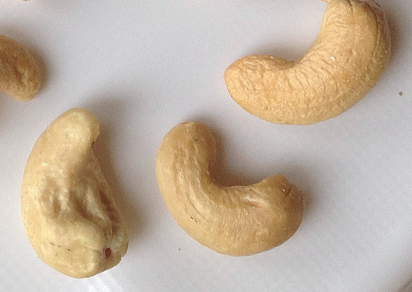
Common name: Cashew (cashew nut)
Parent plant: Anacardium occidentale L.
Kingdom: Plantae
Clade: Angiosperms
Clade: Eudicots
Order: Sapindales
Family: Anacardiaceae
Genus: Anacardium
Species: Anacardium occidentale L.
Cultivation and growth conditions
Climate:
Cashew is a tropical species that grows best in warm, relatively dry climates.
Optimal temperatures range from 24–32 °C.
It does not tolerate temperatures below about 10 °C.
It is highly drought-resistant thanks to its deep root system.
It grows best with a distinct dry season for fruit development and a rainy season for vegetative growth.
Sun exposure:
Cashew requires full sun, which is essential for:
vigorous vegetative growth,
abundant flowering,
high nut production.
Shaded conditions reduce flowering and yield.
Soil:
Cashew grows well in soils that are:
light and well drained,
sandy or sandy-loam,
with pH between 5.0 and 7.0,
even low in fertility.
It does not tolerate heavy clay soils or waterlogged conditions, which lead to root rot. It is extremely tolerant to soil salinity.
Irrigation:
Water needs are low, as cashew is a hardy species:
Some irrigation is useful during the early growth stages.
Mature trees tolerate long periods of drought.
Excess irrigation can reduce nut quality and encourage fungal problems.
This makes cashew suitable for low-input agricultural systems.
Temperature:
Germination: 20–28 °C
Optimal growth: 24–32 °C
Growth inhibited below 15 °C
Severe damage below 10 °C
Moderate air humidity (50–70%) supports flowering and fruit set.
Fertilization:
Cashew has modest nutrient requirements but responds well to:
Nitrogen in moderate amounts during early development,
Phosphorus to strengthen roots and flowering,
Potassium to improve nut size, quality, and yield.
Organic amendments (compost, well-rotted manure) improve soil structure and water retention in commercial plantations.
Crop care:
Weed control during early establishment.
Light pruning to open the canopy and facilitate harvesting.
Monitoring for tropical pests such as:
scale insects,
beetles,
leaf-eating caterpillars.
Control of fungal diseases (anthracnose, rots) especially in humid areas.
Harvest:
Harvest occurs when:
the fleshy accessory fruit (“cashew apple”) turns yellow or red,
the true nut (the seed) detaches easily from the pedicel.
The nut is then dried and subjected to roasting or heat treatment to remove the caustic liquid in the shell (cashew nut shell liquid, CNSL, rich in cardol and cardanol, which are irritants).
After roasting, nuts are shelled, cleaned, and sorted.
Propagation:
Cashew is propagated by:
seed (most common),
grafting (in commercial orchards to ensure uniformity and high productivity).
Seeds are sown directly in the field or in nurseries, with transplanting after 3–4 months.
Caloric value (dry/roasted kernels)
~550–575 kcal per 100 g (varies with moisture and roasting).
Average composition (per 100 g, roasted kernels)
Fat: ~44–48 g
Protein: ~17–19 g
Carbohydrate: ~30 g (of which fiber ~3–4 g, sugars ~5–6 g)
Water: ~2–5 g
Micronutrients: notable copper (Cu), magnesium (Mg), phosphorus (P), zinc (Zn); vitamins B1 (thiamin) and B6.
Fatty-acid profile (indicative, % of total fat)
MUFA (MonoUnsaturated Fatty Acids—generally heart-friendly): oleic (C18:1) ~55–65%
PUFA (PolyUnsaturated Fatty Acids—beneficial but balance with Ω-3): linoleic (C18:2, Ω-6) ~15–20%
SFA (Saturated Fatty Acids—best in moderation): palmitic (C16:0) ~8–12%, stearic (C18:0) ~2–4%
Unsaponifiables: phytosterols; tocopherols (variable)
Sensory & functional properties
Texture: crunchy-creamy, with a buttery mouthfeel.
Flavor: delicately sweet-nutty; roasting (≈110–150 °C) enhances Maillard notes.
Culinary functionality: blends to a very smooth emulsion (cashew cream/butter), excellent for plant-based sauces, desserts, and “cheese” analogues.
Processing
The kernel sits inside a hard shell containing CNSL (Cashew Nut Shell Liquid) rich in anacardic acids, cardanol, cardol (caustic phenolics).
Typical steps: drying → steam/thermal treatment (to deactivate/expel CNSL) → shelling → peeling (testa removal) → roasting/grading → optional salting/flavoring. Proper CNSL removal is critical for safety and flavor.
Cashew oil (brief)
Virgin/refined: mild taste; smoke point ~200–220 °C (refined).
High oleic content supports oxidative stability vs. high-PUFA oils. Used in dressings, mayonnaise, and cosmetics (light emollient).
Food applications
Snacks: roasted/salted or coated (honey/chocolate).
Bakery/confectionery: pralines, bars, cookies; granules in ice creams and fillings.
Plant-based cuisine: cashew butter/cream for sauces, dips, cheesecake bases; cashew milk by blending/straining.
Flour (incl. defatted): for gluten-free/low-carb formulas (requires starch/binder balancing).
Nutrition & health (key points)
Lipid profile driven by MUFA (oleic) with moderate PUFA Ω-6—favorable within a balanced diet (pair with Ω-3 sources).
Protein, minerals (Cu, Mg, Zn), and fiber support satiety and metabolic health.
Sodium low if unsalted; check salted products.
Suggested portion: ~28–30 g (≈ a small handful).
Allergens & safety
Tree-nut allergen → potential IgE-mediated reactions, sometimes severe.
CNSL: the shell liquid is caustic; edible kernels are CNSL-free after proper processing; handle raw shells with PPE.
Mycotoxins: aflatoxin risk generally lower than some nuts but still requires controlled drying/storage.
Oxalates: moderate; consider in individuals prone to kidney stones.
Quality & specifications (typical themes)
Kernel moisture ≤3–4% for crunch and shelf life.
Low peroxide/anisidine (no rancid notes).
Graded by size and defects; residues/aflatoxins within legal limits.
Roast level tuned to avoid bitterness/over-browning.
Storage & shelf life
Store cool, dry, dark, in airtight packs (nuts absorb odors).
6–12 months at controlled ambient; longer if refrigerated/frozen.
Prefer oxygen-barrier packaging (vacuum/inert gas).
Troubleshooting
Early rancidity: lower storage temperature, protect from light/oxygen, use barrier packs; rotate stock.
Loss of crunch: light re-dry/re-roast; sugar/salt coatings help.
Grainy vegan creams: extend soaking, blend at high power, add a touch of lecithin or xanthan.
Sustainability
Major producers: India, Vietnam, West Africa, Brazil. Favor supply chains with traceability, strong social safeguards in shell/CNSL handling, and robust post-harvest practices.
Conclusion
Cashew nuts pair a creamy sensory profile with a MUFA-forward lipid balance, making them versatile for snacks, bakery, and plant-based applications. With moderate portions, proper processing (CNSL removal), and careful storage, they deliver nutritional and technological value with good stability.
Studies
In addition to the famous 'nut' cashew (actually fruit), the shell liquid can be used as a source of phenol for various industrial purposes (1) and its various biological properties such as antimicrobial, anti-inflammatory, anticancer, antioxidant as well as insecticidal properties, they show a remarkable therapeutic potential thanks to anacardic acid, cardanol and cardanol (2).
Phytochemistry
The phytochemical composition of cashew juice (3) (mg / 100 g)
Bioactive compounds (mg / 100) RCAJ UNCAJ
Total vitamin C 86.22 ± 0.21 * 60.45 ± 0.55
Carotenoids 0.39 ± 0.02 0.21 ± 0.01
Phenolic total † 38.30 ± 1.78 * 14.84 ± 0.21
Anthocyanine 2.05 ± 0.03 * 0.69 ± 0.07
Flavonoids 3.92 ± 0.03 * 2.00 ± 0.17
Tannins
Dimerics 0.42 ± 0.07 0.27 ± 0.06
Oligomeric 0.34 ± 0.02 0.25 ± 0.01
Polymers 0.37 ± 0.06 0.24 ± 0.02
It also has significant high levels of total phenols (38.3 mg GAE / 100 g of juice), anthocyanins (2.05 mg / 100 g of juice), yellow flavonoids (3.92 mg / 100 g of juice), Vitamin C (86 , 22 mg / 100 g of juice).
The cashew nut also produces an essential oil (4). It has a positive effect on the epithelium in general.
Cashew nut extracts have demonstrated positive properties for human health because they contain only the positive components, but this nut in its entirety has some contraindications.
The FDA has not included cashews among the nuts approved for cardiovascular disease reduction because of their saturated fat content (5), and other studies have also not observed a positive influence of cashews (6).)

