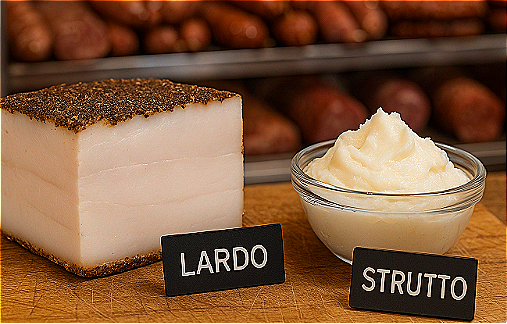
Strutto Lo strutto è il grasso suino ottenuto per fusione dei tessuti adiposi e successiva purificazione di base (filtrazione e chiarifica); può essere ulteriormente raffinato (bleaching/deodorizzazione) per un profilo sensoriale più neutro. Le principali origini sono il lardo dorsale e il grasso perirenale (“leaf lard”), quest’ultimo più fine e plastico per impieghi di pasticceria.
Differenza tra Strutto e Lardo
Strutto: È il grasso del maiale fuso e chiarificato (rendering) poi fatto raffreddare. Risulta una massa spalmabile/semi-solida bianca, dal gusto neutro. Si usa in cucina: fritture, impasti e pasticceria (piadine, gnocco fritto, sfoglie). In inglese “lard” corrisponde allo strutto italiano.
Lardo: È il grasso dorsale del maiale lasciato in pezzi interi e salato/stagionato con erbe e spezie (es. Lardo di Colonnata, Lardo d’Arnad). Si mangia come salume, a fette sottili, crudo o appena scaldato sul pane. Ha sapore aromatico e consistenza compatta.
Valore calorico (prodotto secco, 100 g) Circa 880–902 kcal per 100 g (tipico ≈ 900 kcal/100 g; energia quasi interamente lipidica).
Composizione e profilo in acidi grassi (indicativo, % sui grassi totali) SFA ~35–42% (palmitico ≈ 22–26%; stearico ≈ 10–15%). MUFA ~40–50% (oleico predominante). PUFA ~8–15% (linoleico prevalente; ALA in tracce). Colesterolo: ~80–100 mg/100 g (variabile per razza, dieta e sede anatomica).
Proprietà sensoriali e tecnologiche Lo strutto presenta aroma neutro–leggermente carneo; lo stato semisolido a 20–25 °C e la cristallizzazione preferenziale in forma β′ favoriscono sfogliatura e friabilità di impasti (pie crust, crostate, piadine, brioche). Il punto di fumo è tipicamente ~190–205 °C, idoneo a fritture e salti moderati; riutilizzi prolungati ad alte temperature accelerano ossidazione e formazione di composti secondari. La stabilità ossidativa è intermedia: inferiore a grassi più saturi (per esempio sego), superiore a oli ricchi di PUFA. Il profilo di SFC lungo la curva di temperatura determina plasticità, spalmabilità e performance in laminazione.
Processi produttivi (sintesi) La materia prima adiposa è fusa a bassa–media temperatura con controllo dell’esposizione all’ossigeno; si procede a filtrazione per rimuovere impurità. Il prodotto può essere ulteriormente raffinato (bleached/deodorized) per standard sensoriali costanti e, se richiesto, frazionato fisicamente per modulare la curva SFC. È possibile l’impiego di antiossidanti consentiti per mitigare l’irrancidimento; il trattamento termico e il raffreddamento controllato definiscono la microstruttura cristallina.
Impieghi alimentari Lo strutto è tradizionale in paste sfogliate e lievitate, panificazione regionale, frolle, biscotti, grissini e prodotti fritti. In cucina è usato per soffritti, rosolature e fritture a temperatura moderata, quando si ricerca croccantezza con profilo aromatico neutro. In preparazioni di gastronomia calda e charcuterie può fungere da mezzo di confit o grasso di copertura.
Nutrizione e salute Lo strutto apporta una quota rilevante di MUFA (oleico), SFA significativi e PUFA moderati. L’impatto sul profilo lipidico va valutato sul pattern dietetico complessivo: sostituire SFA con MUFA/PUFA è generalmente favorevole. Lo strutto non idrogenato contiene tracce di TFA; processi di idrogenazione (ove presenti) aumentano i TFA e sono da evitare. Vincoli etici o religiosi (per esempio kosher/halal) e scelte vegetariane/vegane ne escludono l’uso.
Qualità e specifiche (temi tipici) Aspetto: bianco–avorio; limpido da fuso; assenza di particolati. Odore/sapore: neutro; assenza di note rancide o animali. Parametri chimici: acidità libera e indice di perossidi contenuti e stabili; profilo SFC e punto di fumo coerenti con l’applicazione. Contaminanti: metalli e residui di processo entro limiti; conformità per contatto alimentare. Sistema di qualità: tracciabilità e gestione di filiera con GMP e HACCP.
Conservazione e shelf-life Lo strutto va stoccato in contenitori opachi e ben chiusi, al fresco, al riparo da luce, aria e odori. La shelf-life è di alcuni mesi a temperatura ambiente controllata; la refrigerazione ne prolunga la stabilità. È sconsigliato riutilizzare a lungo il bagno di frittura: l’accumulo di composti di ossidazione e polimerizzazione degrada qualità e sicurezza.
Troubleshooting Odore “vernice” o rancido: ossidazione; verificare barriera del packaging, rotazione FIFO e temperatura di stoccaggio. Schiuma in frittura: presenza di acqua/impurezze o degrado termico; filtrare, ridurre temperatura o rinnovare il grasso. Friabilità scarsa in pasticceria: cristallizzazione non ottimale o eccesso di olio liquido in ricetta; rivedere raffreddamento/lavorazione e bilancio dei grassi. Persistenza di nota animale: raffinazione/deodorizzazione non ottimali o materia prima eterogenea; riconsiderare fornitore e parametri di processo.
Sostenibilità e filiera Lo strutto valorizza un sottoprodotto della filiera suina, favorendo l’utilizzo integrale dell’animale. Pratiche di allevamento, alimentazione e benessere influenzano composizione e qualità del grasso. Gli oli/grassi esausti da frittura vanno conferiti a raccolte autorizzate per recupero/riciclo, evitando smaltimenti impropri.
Conclusione Lo strutto offre neutralità aromatica, lavorabilità plastica e performance affidabile in frittura e in pasticceria. Una selezione attenta della materia prima, il controllo del processo e un’adeguata conservazione massimizzano stabilità, sicurezza e risultati sensoriali nelle diverse applicazioni.
Mini-glossario SFA — acidi grassi saturi: da moderare; l’effetto dipende dal contesto dietetico e dai nutrienti sostitutivi. MUFA — acidi grassi monoinsaturi: in genere favorevoli per profilo lipidico e stabilità in cottura (per esempio acido oleico). PUFA — acidi grassi polinsaturi: benefici ma più suscettibili a ossidazione; includono famiglie omega-6 (linoleico) e omega-3. ALA — acido alfa-linolenico (omega-3): presente solo in tracce nello strutto; più abbondante in alcuni oli vegetali. TFA — acidi grassi trans: da evitare; l’idrogenazione industriale incrementa i TFA e il rischio cardiometabolico. SFC — solid fat content: frazione di grasso solido a una data temperatura; parametro chiave per plasticità, spalmabilità e sfogliatura. GMP — good manufacturing practice: buone pratiche di produzione che garantiscono igiene, coerenza, tracciabilità e qualità. HACCP — hazard analysis and critical control points: sistema preventivo di sicurezza alimentare basato su analisi dei pericoli, definizione dei CCP, limiti critici, monitoraggio e verifiche. FIFO — first in, first out: principio di rotazione scorte che impone l’uso prioritario dei lotti più vecchi per preservare qualità e sicurezza.
L'uso consigliato, per una corretta alimentazione, se lo si vuol proprio usare, è di ungerne appena la teglia e non utilizzarlo direttamente negli alimenti, poichè qualche importante controindicazione sul suo utilizzo in campo alimentare arriva da studi effettuati su animali che stabiliscono una relazione tra il forte consumo di strutto, obesità(1) e infiammazionicardiovascolari (2).
Altri studi hanno accertato che assunzioni rilevanti di lardo nell'alimentazione hanno portato ad aumento del volume della prostata (3), tumore al seno (4) e problemi al pancreas (5).
Lo strutto, come la margarina, è una delle principali fonti di acidi grassi trans e acidi grassi saturi. L'associazione tra questi grassi e un alto rischio di malattie cardiovascolari è stato ampiamente dimostrato. Oltretutto, i modelli animali ad alto contenuto di grassi rappresentano il metodo classico e più comune per studiare l'obesità. I risultati di questo studio hanno dimostrato che un elevato apporto dietetico di margarinae lardopotrebbe indurre una specifica infiammazionedel deposito con una ridotta espressione del tessuto adiposo di tipo antinfiammatorio M2 nei tessuti adiposi bianchi (6).
(1) Wang X, Cheng M, Zhao M, Ge A, Guo F, Zhang M, Yang Y, Liu L, Yang N. Differential effects of high-fat-diet rich in lard oil or soybean oil on osteopontin expression and inflammation of adipose tissue in diet-induced obese rats. Eur J Nutr. 2013 Apr;52(3):1181-9. doi: 10.1007/s00394-012-0428-z.
Abstract. Purpose: To examine the effect of different dietary fat types on osteopontin (OPN) expressions and inflammation of adipose tissues in diet-induced obese rats. Methods: Male Sprague-Dawley rats were randomly assigned to one control group fed standard diet (LF, n = 10) and two high-fat diet groups fed isoenergy diet rich in lard or soybean oil (HL or HS, n = 45 each). Diet-induced obese rats in HL and HS group were then subdivided into two groups either continuously fed high-fat diet or switched to low-fat diet for 8 more weeks. Fasting serum glucose, insulin, and OPN concentrations were assayed and QUICKI was calculated; the expression of OPN, IL-6, IL-10, TNF-α, NF-κB, and F4/80 in adipose tissue was determined. Results: Both high-fat diets lead to comparable development of obesity characterized by insulin resistance and adipose tissue inflammation. Obese rats continuously fed high-fat diet rich in lard oil exhibited the highest fasting serum insulin level and adipose tissue OPN, F4/80, TNF-α, and NF-κB expression level. In both high-fat diet groups, switching to low-fat diet resulted in less intra-abdominal fat mass, decreased expression of F4/80, TNF-α, and NF-κB, while decreased OPN expression was only observed in lard oil fed rats after switching to low-fat diet. Conclusions: Reducing diet fat or replacing lard oil with soybean oil in high-fat diet alleviates obesity-related inflammation and insulin resistance by attenuating the upregulation of OPN and macrophage infiltration into adipose tissue induced by high-fat diet.
Abstract. Obesity has reached epidemic proportions worldwide. Several animal models of obesity exist, but studies are lacking that compare traditional lard-based high fat diets (HFD) to "Cafeteria diets" (CAF) consisting of nutrient poor human junk food. Our previous work demonstrated the rapid and severe obesogenic and inflammatory consequences of CAF compared to HFD including rapid weight gain, markers of Metabolic Syndrome, multi-tissue lipid accumulation, and dramatic inflammation. To identify potential mediators of CAF-induced obesity and Metabolic Syndrome, we used metabolomic analysis to profile serum, muscle, and white adipose from rats fed CAF, HFD, or standard control diets. Principle component analysis identified elevations in clusters of fatty acids and acylcarnitines. These increases in metabolites were associated with systemic mitochondrial dysfunction that paralleled weight gain, physiologic measures of Metabolic Syndrome, and tissue inflammation in CAF-fed rats. Spearman pairwise correlations between metabolites, physiologic, and histologic findings revealed strong correlations between elevated markers of inflammation in CAF-fed animals, measured as crown like structures in adipose, and specifically the pro-inflammatory saturated fatty acids and oxidation intermediates laurate and lauroyl carnitine. Treatment of bone marrow-derived macrophages with lauroyl carnitine polarized macrophages towards the M1 pro-inflammatory phenotype through downregulation of AMPK and secretion of pro-inflammatory cytokines. Results presented herein demonstrate that compared to a traditional HFD model, the CAF diet provides a robust model for diet-induced human obesity, which models Metabolic Syndrome-related mitochondrial dysfunction in serum, muscle, and adipose, along with pro-inflammatory metabolite alterations. These data also suggest that modifying the availability or metabolism of saturated fatty acids may limit the inflammation associated with obesity leading to Metabolic Syndrome.
(3) Escobar EL, Gomes-Marcondes MC, Carvalho HF. Dietary fatty acid quality affects AR and PPARgamma levels and prostate growth. Prostate. 2009 Apr 1;69(5):548-58. doi: 10.1002/pros.20905. PMID: 19143008.
(4) Di Pietro PF, Medeiros NI, Vieira FG, Fausto MA, Belló-Klein A. Breast cancer in southern Brazil: association with past dietary intake. Nutr Hosp. 2007 Sep-Oct;22(5):565-72.
Abstract. Objective: To determine possible associations between the risk of breast cancer in Brazilian women and demographic, social and economical variables, and past dietary intake. Methods: A case-control study was conducted in Joinville, Santa Catarina, Brazil, between june and november 2003 involving a group of 33 women recently diagnosed with breast cancer and a control group of 33 healthy women volunteers. Personal details, health history and past dietary intake were obtained via questionnaires and interviews. Data between groups were compared using chi2, Fisher, and Student's t test, whilst associations were evaluated using a non-conditional logistic regression method and odds ratio (OR). Results: Statistically significant differences between the two groups were revealed with respect to age distribution (P = 0.007), family income level (P = 0.02), educational level (P < 0.0001) and attainment of menopause (P < 0.0001). After adjustment, with regard to family income level, of the data concerning past dietary intake, the consumption of pig lard (OR = 6.32) and fatty red meat (OR = 3.48) were found to be associated with an increase in the risk of breast cancer. The regular ingestion of apples (OR = 0.30), watermelons (OR = 0.31), tomatoes (OR = 0.16), plain cakes (OR = 0.30) and desserts (OR = 0.20) afforded some degree of protection against the development of the disease. Conclusions: Age (> 45 years), low family income (< $520/month), poor educational level (primary school level or lower) and past regular consumption of pork fat and fatty meat may be factors associated with an increased risk of breast cancer.
(5) Zhang XL, Li F, Cui YQ, Liu S, Sun HC, Zhonghua Wai Ke Za Zhi. 2012 Jul;50(7):646-9. The role of oxide stress during the pathogenesis of chronic pancreatic injuries induced by chronic high-fat diets in rat.
Abstract . Objective To provide more detailed information on the roles of lipid peroxidation in the pathogenesis of chronic pancreatic injuries in a pre-clinical rat model. Methods Totally 72 rats were divided into 6 groups (12 in each group) Rats in 5 experimental groups (n = 12) were fed with a high-fat diet (1% cholesterol, 10% lard, 0.3% sodium tauroglycocholate, 87.3% standard rodent chow as the control group) for 2, 4, 6, 10 and 16 weeks, respectively. Morphological studies in the pancreas tissue samples from rats were investigated by using various histological methods. Pancreatic stellate cells (PSCs) were identified by immunohistochemical staining for Desmin and α-smooth muscle actin (α-SMA). The expression of the lipid peroxidation was detected by immunostaining for 4-hydroxy-2-nonenal (4-HNE) and thromboxane A2 receptor (TxA2r). The co-localization of α-SMA and 4-HNE or α-SMA and TxA2r in PSCs was also analyzed in this study. Results. Pancreatic cells with positive staining for Desmin and α-SMA in HFD rats were distributed in a more extensive way when compared to that in the control group. The levels of pancreatic 4-HNE and TxA2r were increased in rats from HFD groups significantly. The co-localization of 4-HNE and TxA2r were also found within activated PSCs in both of groups. Conclusion. The results showed that a chronic HFD feeding may increase the lipid peroxidation process and collagen synthesis through a critical signaling pathway of activated PSCs following pancreatic injuries in rats.
(6) Wang N, Guo J, Liu F, Wang M, Li C, Jia L, Zhai L, Wei W, Bai Y. Depot-specific inflammation with decreased expression of ATM2 in white adipose tissues induced by high-margarine/lard intake. PLoS One. 2017 Nov 15;12(11):e0188007. doi: 10.1371/journal.pone.0188007.
Abstract. A high-fat diet has been recognized as an important risk factor of obesity, with variable impacts of different fatty acid compositions on the physiological process. To understand the effects of a high-margarine/lard diet, which is a major source of trans fatty acids (TFAs)/ saturated fatty acids (SFAs), elaidic acid as a biomarker of margarine intake was used to screen affected adipokines on mature human adipocytes in vitro. Weaned male Wistar rats were fed a high-fat diet enriched with margarine/lard to generate obesity-prone (OP) and obesity-resistant (OR) models, which were then used to explore the inflammatory responses of depot-specific white adipose tissue. Adiposity, glucose and lipid metabolism parameters and macrophage cell markers were also compared in vivo. In the subcutaneous depot, a high-margarine diet induced elevated IL-6, MCP-1 and XCL1 expression levels in both M-OP and M-OR groups. High-lard diet-fed rats displayed higher protein expression levels of MCP-1 and XCL1 compared with the control group. In the epididymal depot, significantly elevated IL-6 production was observed in M-OP rats, and high-lard diet-fed rats displayed elevated IL-6 and decreased XCL1 expression. In the retroperitoneal depot, a high-margarine diet caused higher IL-6 and MCP-1 expression levels, a high-lard diet caused elevated IL-6 expression in L-OP/L-OR rats, and elevated XCL1 expression was observed only in L-OP rats. In general, CD206 mRNA levels were notably down-regulated by high-fat diet feeding in the above-mentioned depots. CD11c mRNA levels were slightly upregulated in the subcutaneous depot of OP rats fed a high-margarine/lard diet. In the epidydimal depot, higher expression levels of F4/80 and CD206 mRNA were observed only in high-margarine diet-fed OP rats. These results suggest that depot-specific inflammation with decreased expression of adipose tissue anti-inflammatory M2-type (ATM2) macrophages could be induced by high-margarine/lard intake.