



Sodium Hyaluronate is a chemical compound, polysaccharide, sodium salt of hyaluronic acid. Hyaluronic acid is a natural substance produced by the human body and found in connective tissues such as skin and cartilage, in connective, epithelial and neural cells. It can be extracted from animals.
The name describes the structure of the molecule:
- Sodium indicates the presence of sodium ions (Na+) in the compound.
- Hyaluronate is the salt form of hyaluronic acid, a polysaccharide naturally present in the body that plays a crucial role in maintaining hydration and facilitating healing.
The synthesis process takes place in different stages:
- Fermentation. Sodium hyaluronate is produced through a fermentation process using specific strains of bacteria. These bacteria are able to produce hyaluronic acid.
- Recovery. Hyaluronic acid is recovered from the fermentation broth.
- Purification. The recovered hyaluronic acid undergoes a series of purification steps to remove impurities.
- Conversion to sodium salt. The purified hyaluronic acid is converted into its sodium salt form, sodium hyaluronate, through a neutralisation process.
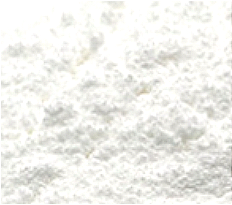
It takes the form of a white powder. Stable, incompatible with strong oxidising agents.
What it is used for and where
Medical
Used in medicine as a protector in cases of injury to internal organs. It can alleviate inflammation of synovial tissue, strengthen the function of lubrication and viscosity of joint fluid, protect joint cartilage. It can improve intestinal function and protect the gastric mucosa.
It is an antioxidant that plays an important role in immunological processes, cell motility and wound healing (1).
Cosmetics
Wetting agent, moisturising, can reduce wrinkles by reinforcing nutrients in the skin or added through creams or lotions. Used in toothpastes as a protective agent.
Humectant. Hygroscopic compound used to minimise water loss in the skin and to prevent it from drying out by facilitating faster and greater absorption of water into the stratum corneum of the epidermis. The epidermis is the most superficial of the three layers that make up human skin (epidermis, dermis and hypodermis) and is the layer that maintains hydration in all three layers. In turn, the epidermis is composed of five layers: horny, the most superficial, granular, spinous, shiny, and basal. Humectants have the ability to retain the water they attract from the air in the stratum corneum and have the function of moisturising the skin. They are best used before emollients, which are oil-based.
Skin conditioning agent. It is the mainstay of topical skin treatment as it has the function of restoring, increasing or improving skin tolerance to external factors, including melanocyte tolerance. The most important function of the conditioning agent is to prevent skin dehydration, but the subject is rather complex and involves emollients and humectants that can be added in the formulation.
Used in toothpastes as a protective agent.
Safety
The EFSA Panel for the Review of Cosmetic Ingredients considers Sodium Hyaluronate to be a safe ingredient (2).
Typical commercial product characteristics Sodium Hyaluronate
| Appearance | White powder |
| Boiling Point | 791.6ºC |
| Flash Point | 432.5ºC |
| Density | 1.78g/cm3 |
| pH | 6.0~7.5 |
| Bulk density | ≥0.2g/cm³ |
| Ignition residue | ≤20% |
| Loss on drying | ≤10% |
| Transparency | ≥99.0% |
| Absorbance | ≤0.24 |
| Glucuronic acid | 47.0%~52.0% |
| Protein | ≤0.1% |
| Heavy metals | ≤19ppm |
| Arsenic | ≤2ppm |
| Total bacterial | ≤100CFU/g |
| Yeasts & mold | ≤20CFU/g |
| PSA | 399.71000 |
| Nitrogen | 3.0-4.0% |
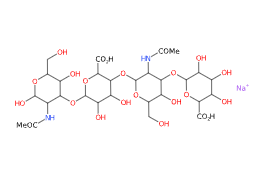 | 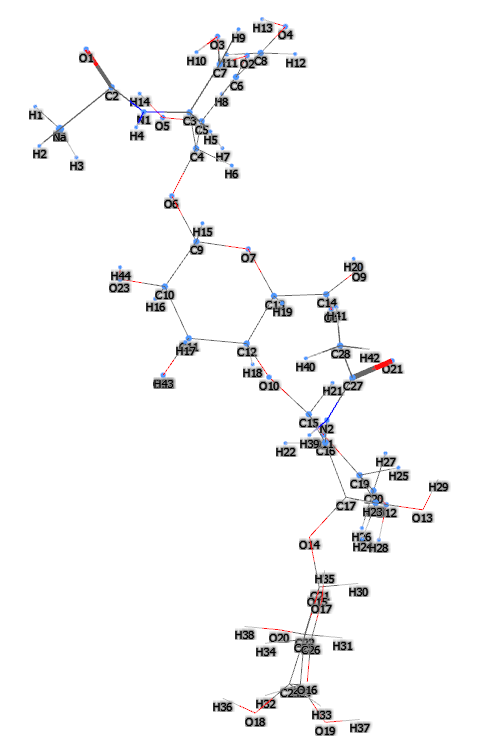 |
- Molecular Formula C28H44N2NaO23+
- Molecular Weight 799.641 g/mol
- Exact Mass 799.22300
- CAS 9067-32-7
- EC Number:618-620-0
- UNII YSE9PPT4TH
- DSSTox Substance ID
- IUPAC sodium;(2S,3S,4S,5R,6R)-6-[(2S,3R,4R,5S,6R)-3-acetamido-2-[(2S,3S,4R,5R,6R)-6-[(2R,3R,4R,5S,6R)-3-acetamido-2,5-dihydroxy-6-(hydroxymethyl)oxan-4-yl]oxy-2-carboxy-4,5-dihydroxyoxan-3-yl]oxy-5-hydroxy-6-(hydroxymethyl)oxan-4-yl]oxy-3,4,5-trihydroxyoxane-2-carboxylic acid
- InChI=1S/C28H44N2O23.Na/c1-5(33)29-9-18(11(35)7(3-31)47-25(9)46)49-28-17(41)15(39)20(22(53-28)24(44)45)51-26-10(30-6(2)34)19(12(36)8(4-32)48-26)50-27-16(40)13(37)14(38)21(52-27)23(42)43;/h7-22,25-28,31-32,35-41,46H,3-4H2,1-2H3,(H,29,33)(H,30,34)(H,42,43)(H,44,45);/q;+1/t7-,8-,9-,10-,11-,12-,13+,14+,15-,16-,17-,18-,19-,20+,21+,22+,25-,26+,27-,28-;/m1./s1
- InChl Key YWIVKILSMZOHHF-QJZPQSOGSA-N
- SMILES CC(=O)NC1C(C(C(OC1O)CO)O)OC2C(C(C(C(O2)C(=O)O)OC3C(C(C(C(O3)CO)O)OC4C(C(C(C(O4)C(=O)O)O)O)O)NC(=O)C)O)O.[Na+]
- MDL number MFCD01773053
- PubChem Substance ID 24895688
- NACRES NA.25
- RTECS MT7250000
Synonyms
- Hyaluronate Sodium
- Hyalurone sodium
- Healon
- Hyaluronic acid, sodium salt
- Synacid
- Hyaluronic acid sodium
- Hyalgan
- Equron
- Nrd101
- Monovisc
- Hyaluronsan
- Nidelon
- Hyaluronan
- Orthovisc
- Suvenyl
- Ostenil
- Hyasol
- Provisc
- Hyladerm Khionat
- Sinovial
- (2S,3S,4R,5R,6R)-6-(((2R,3R,4R,5S,6R)-3-acetamido-2,5-dihydroxy-6-(hydroxymethyl)tetrahydro-2H-pyran-4-yl)oxy)-3-(((2S,3R,4R,5S,6R)-3-acetamido-4-(((2R,3R,4S,5S,6S)-6-carboxy-3,4,5-tri
- Supartz

