



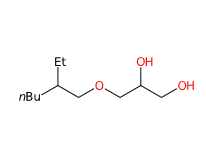
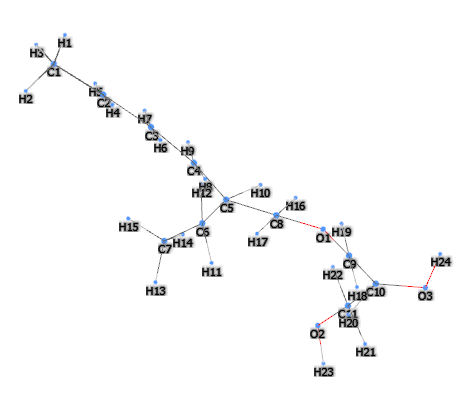
Ethylhexylglycerin (3-(2-ethylhexoxy)propane-1,2-diol) is a chemical compound, a 1-alkyl glyceryl ether, the condensation product of 2-ethylhexanol and glycerin. Branched.
It appears as a colorless transparent liquid.
What it is used for and where it is used
It is a multifunctional additive for cosmetics and is used as a strengthening agent, in combination with Phenoxyethanol to achieve better protection against microbial growth. This study of which I report an excerpt clarifies the consequences of the Ethylhexylglycerin/Phenoxyethanol ratio commonly found in cosmetic products: Preservatives are added to cosmetics to protect consumers from infection and prevent product deterioration. The concentration of preservatives should be kept as low as possible and this can be achieved by adding enhancing agents. The purpose of this study was to investigate the mechanisms underlying the enhancement of the bactericidal effect of a commonly used preservative, 2-phenoxyethanol (PE), by the potentiating agent Ethylhexylglycerin (EHG). Sublethal concentrations of EHG (0.075%) and PE (0.675%) in combination resulted in rapid killing of E. coli (>5 log cfu reduction after 30 min), loss of cellular constituents, disruption of energy metabolism, morphological deformities of cells, and DNA condensation. Used alone, EHG disrupted membrane integrity even at low concentrations. In conclusion, sub-lethal concentrations of EHG potentiate the effect of EP through damage to cell membrane integrity. Therefore, the addition of EHG to EP in a 1: 9 ratio has a similar effect on membrane damage and bacterial viability as doubling the concentration of EP. This study provides information on the mechanism of action of a strong enhancing agent, EHG, which is commonly used in cosmetics along with EP (1).
Cosmetics - INCI Functions
Deodorant. When substances that give off an unpleasant odour are included in cosmetic formulations (typical examples are methyl mercaptan and hydrogen sulphide derived from garlic), deodorants mitigate or eliminate the unpleasant exhalation.
Skin conditioning agent - Miscellaneous. Ingredient whose function is to modify the condition of the skin when it is damaged or dry by reducing flaking and restoring elasticity.
Other uses
- synergistic agent improving the anti-corrosive effect in the anti-corrosive system
- emollient, wetting agent in skin care products
- amphiphilic surfactant
- synergist making the antiseptic system more effective by reducing the surface tension of microbial cell walls
- enhancer of the efficiency of traditional preservatives
- glycol enhancer such as butyl glycol in oil/water emulsions
- increases the efficiency of certain chemical compounds such as: phenoxyethanol, 2-Isopropyl-4-(methylaminomethyl)thiazole, alcohols and glycols
Sicurezza
As with many other chemical components used in cosmetics, specific allergy to this compound may be present. Ethylhexylglycerine is generally a newly recognised contact allergen, but no severe cases of contact allergy have been reported and it is within the average range of low-allergen preservatives (2).
- Aerts O, Verhulst L, Goossens A. Ethylhexylglycerin: a low-risk, but highly relevant, sensitizer in 'hypo-allergenic' cosmetics. Contact Dermatitis. 2016 May;74(5):281-8. doi: 10.1111/cod.12546.
- Sasseville D, Stanciu M. Allergic contact dermatitis from ethylhexylglycerin in sunscreens. Dermatitis. 2014 Jan-Feb;25(1):42-3. doi: 10.1097/DER.0b013e3182a5d8a9.
- Andersen KE. Ethylhexylglycerin-a contact allergen in cosmetic products. Dermatitis. 2012 Nov-Dec;23(6):291. doi: 10.1097/DER.0b013e31827596b1.
The most relevant studies on this ingredient have been selected with a summary of their contents:
Typical optimal characteristics of the commercial product Ethylhexylglycerin
| Appearance | Colourless transparent liquid. |
| Purity | ≥99% |
| Density | 0.963g/cm3 1.0±0.1 g/cm3 |
| Boiling Point | 325.8±22.0 °C at 760 mmHg |
| Melting Point | |
| Flash Point | 150.9±22.3 °C |
| PSA | 49.69000 |
| LogP | 2.24 |
| Vapour Pressure | 0.0±1.6 mmHg at 25°C |
| Index of Refraction | 1.456 |
| ChlorideAssay(asCl,≤ %) | 0.03 |
| Sulfates( ≤%) | 0.03 |
| Moisture(≤%) | 0.35 |
| Residue on ignition(≤%) | 0.04 |
| Heavy metals Assay(asPb, ≤mg/kg) | 0.0005 |
| Arsenic (as As,≤mg/kg) | 0.00025 |
 |  |
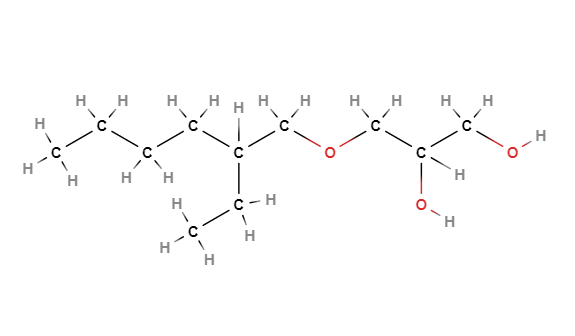 | 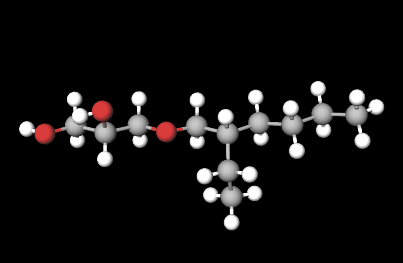 |
- Molecular Formula: C11H24O3
- Molecular Weight: 204.31 g/mol
- Exact Mass 204.172546
- CAS: 70445-33-9
- UNII 147D247K3P
- EC Number 408-080-2 615-116-2
- DSSTox Substance ID DTXSID80990652
- MDL number MFCD03790878
- PubChem Substance ID
- IUPAC 3-(2-ethylhexoxy)propane-1,2-diol
- InChI=1S/C11H24O3/c1-3-5-6-10(4-2)8-14-9-11(13)7-12/h10-13H,3-9H2,1-2H3
- InChl Key NCZPCONIKBICGS-UHFFFAOYSA-N
- SMILES CCCCC(CC)COCC(CO)O
- ChEBI
- ICSC
- NSC
- RTECS
- UN
- NCI
Synonyms:
- 1,2-Propanediol, 3-((2-ethylhexyl)oxy)-
- (3- [2- (etilesil) oxyl] -1,2-propanediol)
- 3-(2-ethylhexoxy)propane-1,2-diol
- 3-(2-ethylhexyloxy)propane-1,2-diol
- 3-(2-ethylhexyloxy)-1,2-propanediol
- 3-[2-(Ethylhexyl)oxyl]-1,2-propandiol
- Octoxyglycerin
- Ethylhexyl Glycerin
- Glycerol alpha-(2-Ethylhexyl) Ether
- 3-((2-Ethylhexyl)oxy)propane-1,2-diol
- 3-[(2-Ethylhexyl)oxy]-1,2-propanediol
- 1,2-Propanediol, 3-((2-ethylhexyl)oxy)-
- 2-ethyl-1-hexyl monoglyceryl ether
- Glycerol |A-(2-Ethylhexyl) Ether

