Chicken eggs (Gallus gallus domesticus)
Natural food composed of albumen (protein solution) and yolk (lipid emulsion rich in phospholipids and carotenoids) enclosed in a calcified shell. Noted for high protein quality, versatile technological functions (emulsification, foaming, gelation), and valuable micronutrients (vitamins A, D, E, B12, folates, choline, selenium).
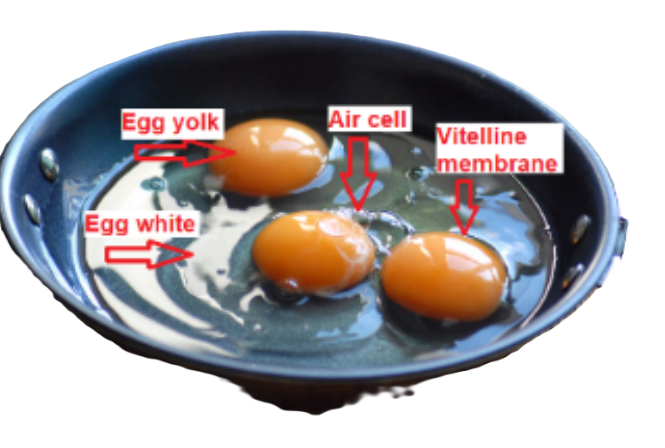
Caloric value (per 100 g and per medium egg)
Whole egg, raw: ~140–155 kcal/100 g; protein ~12–13 g; fat ~10–11 g; carbohydrates ~1 g.
Medium egg (M, 53–60 g with shell): ~70–85 kcal (edible portion ~45–50 g).
Albumen: ~45–55 kcal/100 g; protein ~10–11 g; fat ~0 g.
Yolk: ~310–330 kcal/100 g; protein ~16–17 g; fat ~27–32 g.
Composition and micronutrients (whole egg, per 100 g)
Water ~75 g
Protein ~12–13 g (high BV/PDCAAS≈1)
Fat ~10–11 g
Cholesterol ~370–400 mg (per M egg ~180–220 mg).
Vitamins: A (retinol), D, E, K; B12, B2, B5, biotin, folates.
Minerals: selenium, phosphorus, iodine (diet-dependent), zinc, iron (higher in yolk).
Bioactives: lutein and zeaxanthin (yolk color).
Lipid profile (of the yolk fat fraction)
SFA (saturated): ~31–36% — palmitic (C16:0), stearic (C18:0)
MUFA (monounsaturated): ~40–45% — oleic (C18:1 n-9)
PUFA (polyunsaturated): ~18–22% total
n-6 (linoleic C18:2, arachidonic C20:4) ~14–18%
n-3 (ALA C18:3, DHA C22:6 1–3%; ↑ in omega-3 eggs)
Phospholipids: lecithins (phosphatidylcholine) ~28–32% of yolk lipids.
Commercial classification and quality
Grades: A fresh (retail), B (processing). Sizes: S, M, L, XL. Shell color (white/brown) does not affect nutrition.
Parameters: Haugh unit (albumen quality), yolk index, air cell (freshness), albumen pH (~7.6 fresh → increases with age), shell cleanliness.
Technological properties
Emulsifying (yolk/lecithins) → mayonnaise, sauces.
Foaming (albumen proteins) → meringue, soufflé.
Gelling/coagulating → custards, flans, pasta.
Color and flavor (yolk carotenoids/compounds).
Food uses
Whole eggs for omelets, breading, baking; albumen for light foams and high-protein products; yolk for sauces/emulsions, fresh pasta, pastry. Pasteurized egg products (liquid, frozen, powders) for industrial use and no-heat recipes.
Food safety
Main hazard: Salmonella from shell/contents.
Raw uses (e.g., mayonnaise, tiramisu): use pasteurized eggs.
Internal doneness: cook until set whites and viscous yolks; for filled items/derivatives, reach ≥72 °C core.
Hygiene: avoid cross-contamination, wash hands/tools; do not wash shell eggs at home (can facilitate microbial ingress).
Storage and shelf life
Store at 0–5 °C, point down, in the original carton; avoid temperature swings and strong odors (porous shell). Follow best-before date. Hard-boiled eggs: refrigerate and consume within 3–7 days. Pasteurized products: follow label; egg powder is stable if dry and dark. Apply FIFO.
Nutrition and health
Eggs provide complete proteins, choline (membranes/brain), vitamin D and B12; lutein/zeaxanthin (vision). Cholesterol intake should be considered within total lipid intake and SFA/MUFA/PUFA profile of the diet. Omega-3 enriched eggs offer higher DHA. (No health claims without authorization.)
Quality and specifications (typical topics)
Haugh unit, yolk index, pH, weight/size, shell integrity/cleanliness, yolk L*a*b* color (carotenoids), microbiology (absence of Salmonella), residues within limits. For egg products: documented pasteurization, aw (powders), solubility, foaming/emulsifying capacity.
Allergens and suitability
Egg is among the EU major 14 allergens (albumen/yolk proteins). Egg lysozyme (E1105) is permitted in some foods (e.g., hard cheeses) → requires labeling. Not suitable for vegan diets; religious suitability depends on certification where required.
Sustainability and supply chain
Footprint linked to poultry farming (animal welfare, manure handling), feed, transport, and refrigeration. Improvements: higher welfare housing, energy efficiency, waste reduction (egg products), effluent treatment to BOD/COD targets, recyclable packaging.
Troubleshooting in the kitchen
Split mayonnaise → phase/temperature mismatch: add a little water or yolk and whisk; work at 20–25 °C.
Weeping meringue → sugar/particle size or bake issues: stabilize with acid (cream of tartar/lemon) and bake at proper T.
Green ring on hard yolk → overcooking/slow cooling (FeS): chill rapidly in ice water.
Dry scrambled eggs → excessive heat: cook gently and remove from heat before ideal doneness.
Conclusion
Chicken eggs combine high protein quality, key micronutrients, and broad functional versatility. Careful management of safety, storage, and cooking unlocks their emulsifying, foaming, and gelling roles in home and industrial kitchens.
Mini-glossary
SFA/MUFA/PUFA (n-6/n-3) — saturated/monounsaturated/polyunsaturated fatty acids (omega-6/omega-3 families)
HU (Haugh unit) — albumen quality index
BV/PDCAAS — biological value/protein quality index
aw — water activity (powder stability)
FIFO — first in, first out
BOD/COD — biochemical/chemical oxygen demand (effluents)
L*a*b* — CIELAB color space (yolk/shell)
Studies
Regarding the intake of chicken eggs as its impact on human health, in recent decades, there are conflicting views.
Doubts focus on the cholesterol content and its potential role in cardio-metabolic outcomes.
A whole or boiled chicken egg contains about 15 micrograms of selenium and in addition iron, Vitamin B2, B12, D, E
It also contains lutein, a carotenoid that can be protective against diseases such as age-related macular degeneration (1) and choline, a cellular and nervous restructurer and anti-inflammatory.(2)
Recent studies have also shown that the egg, due to its vitamin D content, helps protect the eyes from cataracts and other degenerative diseases due to ageing.
On the other hand, health recommendations indicate that dietary cholesterol should be limited to less than 200 mg per day; a single large egg yolk contains about 275 mg of cholesterol (3), so taking even a single egg increases LDL cholesterol.
The consumption of whole egg in the middle-aged and elderly population has long been discussed in the scientific literature. The impact on the cardiovascular system with possibility of disease has been under observation for several years. However, this study considers that the intake of whole egg does not affect the risk of cardiovascular disease (4).
This study, on the other hand, considers that a high consumption of eggs is significantly associated with a higher risk of contracting incidental cardiovascular diseases (5).
Egg studies
References____________________________________________________________
(1) Chung HY, Rasmussen HM, Johnson EJ. Lutein bioavailability is higher from lutein-enriched eggs than from supplements and spinach in men. J Nutr. 2004 Aug;134(8):1887-93. 2004.
Abstract. Lutein may be protective against diseases such as age-related macular degeneration (ARMD). At present, data regarding bioavailability of lutein from various sources are insufficient. Healthy men (n = 10) participated in an intervention study with a crossover design. After a 2-wk washout period during which they consumed a low-carotenoid diet, the men were administered 1 of 4 lutein doses (lutein supplement, lutein ester supplement, spinach, and lutein-enriched egg) for 9 d. All lutein doses provided 6 mg lutein except for the lutein ester dose, which provided 5.5 mg lutein equivalents. Serum samples were collected from fasting subjects on d -14, 1 (baseline), 2, 3, and 10 and analyzed for changes in lutein concentration. Triacylglycerol-rich lipoproteins (TRL) were separated from postprandial blood samples (0-24 h) after the first lutein dose and analyzed for lutein concentration. Subjects completed all 4 treatments of the study in random order. Results from repeated-measures 1-way ANOVA showed that the baseline and dose-adjusted lutein response in serum was significantly higher after egg consumption than after lutein, lutein ester, and spinach consumption on d 10. There was no significant difference in TRL response. In conclusion, the lutein bioavailability from egg is higher than that from other sources such as lutein, lutein ester supplements, and spinach. The lutein bioavailability from lutein, lutein ester supplements, and spinach did not differ. This finding may have implications for dietary recommendations that may decrease the risk of certain diseases, e.g., ARMD.
(2) Zeisel SH. Choline: critical role during fetal development and dietary requirements in adults. Annu Rev Nutr. 2006;26:229-50. 2006.
Abstract. Choline is an essential nutrient needed for the structural integrity and signaling functions of cell membranes; for normal cholinergic neurotransmission; for normal muscle function; for lipid transport from liver; and it is the major source of methyl groups in the diet. Choline is critical during fetal development, when it influences stem cell proliferation and apoptosis, thereby altering brain and spinal cord structure and function and influencing risk for neural tube defects and lifelong memory function. Choline is derived not only from the diet, but from de novo synthesis as well. Though many foods contain choline, there is at least a twofold variation in dietary intake in humans. When deprived of dietary choline, most men and postmenopausal women developed signs of organ dysfunction (fatty liver or muscle damage), while less than half of premenopausal women developed such signs. Aside from gender differences, there is significant variation in the dietary requirement for choline that can be explained by very common genetic polymorphisms.
(3) Spence JD, Jenkins DJ, Davignon J. Dietary cholesterol and egg yolks: not for patients at risk of vascular disease Can J Cardiol. 2010 Nov;26(9):e336-9.
A widespread misconception has been developing among the Canadian public and among physicians. It is increasingly believed that consumption of dietary cholesterol and egg yolks is harmless. There are good reasons for long-standing recommendations that dietary cholesterol should be limited to less than 200 mg/day; a single large egg yolk contains approximately 275 mg of cholesterol (more than a day's worth of cholesterol). Although some studies showed no harm from consumption of eggs in healthy people, this outcome may have been due to lack of power to detect clinically relevant increases in a low-risk population. Moreover, the same studies showed that among participants who became diabetic during observation, consumption of one egg a day doubled their risk compared with less than one egg a week....
(4) Wang MX, Wong CH, Kim JE. Impact of whole egg intake on blood pressure, lipids and lipoproteins in middle-aged and older population: A systematic review and meta-analysis of randomized controlled trials. Nutr Metab Cardiovasc Dis. 2019 Jul;29(7):653-664. doi: 10.1016/j.numecd.2019.04.004.
(5) Zhong VW, Van Horn L, Cornelis MC, Wilkins JT, Ning H, Carnethon MR, Greenland P, Mentz RJ, Tucker KL, Zhao L, Norwood AF, Lloyd-Jones DM, Allen NB. Associations of Dietary Cholesterol or Egg Consumption With Incident Cardiovascular Disease and Mortality. JAMA. 2019 Mar 19;321(11):1081-1095. doi: 10.1001/jama.2019.1572.
Abstract. Importance: Cholesterol is a common nutrient in the human diet and eggs are a major source of dietary cholesterol. Whether dietary cholesterol or egg consumption is associated with cardiovascular disease (CVD) and mortality remains controversial. Objective: To determine the associations of dietary cholesterol or egg consumption with incident CVD and all-cause mortality. Design, setting, and participants: Individual participant data were pooled from 6 prospective US cohorts using data collected between March 25, 1985, and August 31, 2016. Self-reported diet data were harmonized using a standardized protocol. Exposures: Dietary cholesterol (mg/day) or egg consumption (number/day). Main outcomes and measures: Hazard ratio (HR) and absolute risk difference (ARD) over the entire follow-up for incident CVD (composite of fatal and nonfatal coronary heart disease, stroke, heart failure, and other CVD deaths) and all-cause mortality, adjusting for demographic, socioeconomic, and behavioral factors. Results: This analysis included 29 615 participants (mean [SD] age, 51.6 [13.5] years at baseline) of whom 13 299 (44.9%) were men and 9204 (31.1%) were black. During a median follow-up of 17.5 years (interquartile range, 13.0-21.7; maximum, 31.3), there were 5400 incident CVD events and 6132 all-cause deaths. The associations of dietary cholesterol or egg consumption with incident CVD and all-cause mortality were monotonic (all P values for nonlinear terms, .19-.83). Each additional 300 mg of dietary cholesterol consumed per day was significantly associated with higher risk of incident CVD (adjusted HR, 1.17 [95% CI, 1.09-1.26]; adjusted ARD, 3.24% [95% CI, 1.39%-5.08%]) and all-cause mortality (adjusted HR, 1.18 [95% CI, 1.10-1.26]; adjusted ARD, 4.43% [95% CI, 2.51%-6.36%]). Each additional half an egg consumed per day was significantly associated with higher risk of incident CVD (adjusted HR, 1.06 [95% CI, 1.03-1.10]; adjusted ARD, 1.11% [95% CI, 0.32%-1.89%]) and all-cause mortality (adjusted HR, 1.08 [95% CI, 1.04-1.11]; adjusted ARD, 1.93% [95% CI, 1.10%-2.76%]). The associations between egg consumption and incident CVD (adjusted HR, 0.99 [95% CI, 0.93-1.05]; adjusted ARD, -0.47% [95% CI, -1.83% to 0.88%]) and all-cause mortality (adjusted HR, 1.03 [95% CI, 0.97-1.09]; adjusted ARD, 0.71% [95% CI, -0.85% to 2.28%]) were no longer significant after adjusting for dietary cholesterol consumption. Conclusions and relevance: Among US adults, higher consumption of dietary cholesterol or eggs was significantly associated with higher risk of incident CVD and all-cause mortality in a dose-response manner. These results should be considered in the development of dietary guidelines and updates.




