



Prallethrin: properties, uses, pros, cons, safety
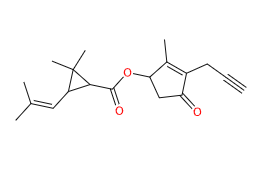
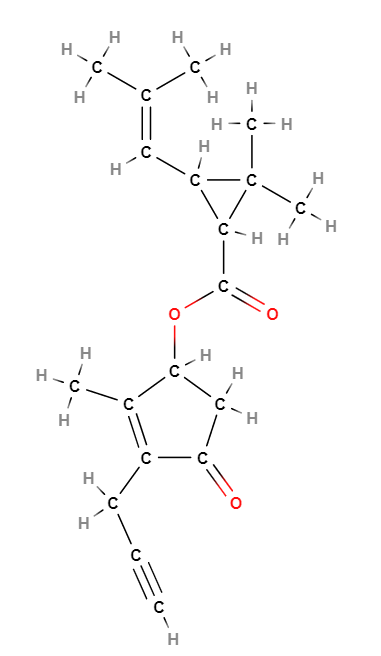
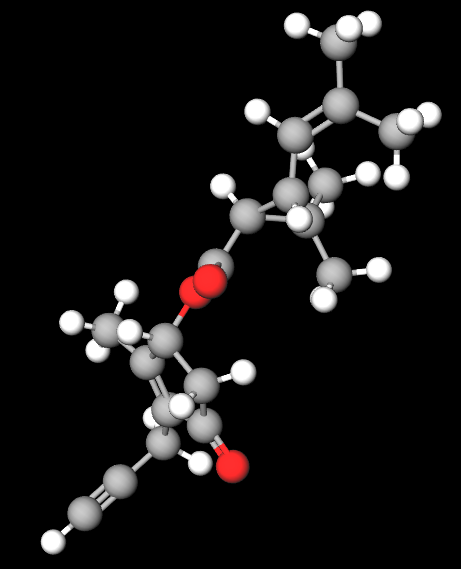
Prallethrin is a chemical compound, a terminal acetylenic compound belonging to the cyclopranes, cyclic hydrocarbons, a structural derivative of naturally occurring pyrethrins.
The name describes the structure of the molecule:
- Pralle- is a prefix used in the naming of various synthetic pyrethroids. It has no specific chemical significance in this context.
- -thrin is common in the names of pyrethroid insecticides and is derived from "pyrethrin", the natural insecticide that pyrethroids mimic.
The raw materials for the production of prallethrin include:
- Chloroethanoic acid - This is an organic compound used as a building block in the synthesis of prallethrin.
- 2,4-Dimethyl-3-methylcyclopent-2-enone - This is another key building block used in the synthesis of prallethrin.
- Allyl bromide - This compound is used as an alkylating agent in the synthesis of prallethrin.
It is composed of:
- Carbon (C): 19 atoms, 39.6% mol, 75.46% mass
- Hydrogen (H): 26 atoms, 54.2% mol, 8.666% mass
- Oxygen (O): 3 atoms, 6.25% mol, 15.87% mass
The synthesis process takes place in different steps:
- Preparation. The ingredients are cyclopentadiene, propargyl chloride, and a chrysanthemic acid derivative.
- Diels-Alder reaction. Cyclopentadiene is reacted with the chrysanthemic acid derivative in a Diels-Alder reaction, a type of cycloaddition reaction that forms a six-membered ring.
- Esterification. The product of the Diels-Alder reaction is reacted with propargyl chloride in an esterification reaction, forming pralletrine.
- Purification. All unreacted materials and by-products are removed from the mixture to obtain pure pralletrine.
It appears as a yellowish, stable liquid, incompatible with strong oxidizing agents.
What it is used for and where
Insecticides
It is a synthetic insecticide based on pyrethrin, a pyrethroid, that is, derived from pyrethrum, a component that is obtained from chrysanthemum (Chrysanthemum cinerarilifolium) , commonly used against household insects such as flies, mosquitoes, and cockroaches.
The synthesis of prallethrin, like other pyrethroids, involves a series of complex chemical reactions. The exact process may vary, but generally involves the esterification of a specific alcohol with a specific acid, both of which have complex structures. The alcohol and acid precursors are themselves synthesised through a series of reactions.
It is important to note that the synthesis of prallethrin is typically carried out in a controlled laboratory or industrial environment by trained chemists, due to the complexity of the reactions and the need for precise control of conditions.
Pyrethrins and pyrethroids are obtained from the chrysanthemum.
- Pyrethrins are commonly used in household insecticides and products for controlling insect pests of domestic and other animals.
- Pyrethroids are more potent as insecticidal action and persist in the environment longer than pyrethrins. but they pose a danger to bees.
- The class of pyrethroids includes about 42 chemical compounds
Do not take citrus fruits or fruits or vegetables after any spraying with Pralletrin for at least 14 days. The time varies depending on the eventual dose sprayed. Read the instructions in the leaflet.
Safety
In this 2008 study, it was explained that both humans and mammals are able to metabolize pyrethroid compounds into substances without toxicity, however, cases of both accidental and intentional intoxication have occurred (1). In this 2020 study, neurotoxicity of inhaled Pralletrin particulates was detected with complex metabolisms within the body, in this case laboratory animals (2).
The most relevant studies on this chemical compound have been selected with a summary of their contents:
Typical commercial product characteristics Prallethrin
| Appearance | Yellow brown to red brown liquid |
| Boiling Point | 389.8ºC at 760 mmHg |
| Flash Point | 167.9ºC |
| Density | 1.08 g/cm3 |
| PSA | 43.37000 |
| LogP | 3.44920 |
| Loss on drying | ≤2.0% |
| Water | ≤1.0% |
| Heavy metals | ≤10 ppm |
| Sulphated ash | ≤0.5%/g |
| Residue on ignition | |
| Total Impurity | ≤0.5% |
| Storage | 2-8°C |
| Safety | 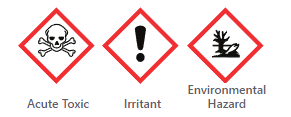 |
 |  |
 |  |
Price
100 g $202.00
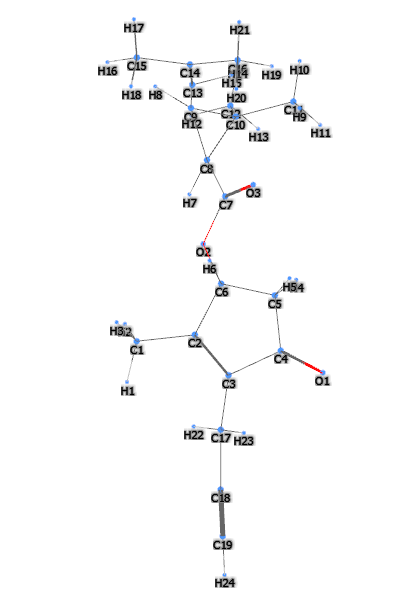
- Molecular Formula C19H24O3
- Molecular Weight 300.398 g/mol
- Exact Mass 300.17300
- CAS: 23031-36-9
- EC Number: 245-387-9
- PubChem Substance ID 329754385
- MDL number MFCD03792792
- DSSTox Substance ID DTXSID0032572
- UNII 2X67A9B2Z7
- IUPAC (2-methyl-4-oxo-3-prop-2-ynylcyclopent-2-en-1-yl) 2,2-dimethyl-3-(2-methylprop-1-enyl)cyclopropane-1-carboxylate
- InChI=1S/C19H24O3/c1-7-8-13-12(4)16(10-15(13)20)22-18(21)17-14(9-11(2)3)19(17,5)6/h1,9,14,16-17H,8,10H2,2-6H3
- InChl Key SMKRKQBMYOFFMU-UHFFFAOYSA-N
- SMILES CC1=C(C(=O)CC1OC(=O)C2C(C2(C)C)C=C(C)C)CC#C
- ChEBI 39391
- RIDADR UN2811 6.1/PG 2
- HS Code 2916209027
- RTECS GZ1725300
Synonyms:
- D-Prallethrin
- Prallethrin
- ETOC
- Cyclopropanecarboxylic acid, 2,2-dimethyl-3-(2-methyl-1-propenyl)-, 2-methyl-4-oxo-3-(2-propynyl)-2-cyclopenten-1-yl ester
- d,d-T80-Prallethrin
- (RS)-2-Methyl-4-oxo-3-prop-2-ynylcyclopent-2-enyl (1RS,3RS;1RS,3SR)-2,2-dimethyl-3-(2-methylprop-1-enyl)cyclopropanecarboxylate
- 2,2-Dimethyl-3-(2-methyl-1-propen-1-yl)cyclopropanecarboxylic Acid 2-Methyl-4-oxo-3-(2-propyn-1-yl)-2-cyclopenten-1-yl Ester
- Cyclopropanecarboxylic acid, 2,2-dimethyl-3-(2-methylpropenyl)-, ester with 4-hydroxy-3-methyl-2-(2-propynyl)-2-cyclopenten-1-one, trans-(.+/-.)-
- trans-( inverted exclamation markA)-4-Hydroxy-3-methyl-2-(2-propynyl)-2-cyclopenten-1-one 2,2-Dimethyl-3-(2-methylpropenyl)cyclopropanecarboxylate, (8CI)
- 2-methyl-4-oxo-3-prop-2-yn-1-ylcyclopent-2-en-1-yl 2,2-dimethyl-3-(2-methylprop-1-en-1-yl)cyclopropanecarboxylate
- (2-methyl-4-oxo-3-prop-2-ynylcyclopent-2-en-1-yl) 2,2-dimethyl-3-(2-methylprop-1-enyl)cyclopropane-1-carboxylate

