



N8X305N
Definition
The N8X305N is a high-speed 8-BIT microcontroller/microprocessor in the SIGNETICS 8X3XX family, introduced as the direct successor to the 8X300 and released in 1982. It was designed to preserve functional and practical compatibility with its predecessor, while adding targeted improvements—especially in internal data handling and on-chip resources.
Compatibility with 8X300 and the rationale for the upgrade
The N8X305N was intended to replace the 8X300 without forcing major redesigns:
Compatibility at the level of operating model and typical use in systems originally designed for the 8X300.
Internal improvements addressing some of the 8X300’s constraints, particularly in “working storage/register” availability and data handling.
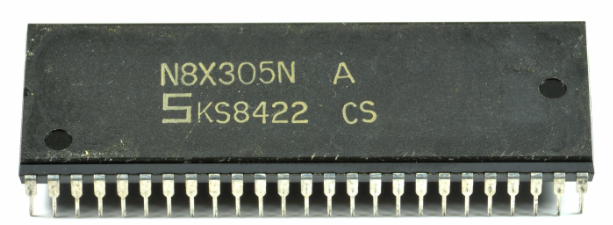
Registers: from 8 to 13 (increase in internal working capacity)
A key distinguishing point (as you noted) is the increase in usable working registers from 8 to 13. In practical terms, this typically means:
More intermediate values can be kept in registers instead of being “spilled” to external memory or managed through less efficient mechanisms.
Cleaner, more linear data-manipulation sequences with fewer constraints on temporaries and addressing.
More headroom when designing microcode/firmware for protocols, sequencing, and control logic.
Performance (what changes in practice vs 8X300)
Compared to the 8X300, the 8X305 family is generally associated with a faster instruction cycle and therefore higher throughput. At system level this typically translates into:
Better responsiveness in I/O-centric sequences and “signal/control processing” workloads that historically matched the typical use of these devices.
More margin for tighter time-bases and lower-latency control logic.
Second-source production: AMD AM29X305
As was common for strategic components, the N8X305N/8X305 was also second-sourced by AMD under the designation AM29X305. This mattered for:
Supply continuity for medium/high-volume production and industrial installations.
Reduced risk from dependence on a single vendor.
Potential commercial advantages (price, availability, lot timing).
Cited deployments: GenRad 2515 and IBM 3270 Emulator
The N8X305N is reported as being used in GENRAD instruments such as the 2515 COMPUTER AIDED TEST SYSTEM, and it is also cited in the context of an IBM 3270 EMULATOR. In these scenarios, the practical advantage of a fast, deterministic, control-oriented device like the 8X305 class is reliable execution of control sequences, I/O handling, and timing—often implemented as state-machine-driven flows and proprietary protocols.
Sketch of the most important connections
                 ┌──────────────────────────────┐
                 │        BOARD / SYSTEM         │
                 │ control logic + I/O BUS        │
                 └──────────────┬───────────────┘
                                │ data/control signals
                                ▼
                       ┌──────────────────┐
                       │     N8X305N      │
                       │    8-BIT CPU     │
                       │   13 REGISTERS   │
                       │     I/O logic    │
                       └─────────┬────────┘
                                 │
                                 ▼
                 ┌────────────────────────────────┐
                 │ PERIPHERALS / INTERFACES        │
                 │ digital lines, timing, logic    │
                 └────────────────────────────────┘
Table 1 – Identification data and specifications (English)
| Characteristic | Typical value |
|---|---|
| Device | N8X305N ( 8X305 family) |
| Role | High-speed 8-BIT microcontroller/microprocessor |
| Market introduction | 1982 |
| Compatibility | Compatible with 8X300 (direct successor) |
| Registers | “Working registers” increased from 8 to 13 |
| Second source | AMD AM29X305 |
| Cited deployments | GENRAD 2515; IBM 3270 EMULATOR |
Table 2 – Operational and design aspects (English)
| Aspect | Practical meaning |
|---|---|
| Higher register count | Fewer constraints on temporaries and data handling, cleaner firmware structure |
| Compatible upgrade | Migration from 8X300 with reduced impact on the design |
| Performance | Faster instruction cycle vs 8X300, better control responsiveness |
| Second-source strategy | Supply-chain continuity thanks to AMD as an alternative |
| Use in test/emulation equipment | Deterministic sequencing, I/O handling, and timing in specialized systems |

