



Wheat protein (Triticum spp.)
Description
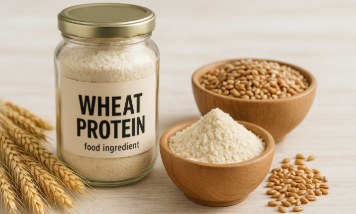
Plant-based proteins from wheat, used mainly as vital wheat gluten, hydrolyzed wheat protein (HWP), and less commonly wheat protein isolate.
Functional rationale: gluten network formation (elastic glutenin + extensible gliadin) delivers structure, gas retention, film-forming, and chew in doughs and meat-analog systems.
Sensory profile: neutral to mildly cereal, clean aroma; HWP can add umami/fermented notes at low doses.
Caloric value (per 100 g, dry powders)
Vital wheat gluten: ~360–380 kcal, protein 70–80 g, carbohydrates 10–15 g, fat 4–8 g.
Hydrolyzed wheat protein / isolates: typically 360–390 kcal, protein 80–90 g (grade-dependent), fat ≤3 g.
Key constituents
Gluten proteins: glutenins (polymeric, elasticity) and gliadins (monomeric, viscoelastic flow).
Peptides/amino acids (in HWP) for solubility and surface activity.
Minerals/vitamins: traces (processing removes most non-protein solids).
Production process
Milling → dough washing to remove starch → gluten separation, dewatering, drying → milling (vital wheat gluten).
Hydrolysis (enzymatic/acid) of gluten → HWP, then neutralisation, filtration, spray drying.
Optional fractionation/filtration to tailor MW distribution and solubility; instantising/agglomeration for dispersibility.
Quality controls: protein % (Kjeldahl/Dumas), moisture, ash, particle size/flow, solubility curve (pH), micro counts, mycotoxins (e.g., DON), metals.
Sensory and technological properties
Structure & gas retention: creates elastic networks for high oven spring and crumb.
Water management: increases water absorption and dough tolerance; improves freeze–thaw resilience with proper formulation.
Emulsifying/foaming: stronger with HWP (smaller peptides, higher surface activity).
Heat setting & film-forming: aids binding and sliceability in meat analogues/hybrids and filled pastas.
pH–salt sensitivity: functionality shifts with ionic strength and oxidation–reduction balance.
Food applications
Bakery: breads, rolls, flatbreads, high-protein loaves, noodles/pasta (firmness), laminated doughs.
Meat analogues & extenders: seitan, patty/loaf systems; binder in sausages where permitted.
Snacks/extrusion: improves elasticity and cell structure.
Beverages/culinary: HWP for foam stability, mouthfeel, and umami in soups/sauces (check allergen/gluten claims).
Nutrition and health
High protein density; lysine-limited profile → pair with legumes/soy for amino-acid complementarity.
Dietary fiber minimal (in isolated forms). Sodium intrinsically low.
Gluten-related disorders: not suitable for celiac disease or wheat allergy; HWP remains allergenic for sensitized individuals.
Fat profile
Low total fat; residual lipids are mainly PUFA — polyunsaturated fatty acids (e.g., linoleic n-6; beneficial when balanced, more oxidation-prone) and MUFA — monounsaturated fatty acids (e.g., oleic n-9; often neutral/beneficial), with minimal SFA — saturated fatty acids (keep moderated overall). TFA — trans fatty acids negligible; MCT — medium-chain triglycerides not significant.
Quality and specifications (typical topics)
Protein % (dry basis), moisture/ash, gluten index or wet gluten, Extensograph/Alveograph (e.g., W, P/L), water absorption (Farinograph), solubility (HWP), color/odor.
Microbiology: low counts, pathogens absent/25 g.
Contaminants: DON (deoxynivalenol), heavy metals within limits.
Storage and shelf life
Store cool/dry/airtight, away from odors; typical shelf life 12–24 months for low-aw powders.
Hydrated doughs/mixes: treat as perishable, ≤4 °C, use per recipe timing.
Allergens and safety
Contains major allergen: wheat (gluten). Mandatory labelling in most markets.
Risk of cross-contact with other allergens in mixed facilities; maintain validated allergen controls.
INCI functions in cosmetics (when applicable)
INCI names: Hydrolyzed Wheat Protein, Wheat Gluten, Wheat Amino Acids.
Roles: film-forming, skin conditioning, light humectancy, emulsion stabilising (use within safety/claim limits).
Troubleshooting
Dense loaf/poor volume: under-kneading or weak gluten → increase mixing/oxidants (e.g., ascorbic acid), adjust hydration, boost vital gluten.
Tearing/low extensibility: network over-oxidised/tight → reduce mix time/oxidants, add reducing agent (e.g., L-cysteine where allowed), increase resting.
Sticky dough/poor handling: over-hydration or salt too low → rebalance water/salt, cool dough, add fat/emulsifier.
Crumbly patties (meat analogues): raise hydration/binders (starches/fibers), incorporate oil emulsion, optimise heat set.
Sustainability and supply chain
Wheat is widely rotated, supporting soil health; lower GHG per protein vs many animal sources.
Operate under GMP/HACCP, manage process water toward BOD/COD targets, and use recyclable packaging; verify mycotoxin control in upstream grain.
Labelling
Declare as “vital wheat gluten”, “hydrolyzed wheat protein”, or “wheat protein isolate” as appropriate; highlight wheat/gluten allergen.
Protein claims (e.g., “high protein”) only when regulatory thresholds are met.
Conclusion
Wheat proteins provide best-in-class structure for bakery and robust binding/film-forming in culinary and meat-analogue systems. Selecting the right form (gluten vs HWP), and tuning hydration, oxidation–reduction balance, pH, and salt, delivers high volume, chew, and stable textures with clean flavor.
Mini-glossary
HWP — hydrolyzed wheat protein: Enzymatically/acid-treated wheat protein with higher solubility and surface activity.
WHC/OHC — water/oil-holding capacity: Governs yield, juiciness, and fat retention.
PUFA — polyunsaturated fatty acids: Potentially beneficial when balanced; more oxidation-prone.
MUFA — monounsaturated fatty acids: Often neutral/beneficial and relatively stable.
SFA — saturated fatty acids: Keep moderated overall; low share in wheat proteins.
TFA — trans fatty acids: Negligible in non-hydrogenated ingredients.
MCT — medium-chain triglycerides: Not significant in wheat proteins.
GMP/HACCP — good manufacturing practice / hazard analysis and critical control points: Preventive hygiene systems with validated CCPs.
BOD/COD — biochemical/chemical oxygen demand: Wastewater metrics tied to environmental impact and treatment performance.

