



Sodium monofluorophosphate: properties, uses, pros, cons, safety
Sodium monofluorophosphate is an inorganic chemical compound produced synthetically by the reaction of sodium fluoride with sodium metaphosphate or the reaction of disodium phosphate or tetrasodium pyrophosphate with hydrogen fluoride.
The name defines the structure of the molecule:
- Sodium is a chemical element with the symbol Na (from the Latin "Natrium") and the atomic number 11. In the context of sodium monofluorophosphate, it indicates the presence of a sodium salt.
- Monofluorophosphate is a compound that consists of a phosphate group (PO4) and a fluorine atom (F). It is commonly used as a source of fluoride in oral care products, such as toothpaste and mouthwash. Fluoride helps prevent tooth decay by strengthening the enamel and inhibiting the growth of caries-causing bacteria.
Description of the raw materials used in its production:
- Sodium hydroxide (NaOH) - Sodium hydroxide is used as a source of sodium ions in the synthesis of sodium monofluorophosphate. It provides the necessary sodium component for the compound.
- Phosphoric acid (H3PO4) - Phosphoric acid is reacted with sodium fluoride to produce sodium monofluorophosphate. It serves as a source of phosphate ions in the compound.
- Sodium fluoride (NaF) - Sodium fluoride is combined with phosphoric acid to form sodium monofluorophosphate. It provides the fluoride component, which is essential for the compound's oral care benefits.
The synthesised extraction process takes place in four steps:
- Reaction. In the first step of the process, phosphorus pentachloride reacts with hydrogen fluoride to form phosphorus pentafluoride:
- Hydrolysis. Phosphorous pentafluoride is hydrolysed and reacted with water. Phosphoric acid and hydrogen fluoride are thus formed.
- Formation of monofluorophosphoric acid. Phosphoric acid is reacted again with hydrogen fluoride to form monofluorophosphoric acid.
- Neutralisation. In the fourth and final step, monofluorophosphoric acid is neutralised with sodium hydroxide to form sodium monofluorophosphate.
It appears in the form of a white powder, easily soluble in water at 42% at 25°C and strongly hygroscopic, Incompatible with phosphorus oxides, strong oxidising agents.

What it is used for and where
Dentistry
Used in toothpastes for enamel protection, anti-caries agent, dentine desensitisation. Sodium fluoride substitute. Sodium monofluorophosphate generally accounts for 0.7-0.76% in toothpaste ingredients and has virtually replaced sodium fluoride. Fungicide and preservative.
Safety
Maximum concentration in the ready-to-use preparation: 0.15% calculated as Fluorine. When mixed with other fluorine compounds permitted by this annex, the total concentration of F shall not exceed 0.15%.
Formulation of conditions of use and warnings: Contains sodium monofluorophosphate. For any toothpaste containing 0.1 to 0.15 percent fluoride, unless it is already labeled as contraindicated for children (e.g., "for adult use only"), the following labeling is mandatory: "Children 6 years of age or younger: Use a minimum amount for supervised brushing to minimize ingestion." In case of fluoride intake from other sources, consult a dentist or physician."
Cosmetics
It is a restricted ingredient III/27 as a Relevant Item in the Annexes of the European Cosmetics Regulation No. 1223/2009.
Anti-plaque agent. It is an ingredient that has the property of preventing the occurrence of caries by fighting the bacteria responsible for acid corrosion of teeth.
Oral hygiene agent. This ingredient can be inserted into the oral cavity of to improve and/or maintain its oral hygiene and health, to prevent or improve a disorder of the teeth, gums, mucosa.
Other uses
Metal surface cleaning, special glass production, drinking water fluorination, concrete corrosion inhibitor
Commercial applications
Fluoridating Agent in Toothpastes. Sodium Monofluorophosphate is used in toothpastes to help prevent tooth decay.
Component in Oral Care Products. Used in mouthwashes and other oral care products to promote tooth health.
Preservative Agent for Dental Materials. It can be used in dental materials as a preservative and stabilizing agent.
Ingredient in Pharmaceutical Preparations. Used in some pharmaceutical preparations for its antimicrobial properties.
For more information:
Sodium monofluorophosphate studies
Typical characteristics of the commercial product Sodium monofluorophosphate for use in toothpastes
| Appearance | White powder |
| pH | 6.5-8.0 |
| Melting Point | 625°C |
| Apparent Density | 1.5 g/cm3 |
| PSA | 73.00000 |
| LogP | 0.92500 |
| Na | ≥32.0% |
| Arsenic | ≤0.0003% |
| Lead | ≤0.0001% |
| Heavy metal | ≤0.005% |
| P (P2O5) | ≥49.0% |
| Combined fluorine | ≥12.49% |
| Free fluorine | ≤0.5% |
| Total F | ≥13.0% |
| F Combined in PO3F2- | ≥12.54% |
| Loss on dry (105℃/2H) | ≤0.2% |
| Whiteness (70-90umGranularity) | ≥94% |
| Transmission (15% Aq.solution) | ≥89% |
| Mesh granularity | 90% pass 100-200 mesh |
| Shelf life | 2 years |
| Chemical Safety |  |
 |  |
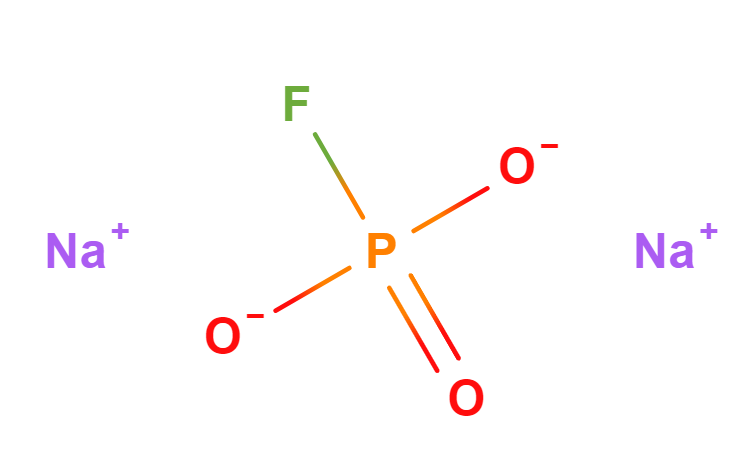 |  |
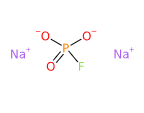
- Molecular Formula FNa2O3P Na2PFO3
- Molecular Weight 143.949 g/mol
- Exact Mass 143.93600
- CAS 10163-15-2
- UNII: C810JCZ56Q
- EC Number: 233-433-0
- DSSTox Substance ID DTXSID70872554 DTXSID40872566
- IUPAC disodium;fluoro-dioxido-oxo-λ5-phosphane
- InChl=1S/FH2O3P.2Na/c1-5(2,3)4;;/h(H2,2,3,4);;/q;2*+1/p-2
- InChl Key BFDWBSRJQZPEEB-UHFFFAOYSA-L
- SMILES [O-]P(=O)([O-])F.[Na+].[Na+]
- MDL number MFCD00014248
- PubChem Substance ID
- ChEBI 86431
- RTECS TE6130000
- NCI C61945
- RXCUI 56501
Synonyms:
- Disodium monofluorophosphate
- disodium;fluoro-dioxido-oxo-λ5-phosphane
- Sodium fluorophosphate
- Disodium fluorophosphate
- Sodium phosphorofluoridate
- Sodium monofluorophosphate [USP]
- disodium fluoro-dioxido-oxophosphorane
- Fluoridophosphoric acid disodium salt
- Phosphorofluoridic acid disodium salt
- Phosphorofluoridic acid, disodium salt
- Fluorophosphoric acid, sodium salt
- Disodium phosphorofluoridate
- dinatriumfluorophosphat

