



Tricalcium phosphate: properties, uses, pros, cons, safety
Tricalcium phosphate is an inorganic salt of calcium and phosphate, used as a raw material in three main supply chains: food (additive E 341(iii), mainly as an anti-caking agent and carrier), pharmaceutical (tablet/capsule excipient), and cosmetics (especially oral care, with functions related to opacifying and technological support). In practice, what truly matters is the grade (food grade/FCC vs pharma grade/USP-NF), particle size distribution, and lot-to-lot quality (moisture, flowability, contaminants, heavy metals).
An often underestimated operational aspect is that, in commerce, “tricalcium phosphate” may include materials with different microstructure and phase (more or less crystalline forms, apatite-like fractions), with measurable impacts on apparent solubility, suspension behavior, and anti-caking performance. This is not a “conceptual” issue, but one that requires specifications and analytical methods aligned with the end use.
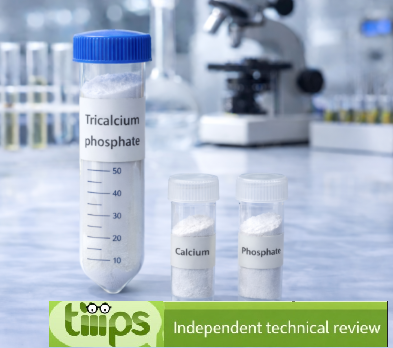
Definition
It is a substance with a defined salt composition (Ca₃(PO₄)₂), but in industrial practice it may show phase and morphology variability (e.g., different crystallinity levels or the presence of apatite-like fractions). Operationally, quality control focuses on: identity, purity, moisture, particle size, bulk density, and contaminant limits.
In the food sector, it is used as additive E 341(iii) for technological functions (anti-caking, carrier/support, and sometimes a calcium/phosphorus source depending on formulation context).
Main uses
Food
Used mainly as an anti-caking agent in powder blends (e.g., vitamin-mineral premixes, spices, dry mixes) and as a carrier for nutrients or ingredients sensitive to moisture. In some formulations it is also used as a calcium and phosphorus source, but its nutritional usefulness depends on the matrix and solubility under use conditions.
Cosmetics
Used primarily in oral care (e.g., toothpastes) as a technological component: contribution to opacifying and support for product “feel”/structure, with possible roles as a functional particulate in controlled abrasive systems (depending on grade and formulation design).
INCI functions
- Abrasive agent. It contains abrasive particles to remove stains or biofilm that accumulate on the stratum corneum or teeth. Baking soda, kieselguhr, silica and many others have abrasive properties. Peeling or exfoliating products used in dermatology or cosmetic applications contain abrasive agents in the form of synthetic microspheres, however, these microspheres, or abrasive particles may not be biodegradable and create pollution in aquatic ecosystems.
- Anticaking agent. This compound facilitates free flow and prevents aggregation or clumping of substances in a formulation by reducing the tendency of certain particles to stick together
- Fragrance. It plays a very important role in the formulation of cosmetic products as it provides the possibility of enhancing, masking or adding fragrance to the final product, increasing its marketability. It is able to create a perceptible pleasant odour, masking a bad smell. The consumer always expects to find a pleasant or distinctive scent in a cosmetic product.
- Opacifying agent. It is useful into formulations that may be translucent or transparent to make them opaque and less permeable to light.
- Oral care agent. This ingredient can be placed in the oral cavity to improve and/or maintain oral hygiene and health, to prevent or improve a disorder of the teeth, gums, mucous membrane. It provides cosmetic effects to the oral cavity as a protector, cleanser, deodorant.
Pharmaceutical
Used as an excipient (diluent/filler) and sometimes as a functional component in tablets/capsules, where compressibility, flowability, density, and compatibility with other excipients are critical.
Industrial use
Used as a “service” raw material to stabilize powders, improve processability, act as a premix support, and manage residual moisture. It is also used as an input in technical applications requiring specific purity and contaminant control (depending on sector).
Key constituents
The relevant constituents are calcium ions and phosphate groups; any operational differences stem from phase, crystallinity, and microstructure. Relevant “impurities”, when present, are typically trace-level (e.g., heavy metals) and become a specification topic mainly for food and pharmaceutical use.
Nutritional use note and bioactive compounds
In food contexts it can contribute calcium and phosphorus, but its low water solubility means nutritional performance is strongly matrix-dependent; in practice, it is selected primarily for its technological functions (anti-caking/carrier), and only secondarily as a mineral source when consistent with the formulation and specifications.
Calories (energy value)
As an inorganic mineral salt, the energy contribution is zero (0 kcal) at relevant use levels.
Identification data and specifications
| Characteristic | Value |
|---|---|
| Common name | Tricalcium phosphate |
| Frequent synonyms | Tricalcium phosphate; tribasic calcium phosphate; tricalcium bis(orthophosphate) |
| CAS number | 7758-87-4 |
| EC number | 231-840-8 |
| Molecular formula | Ca₃(PO₄)₂ |
| Molecular weight | 310.18 g/mol |
| Nature of substance | Inorganic salt (solid) |
| Typical commercial grades | Food grade (FCC) / Pharma grade (USP-NF) / Technical grade |
| EU food use (operational) | Additive E 341(iii) (uses and categories per applicable legislation) |
| Regulatory note (operational) | In the EU, additive use depends on categories and conditions; in the USA “calcium phosphate (mono-, di-, tribasic)” is GRAS with use according to GMP |
Indicative chemical-physical properties
| Characteristic | Indicative value | Note |
|---|---|---|
| Appearance | White powder | Whiteness and fineness depend on process and grade |
| Water solubility | Very low | In water it tends to form dispersions/turbid systems |
| Density | ~3.1 g/cm³ | Indicative; distinguish true density vs powder bulk density |
| Stability | High under normal conditions | Sensitive to strong acids (reacts forming more soluble phosphate species) |
| Hygroscopicity | Generally low–moderate | Depends on particle size and fines; impacts caking |
| Critical parameters | Moisture, particle size, bulk density, heavy metals | Main drivers for flow, anti-caking, and compliance |
Functional role and practical mechanism of action
In food powders, tricalcium phosphate acts mainly as an anti-caking particulate: it reduces capillary bridges and adhesion between particles, improving flowability and dosing. In oral care, the role is predominantly technological (opacity and contribution to system structure), with performance driven by particle size and particle-size distribution.
In pharmaceuticals, performance is driven by rheology (flow), compressibility, and compatibility with excipients and APIs.
Formulation compatibility
In powders (food and supplements): compatibility is generally good, but moisture and particle size must be managed to avoid segregation in blends and loss of flow. In tablets: useful as a filler, but performance varies with bulk density and fines content. In cosmetics/oral care: impact on opacity and sensory requires tuning of the particle-size curve; attention to abrasivity and compliance with finished-product specifications.
Use guidelines
In practice, good norms include: defining grade and specifications (food/pharma), setting a particle-size and bulk-density range, controlling moisture and heavy metals, validating stability in real packaging, and establishing objective criteria for flowability and absence of caking (especially in humid climates or long logistics chains).
Quality, grades, and specifications
Supplier variability can be significant for: particle size, fines content, bulk density, and contaminant levels. A robust control plan includes: grade qualification (FCC/USP-NF where required), COA with traceable methods, heavy-metal limits consistent with use, and repeatable physical controls (moisture, flowability, bulk density). Adoption of GMP and HACCP remains a key operational requirement to reduce variability and manage contamination risk along the supply chain.
Safety, regulatory, and environment
From a toxicological perspective, the profile is generally manageable at typical use levels as an additive or excipient, but safety must always be assessed on the finished product (dose, target population, duration of use). The most common practical issue is dust management (inhalation/dusting in production environments) and compliance with contaminant limits.
Allergen.
Not a “label allergen” and not typically among regulated allergens; non-specific individual sensitivities remain possible.
Contraindications (brief).
Caution in subjects with conditions requiring clinical control of calcium/phosphorus (e.g., advanced renal insufficiency, significant mineral imbalances) and in case of prolonged high intake via multi-source supplements. For industrial handling, properly manage dust exposure with engineering controls and appropriate PPE.
Formulation troubleshooting
Caking in powders.
Action: reduce moisture, improve barrier packaging, optimize particle size, verify bulk density and storage conditions.
Segregation in blends (premixes).
Action: harmonize bulk density and particle size with other components, optimize loading order and mixing times, validate homogeneity.
Opacity/texture variations in oral care.
Action: select a grade with a more suitable particle-size curve, retune particulate level and vehicle rheology, validate accelerated stability.
In medicine it is used in the treatment of bones (1), in odontostomatology for the treatment of dental enamel (2) and in bone grafts (3).
In the food field it is an additive with the name of E341 (iii) with functions of acidity regulator and to avoid the formation of lumps in the powders.
It is also found in chewingum.
Conclusion
Tricalcium phosphate is a versatile mineral raw material used mainly as an anti-caking agent/carrier in food (E 341(iii)), as an excipient in pharmaceuticals, and as a technological component in oral care. In practice, the decisive levers are: selecting the right grade (FCC vs USP-NF), controlling particle size and moisture, managing contaminants, and validating physical performance in the finished product and packaging.
Mini-glossary
GMP. Good manufacturing practice; benefit: reduces variability and contamination through controlled production practices.
HACCP. Hazard analysis and critical control points; benefit: systematic prevention and control of food-safety hazards via critical points.
E 341(iii). EU code for tricalcium phosphate within the calcium phosphate family used as food additives, with use conditions and categories defined in legislation.

