

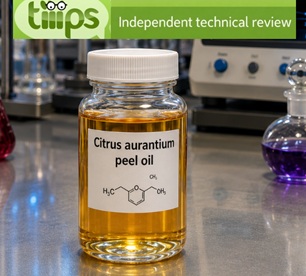
Citrus aurantium peel oil
Rating : 6
| Evaluation | N. Experts | Evaluation | N. Experts |
|---|---|---|---|
| 1 | 6 | ||
| 2 | 7 | ||
| 3 | 8 | ||
| 4 | 9 | ||
| 5 | 10 |
Cons:
Cosmetics Regulation provisions (1)0 pts from admin
| Sign up to vote this object, vote his reviews and to contribute to Tiiips.Evaluate | Where is this found? |
| "Descrizione" about Citrus aurantium peel oil by admin (19570 pt) | 2026-Jul-19 18:28 |
| Read the full Tiiip | (Send your comment) |
Citrus aurantium peel oil: properties, uses, pros, cons, safety
Citrus aurantium peel oil is the essential oil obtained from the peel of the fruit of Citrus aurantium, commonly known as bitter orange, sour orange, or bitter orange. In the INCI context, the most precise entry is often CITRUS AURANTIUM PEEL OIL EXPRESSED, meaning oil expressed from the fresh epicarp of the fruit. It is a natural aromatic raw material used mainly in perfumery, cosmetics, detergency, and fragrance compositions, with the main function perfuming.
From a technical standpoint, it is not a single substance, but a complex mixture of volatile and non-volatile compounds, generally dominated by D-limonene, with smaller amounts of other terpenes and oxygenated compounds such as linalool, citral, decanal, methyl anthranilate, and terpineol. Cosmetic assessment must consider above all three aspects: fragrance allergens, oxidation of terpenes, and the possible presence of phototoxic furocoumarins.

Description
Citrus aurantium peel oil is a citrus essential oil with a fresh, bitter, orange-like, green, fruity, and slightly floral olfactory profile. It is different from neroli oil, which comes from the flowers of bitter orange, and from petitgrain oil, which comes from leaves and twigs. In this case, the part used is the peel of the fruit.
The traditional method of production is cold expression or pressing of the peel, a method that preserves the citrus olfactory profile well but may also carry over less volatile components, including possible furocoumarins. For this reason, expressed oil requires a more cautious assessment than rectified, distilled, or furocoumarin-free fractions.
In cosmetics, its value is essentially sensory: it perfumes the product, improves perceived pleasantness, and can help mask technical odors from the formulation base. However, it should not be presented as a “healthy” ingredient simply because it is natural: it is a biologically active and potentially sensitizing fragrance mixture.
Production process
The production process starts from bitter orange fruits. The peel is separated or processed together with the fruit and subjected to pressing/expression, often using mechanical systems that rupture the oil glands of the epicarp. The essential oil is then separated from the aqueous phase and solids by centrifugation, decantation, filtration, and, when necessary, further purification steps.
In some cases, the material may be rectified, deterpenated, or treated to reduce crude odor, color, oxidizable compounds, or phototoxic fractions. Folded, concentrated, or deterpenated grades may have a very different compositional profile from normal expressed oil: if some light fractions are removed, less volatile components may become relatively more concentrated.
Final quality depends on botanical variety, geographical origin, fruit ripeness, extraction method, storage, exposure to oxygen, light and heat, and the supplier’s analytical standards.
Main compounds present
The main component is normally D-limonene, often around 90% in typical expressed bitter orange peel oil grades. Smaller amounts are then present, including:
myrcene;
α-pinene;
β-pinene;
linalool;
citral;
decanal;
methyl anthranilate;
terpineol;
other monoterpenes, aldehydes, and minor aromatic compounds.
From a cosmetic standpoint, some of these components are relevant because they fall among fragrance allergens that must be declared on the label when they exceed the required thresholds. Those requiring particular attention include Limonene, Linalool, Citral, Geraniol, Citronellol, Eugenol, Farnesol, and any other components present in the fragrance or essential oil.
Composition can vary greatly between batches and suppliers. For this reason, assessment should not be based only on the botanical name, but on GC-MS, certificate of analysis, allergen declaration, IFRA certificate, and updated technical data sheet.
Identification data and specifications
| Characteristic | Value | Note |
|---|---|---|
| Main INCI name | Citrus Aurantium Peel Oil Expressed | essential oil expressed from the peel |
| Botanical name | Citrus aurantium | Rutaceae |
| Common name | bitter orange peel oil | bitter orange peel oil |
| Plant part | epicarp / fruit peel | not flowers, not leaves |
| CAS | 72968-50-4 | commonly reported for bitter orange peel oil |
| Alternative / related CAS | 68916-04-1 | reported in some databases for bitter orange materials |
| EC | 277-143-2 | reference reported for the oil |
| CosIng Ref. | 41394 | for Citrus Aurantium Peel Oil Expressed |
| Chemical category | citrus essential oil | complex natural mixture |
| Predominant component | D-limonene | often about 90% |
| Main cosmetic function | perfuming | fragrance ingredient |
| Food use | flavouring in specific contexts | non-nutritional |
| Critical cosmetic point | allergens + furocoumarins + oxidation | requires supplier documentation |
Indicative physicochemical properties
| Characteristic | Indicative value | Note |
|---|---|---|
| Appearance | mobile liquid | typical of citrus essential oils |
| Color | pale yellow to light orange | depends on grade and oxidation |
| Odor | citrus, bitter, fresh, orange-like | characteristic of bitter orange |
| Water solubility | very low / insoluble | requires solubilizers or an oil phase |
| Solubility in alcohol | good | useful in perfumery |
| Density | about 0.84-0.86 g/mL | indicative value for limonene-rich citrus oils |
| Volatility | high | volatile fragrance component |
| Oxidative stability | moderate / to be controlled | terpenes may oxidize |
| Sensitivity | light, oxygen, heat | store tightly closed and protected |
| Main technical risk | oxidation and phototoxicity if furocoumarins are present | depends on commercial grade |
Food
In the food sector, Citrus aurantium peel oil may be used as a flavouring or aromatic component, but it has no nutritional role. Its value is linked to its bitter citrus profile, useful in beverages, confectionery products, liqueurs, citrus flavourings, and preparations where a bitter orange note is desired.
It should be distinguished from the use of bitter orange peel as a botanical ingredient and from food or botanical extracts containing alkaloids such as synephrine: peel essential oil is mainly a volatile fragrant fraction, not a supplement and not a nutritional ingredient.
For a correct food assessment, food grade, purity, dosage, flavouring compliance, allergen profile, and contaminant control are required. In a cosmetic report, the food focus therefore remains secondary and essentially sensory, not health-related.
Cosmetics
In cosmetics, Citrus aurantium peel oil is used mainly as a perfuming ingredient. It may appear in perfumes, scented waters, cleansers, soaps, shampoos, conditioners, creams, body products, deodorants, hair products, bath products, and make-up when a fresh, bitter, natural citrus note is desired.
The most delicate point is that the essential oil contains naturally occurring components that may fall among fragrance allergens. On the label, it is not enough to indicate only the essential oil if individual allergens exceed the required thresholds: individual allergens must be declared according to the European Cosmetics Regulation.
Another critical aspect is the possible presence of furocoumarins, substances associated with phototoxicity. The issue is particularly relevant for expressed citrus oils and for leave-on products intended for sun-exposed areas. In sunscreen and tanning products, European legislation requires furocoumarins to be below 1 mg/kg in the finished product. In addition, IFRA standards provide specific restrictions for bitter orange peel oil expressed related to phototoxicity.
Pros
It has a fresh, citrus, natural, and recognizable olfactory profile.
It is useful as a perfuming ingredient in cosmetics, cleansers, perfumes, and hair products.
It can also perform a masking function, covering technical odors in the formula.
It is a plant-derived ingredient obtained from bitter orange peel.
It is rich in D-limonene, the characteristic component of citrus essential oils.
It can contribute to a perception of freshness and cleanliness in the finished product.
In properly controlled grades, it can be used safely in well-designed cosmetic formulas.
Cons
It is not a nutritional food ingredient: its role in food is only aromatic.
It naturally contains fragrance allergen components, especially Limonene and possible amounts of Linalool, Citral, and other allergens.
Oxidized terpenes, especially oxidized limonene, may increase the risk of sensitization.
Expressed citrus oils may contain phototoxic furocoumarins.
In leave-on products intended for sun exposure, it requires particularly cautious assessment.
Composition varies greatly according to botanical origin, batch, extraction, rectification, and storage.
It should not be confused with neroli oil or petitgrain oil, which come from different parts of the same plant and have different composition and regulatory profiles.
Safety, regulatory aspects, and environment
From a cosmetic standpoint, Citrus aurantium peel oil is a useful but non-trivial ingredient. The fact that it is natural does not eliminate the risk of sensitization, especially because it contains fragrant terpenes and potential allergens. The safety profile depends on the concentration in the finished product, product category, oil quality, oxidation, allergen levels, and the presence of furocoumarins.
For European labeling, the presence of individual fragrance allergens must be checked and declared when they exceed the applicable thresholds: 0.001% in leave-on products and 0.01% in rinse-off products. For a citrus peel oil rich in limonene, this verification is essential.
The furocoumarin issue is equally important. The European Cosmetics Regulation prohibits furocoumarins except for the normal content in natural essences used; in sunscreen and tanning products, the content must be below 1 mg/kg. The SCCP opinion also recalls that furocoumarins are recognized as photomutagenic and photocarcinogenic in the presence of UV radiation.
The IFRA standards for Bitter orange peel oil expressed are based on phototoxicity and provide limits of use in different product categories when the furocoumarin content is not known. The standard indicates, for many skin-contact categories, a limit of 1.25% in the finished product; some categories have no specific restriction, but combinations with other phototoxic furocoumarin-containing ingredients must be considered in the overall calculation.
In practical terms, to use Citrus aurantium peel oil correctly in cosmetics, it is advisable to request at least the following from the supplier:
updated SDS;
certificate of analysis;
GC-MS analysis;
allergen declaration;
IFRA certificate;
content of furocoumarins / 5-MOP / bergapten;
indication of whether the grade is expressed, distilled, rectified, deterpenated, or furocoumarin-free;
information on oxidation, peroxides, and storage.
From an environmental standpoint, the oil is derived from a plant source and often from by-products of citrus processing, but the real profile depends on cultivation, pesticide use, extraction yield, distillation or rectification, transport, and disposal. In rinse-off products, the fate of the volatile fraction and terpenes in wastewater should also be considered.
Conclusion
Citrus aurantium peel oil is a citrus essential oil of strong cosmetic interest, mainly as a natural perfuming and sensory ingredient. Its main value is its fresh, bitter, orange-like note, useful in perfumes, cleansers, body products, hair care, and personal care.
Professional assessment, however, must be rigorous. The key points are high D-limonene, possible fragrance allergens, terpene oxidation, presence of furocoumarins, and phototoxicity in leave-on products exposed to the sun. In a well-designed formula and with complete supplier documentation, it can be a favorable ingredient; without control of allergens, oxidation, and furocoumarins, however, it should not be considered automatically safe simply because it is natural.
| Sign up to vote this object, vote his reviews and to contribute to Tiiips.EvaluateClose | (0 comments) |
Read other Tiiips about this object in __Italiano (1)
Component type:   Natural Main substances:   Last update:   2026-07-19 18:21:21 | Chemical Risk:   |

