

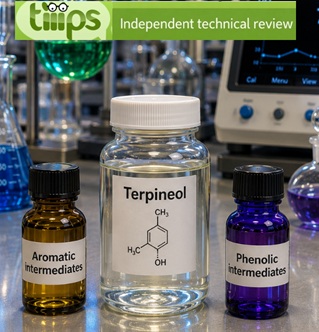
Terpineol
Rating : 5
| Evaluation | N. Experts | Evaluation | N. Experts |
|---|---|---|---|
| 1 | 6 | ||
| 2 | 7 | ||
| 3 | 8 | ||
| 4 | 9 | ||
| 5 | 10 |
Cons:
Cosmetics Regulation provisions (1)0 pts from admin
| Sign up to vote this object, vote his reviews and to contribute to Tiiips.Evaluate | Where is this found? |
| "Descrizione" about Terpineol by admin (19570 pt) | 2026-Jul-19 18:17 |
| Read the full Tiiip | (Send your comment) |
Terpineol: properties, uses, pros, cons, safety
Terpineol is a monoterpene alcohol with the molecular formula C10H18O and a molecular weight of about 154.25 g/mol. In practice, the term “Terpineol” may indicate a mixture of isomers, including mainly α-terpineol, but also β-terpineol and γ-terpineol. It is a natural or synthetic odorant, characterized by a floral, lilac, pine-like, fresh and slightly citrusy olfactory profile, widely used in perfumery, cosmetics, detergency and, in the food sector, as a flavouring agent.
In cosmetics, the most important aspect is regulatory: Terpineol is now included in Annex III of the European Cosmetics Regulation as a fragrance allergen to be declared on the label when it exceeds 0.001% in leave-on products and 0.01% in rinse-off products. Terpineol must also be distinguished from the related entry Terpineol Acetate / Terpinyl Acetate, which has its own chemical identity and a separate CosIng entry.

Description
Terpineol belongs to the family of oxygenated terpenes, more precisely cyclic monoterpene alcohols. It occurs naturally in several essential oils, including pine, cajeput, tea tree, eucalyptus, lavender, cardamom and other aromatic essences. It can also be obtained synthetically or by transformation of other terpenes, particularly from intermediates such as α-pinene, limonene or hydrated terpine compounds.
From a formulation standpoint, it is used mainly for its perfuming and masking functions. It can contribute a fresh, floral or resinous note, or cover less pleasant technical odors from surfactants, fatty bases or other ingredients. It is not a cosmetic “active” in the dermatological sense, but a functional substance from a sensory/olfactory perspective.
The INCI entry TERPINEOL should not be confused with TERPINEOL ACETATE or TERPINYL ACETATE. The former is a monoterpene alcohol; the latter is an acetic ester of terpineol, with the formula C12H20O2, also used as a fragrance ingredient. In cosmetic assessment, it is therefore important to read both CosIng entries when the fragrance composition may contain both Terpineol and Terpineol Acetate.
Production process
Terpineol can be obtained from natural sources or by synthesis. The natural route consists of isolation from essential oils rich in terpene fractions, followed by fractional distillation, purification and standardization. In this case, the final profile may contain a mixture of isomers and small amounts of other terpenes, depending on the starting essential oil.
The most common industrial route starts from α-pinene or other monoterpenes obtained from turpentine, pine oils or terpene fractions. Through hydration, rearrangement and purification, mixtures more or less rich in α-terpineol are obtained. Commercial quality may vary greatly: some grades are mixtures of isomers, while others are enriched in α-terpineol.
Terpineol Acetate / Terpinyl Acetate is instead obtained by acetylation of Terpineol, generally with acetic anhydride or other acetylating systems, producing a sweeter, lavender-like, citrusy or herbaceous ester used mainly in perfumery. This ingredient must be assessed separately from Terpineol.
Main compounds present
In the commercial grade called Terpineol, several isomers may be present:
α-terpineol, normally the most important commercially;
β-terpineol;
γ-terpineol;
δ-terpineol, in smaller amounts in some mixtures;
traces of other monoterpenes or terpene compounds, depending on origin and process.
In Terpineol intended for food use, the EU flavourings sheet reports a typical composition as the sum of isomers, with a predominant contribution from α-terpineol and smaller amounts of γ, β cis/trans and δ. This confirms that the term Terpineol, in many practical contexts, identifies a technical mixture of isomers and not a perfectly mono-isomeric single substance.
Identification data and specifications
| Characteristic | Value | Note |
|---|---|---|
| INCI name | Terpineol | cosmetic designation |
| Chemical category | cyclic monoterpene alcohol | oxygenated terpene |
| Molecular formula | C10H18O | common to the main isomers |
| Molecular weight | about 154.25 g/mol | theoretical value |
| Mixture CAS | 8000-41-7 | Terpineol, mixture of isomers |
| Mixture EC | 232-268-1 | mixture reference |
| α-terpineol CAS | 98-55-5 | p-Menth-1-en-8-ol |
| β-terpineol CAS | 138-87-4 | isomer |
| γ-terpineol CAS | 586-81-2 | isomer |
| Cosmetic functions | masking, perfuming | according to CosIng |
| Main EU restriction | Annex III, entry 343 | fragrance allergen to be declared above threshold |
| Leave-on threshold | 0.001% | labeling obligation above threshold |
| Rinse-off threshold | 0.01% | labeling obligation above threshold |
| Food use | flavouring agent | mainly α-terpineol / Terpineol as flavouring |
| Related Terpineol Acetate | CAS 8007-35-0 / α-terpinyl acetate CAS 80-26-2 | separate ingredient, not to be confused with Terpineol |
Indicative physicochemical properties
| Characteristic | Indicative value | Note |
|---|---|---|
| Appearance | viscous liquid or oily liquid | may vary depending on isomer and purity |
| Color | colorless or very pale yellow | typical of purified grades |
| Odor | floral, lilac, pine-like, fresh | depends on isomeric composition |
| Water solubility | low / limited | typical of oxygenated monoterpenes |
| Solubility in alcohol | good | useful in perfumery and flavours |
| Density | about 0.93 g/cm³ | indicative value |
| Boiling point | about 213-219 °C | varies according to isomer and source |
| Flash point | about 88-89 °C | relevant for handling |
| Log P | about 2.9 | moderate lipophilicity |
| Formulation status | fragrance/flavour ingredient | normally used at low doses |
Food
In the food sector, Terpineol is relevant as a flavouring substance, not as a nutrient. α-terpineol is recognized by JECFA as a flavouring agent, with JECFA No. 366 and FEMA No. 3045. Its function is to provide or modulate fresh, herbaceous, floral, minty or resinous aromatic notes.
In the European Food and Feed Information Portal, Terpineol appears as a flavouring composed of a sum of isomers, with relative contributions of α, γ, cis-β, trans-β and δ-terpineol. This is important because it confirms that Terpineol used as a flavouring is not always a single isolated molecule, but may be a defined mixture of isomers.
From a nutritional standpoint, Terpineol does not provide direct food benefits. Its value is essentially sensory. As with other flavourings, safety of use depends on purity, dosage, food-grade specification, regulatory compliance and the amount actually consumed.
Cosmetics
In cosmetics, Terpineol is used mainly as a perfuming and masking ingredient. It may be included in perfumes, eau de toilette, cleansers, soaps, shampoos, conditioners, deodorants, creams, body products, hair products and formulas where a fresh/floral note or correction of base odor is needed.
The cosmetic functions reported for TERPINEOL are masking and perfuming. The masking function indicates the ability to reduce or cover the base odor of the product; the perfuming function indicates contribution to the fragrance of the cosmetic.
The central cosmetic restriction concerns labeling as a fragrance allergen. Regulation (EU) 2023/1545 introduced or updated the obligation to declare numerous fragrance allergens in the ingredient list. For Terpineol, Annex III entry 343, its presence must be indicated in the ingredient list when concentration exceeds:
0.001% in leave-on products;
0.01% in rinse-off products.
As of July 19, 2026, the sector is still within the transitional period preceding the first deadline of July 31, 2026 for placing on the market products not yet adapted to the new restrictions; making such products available on the market is allowed until July 31, 2028 for products already placed on the market under the transitional conditions.
For Terpineol Acetate / Terpinyl Acetate, the separate CosIng entry indicated by the supplier or database must be considered. It is not correct to automatically add it to Terpineol unless the regulation expressly requires this, but it is correct to verify it in the fragrance allergen documentation, SDS and IFRA/regulatory declaration from the supplier.
Pros
It has a pleasant, fresh, floral, lilac-like and slightly resinous olfactory profile.
It is useful as a perfuming ingredient in cosmetics, detergents, hair products and personal care.
It can perform a masking function by covering unpleasant technical odors in the formula.
It occurs naturally in several essential oils, although it can also be produced synthetically.
It is also used as a food flavouring, so it has broad applied interest.
The mixture of isomers allows different olfactory nuances depending on the commercial grade.
EU regulation is now clear: above certain thresholds, it must be declared on the label as a fragrance allergen.
Cons
It is not a nutritional food ingredient: its role in food is only aromatic.
In cosmetics it is a fragrance allergen to be declared above threshold.
It may cause problems in sensitized individuals or in those predisposed to allergic contact dermatitis.
Quality varies greatly according to origin, purity, isomeric profile and presence of other terpenes.
Being lipophilic and poorly soluble in water, it requires correct solubilization in the formula.
Like many terpene substances, oxidative stability and storage quality must be controlled.
It must not be confused with Terpineol Acetate / Terpinyl Acetate, which is a distinct ester with its own identity and documentation.
Safety, regulatory aspects and environment
From a cosmetic standpoint, Terpineol should not be assessed only as a pleasant fragrance substance, but also as a potential fragrance allergen. The main risk in the finished cosmetic concerns sensitized subjects, leave-on products applied to large areas, frequently used products and formulas with multiple fragrance components that may contribute to overall exposure.
European regulation does not prohibit Terpineol in cosmetics, but requires its specific indication on the label when it exceeds the established thresholds. This is essential for transparency toward allergic or sensitized consumers. The relevant entry is Annex III, No. 343, with thresholds of 0.001% leave-on and 0.01% rinse-off.
From the standpoint of the concentrated raw material, some SDS documents report classifications such as skin irritant and eye irritant. This mainly concerns industrial handling and should not be automatically transferred to the finished cosmetic at low concentration, but it still requires formulation attention, good solubilization and proper assessment of the finished product.
For Terpineol Acetate / Terpinyl Acetate, caution means not treating it as a simple synonym of Terpineol. It is a related substance, often present in essential oils and fragrances, but with a different formula and behavior. In a professional cosmetic dossier, it is advisable to verify separately:
CosIng entry for Terpineol;
CosIng entry for Terpineol Acetate;
fragrance allergen declaration;
IFRA certificate;
SDS;
concentration in the finished product;
possible indirect presence from essential oils or fragrance compounds.
From an environmental standpoint, Terpineol is a relatively small, volatile molecule of natural or synthetic origin. The real assessment depends on production process, purity, final use, amount released and biodegradability of the system. In rinse-off products, it is prudent to assess the impact of the fragrance fraction in wastewater discharge, while in leave-on products the main issue is skin exposure and allergen labeling.
Conclusion
Terpineol is an ingredient of mainly sensory interest, used as a perfuming, masking and, in food, flavouring substance. Its fresh, floral and resinous olfactory profile makes it useful in perfumes, detergents, cosmetics, hair products and aromatic compositions.
Professional assessment, however, must be cautious. The most important point today is not its olfactory performance, but correct regulatory management: Terpineol is included in Annex III as a fragrance allergen to be declared above 0.001% in leave-on products and 0.01% in rinse-off products. In addition, when Terpineol Acetate / Terpinyl Acetate is also present in the formula or fragrance, it must be checked as a distinct entry, without confusing the alcohol and the ester.
In a well-designed formula and with complete supplier documentation, Terpineol can be a useful and functional ingredient. The points to control are isomeric profile, purity, stability, oxidation, solubilization, actual concentration in the finished product, allergen declaration and compliance with European cosmetic restrictions.
| Sign up to vote this object, vote his reviews and to contribute to Tiiips.EvaluateClose | (0 comments) |
Read other Tiiips about this object in __Italiano (1)
Component type:   Chemical Main substances:   Last update:   2026-07-19 18:10:13 | Chemical Risk:   |

