

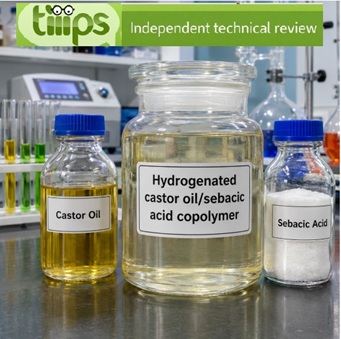
Hydrogenated castor oil/sebacic acid copolymer
Rating : 7
| Evaluation | N. Experts | Evaluation | N. Experts |
|---|---|---|---|
| 1 | 6 | ||
| 2 | 7 | ||
| 3 | 8 | ||
| 4 | 9 | ||
| 5 | 10 |
0 pts from admin
| Sign up to vote this object, vote his reviews and to contribute to Tiiips.Evaluate | Where is this found? |
| "Descrizione" about Hydrogenated castor oil/sebacic acid copolymer by admin (19570 pt) | 2026-Jul-19 08:03 |
| Read the full Tiiip | (Send your comment) |
Hydrogenated castor oil/sebacic acid copolymer: properties, uses, pros, cons, safety
Hydrogenated Castor Oil/Sebacic Acid Copolymer is a cosmetic copolymer obtained from the reaction between hydrogenated castor oil and sebacic acid. It is not a single molecule with a fixed formula, but a polymeric/oligomeric material derived from lipid and dicarboxylic components. In cosmetics it is used mainly as an emollient, hair conditioning agent, and skin conditioning agent. In some commercial grades it is also promoted as a film-former, adhesive polymer, oil rheology modifier, and ingredient useful for increasing water resistance, make-up wear, and sensoriality.
Description
This is a technical-cosmetic raw material, not a food ingredient. The base derives from hydrogenated castor oil, namely castor oil treated with hydrogen to make the lipid fraction more saturated and stable, and from sebacic acid, a dicarboxylic acid with 10 carbon atoms. The combination of these two components generates a lipophilic copolymer with good affinity for oils, waxes, pigments, and keratin surfaces.
Its main function is to improve softness, adhesion, surface film, spreadability, wear, and sensory comfort. In hair products it can help make the fiber feel smoother and easier to comb; in make-up and sunscreen products it can help improve pigment distribution, transfer resistance, and formula durability.

Production process
Industrially, the material is obtained by reacting hydrogenated castor oil with sebacic acid. Hydrogenated castor oil derives from the hydrogenation of castor oil, originally rich in ricinoleic acid. Hydrogenation transforms the unsaturated fraction into a more saturated, waxy, and stable structure, in which the characteristic component is linked to derivatives of 12-hydroxystearic acid.
Sebacic acid, on the other hand, can be industrially obtained from supply chains linked to castor oil, through cleavage/transformation processes of ricinoleic acid. This makes it possible, in some commercial grades, to position the ingredient as largely bio-based or naturally derived according to specific certification criteria.
After the copolymerization/esterification reaction, the usual steps include purification, standardization, control of viscosity or consistency, verification of compatibility with oils and waxes, and preparation of the commercial grade in the form of flakes, paste, adhesive polymer, or rheology modifier.
Main compounds present
In the commercial grade, the main component is the copolymer of hydrogenated castor oil and sebacic acid. Since this is a polymeric material, chains of different length, different degrees of esterification, minimal residues of unreacted raw materials, hydrogenated lipid fractions, and minor process-related components may be present.
It is important to distinguish between the INCI name HYDROGENATED CASTOR OIL/SEBACIC ACID COPOLYMER and the individual starting ingredients. Hydrogenated castor oil and sebacic acid have their own properties, but the final copolymer has a different formulation behavior: more oriented toward film, adhesion, structure, emollience, and conditioning.
Identification data and specifications
| Characteristic | Value | Note |
|---|---|---|
| INCI name | Hydrogenated Castor Oil/Sebacic Acid Copolymer | cosmetic designation |
| Chemical category | copolymer / lipid oligoester | from hydrogenated castor oil and sebacic acid |
| CosIng description | copolymer formed by the reaction of Hydrogenated Castor Oil with Sebacic Acid | EU cosmetic reference |
| CosIng Ref No. | 56628 | reference reported in cosmetic databases |
| CAS | not uniquely reported in the main public INCI sheets consulted | to be verified on the supplier SDS |
| Molecular formula | not applicable as a single formula | polymeric material |
| Molecular weight | variable | depends on commercial grade |
| Cosmetic functions | emollient, hair conditioning, skin conditioning | commonly reported functions |
| Additional technical functions | film forming, adhesive polymer, oil rheology modifier | depends on commercial grade |
| Technical origin | semi-synthetic / bio-based in some grades | from castor-related raw materials |
| Food use | not relevant | not a common food additive |
Indicative physicochemical properties
| Characteristic | Indicative value | Note |
|---|---|---|
| Appearance | flakes, paste, waxy solid, or viscous material | depends on commercial grade |
| Color | white, cream, or slightly brownish | varies by supplier and grade |
| Odor | mild or almost absent | important for make-up and skin care |
| Water solubility | insoluble | lipophilic/polymeric behavior |
| Oil compatibility | good | useful in anhydrous systems, make-up, and sunscreens |
| Processing temperature | about 75-80 °C in some commercial grades | data from specific technical sheets |
| Typical dosage | about 1-5% for some commercial film-formers | depends on the required function |
| Formulation effect | film, adhesion, conditioning, structure | varies with formula and oil phase |
| Stability | good under normal cosmetic conditions | to be verified with heat, oils, and packaging |
| Sensory profile | soft, silky, smoothing | especially in skin care, hair care, and make-up |
Food
Hydrogenated Castor Oil/Sebacic Acid Copolymer has no relevant food role. It is not a nutrient, not a flavouring, and should not be confused with food ingredients derived from vegetable oils. Even though the starting raw materials may have vegetable or bio-based origin, the final copolymer is a technical ingredient intended mainly for cosmetics and personal care.
For food assessment, therefore, the judgment is straightforward: the food focus is not relevant. Its interest is formulation-related, not nutritional.
Cosmetics
In cosmetics, the ingredient is used as an emollient, hair conditioner, and skin conditioner. In hair products it can help improve the feeling of smoother, softer, and more manageable hair fiber, especially when the hair is damaged by treatments, coloring, heat, or mechanical stress.
In make-up, lip care, and sun care products it can contribute to the formation of a more uniform film, better pigment adhesion, longer formula wear, and reduced transfer. Some commercial grades are promoted as naturally derived/bio-based film-formers, useful as alternatives to petrochemical polymers in make-up, sunscreen, and hair care formulas.
In anhydrous or oil-based systems it can also act as a rheology modifier, helping to structure oils, stabilize dispersions, suspend pigments or fillers, and improve the final texture. Performance, however, depends greatly on the type of oil, processing temperature, percentage used, and compatibility with waxes, esters, pigments, and UV filters.
Pros
It is an emollient and conditioning ingredient useful for skin and hair.
It can improve the feeling of softness, smoothness, and spreadability.
In hair products it can help make the fiber smoother and easier to comb.
In make-up and sunscreens it can contribute to film, wear, transfer resistance, and better pigment distribution.
Some commercial grades are promoted as bio-based or naturally derived alternatives to synthetic film-formers.
It can be useful in oil-based systems as a rheology modifier or structuring agent.
It is not a fragrance allergen and has no perfuming function.
Cons
It is not a food ingredient and has no nutritional value.
It is not a dermatological cosmetic active: its function is mainly technical-sensory.
Since it is a copolymer, molecular formula and molecular weight are not unique.
Properties vary greatly according to commercial grade, origin, purity, polymeric structure, and supplier specification.
It may require relatively high processing temperatures to be dispersed or incorporated correctly.
In poorly balanced formulas it may give excessive structure, heaviness, or a film-forming feel.
Claims such as “natural”, “bio-based”, or “biodegradable” must be verified in the documentation of the individual supplier, not automatically inferred from the INCI name.
Safety, regulatory aspects, and environment
From a cosmetic standpoint, Hydrogenated Castor Oil/Sebacic Acid Copolymer is generally considered a low-concern ingredient when used in suitable cosmetic grades and under normal conditions of use. Its function is mainly superficial: it forms or contributes to a film, improves texture, and provides an emollient/conditioning effect.
No specific European cosmetic restrictions comparable to those for preservatives or fragrance allergens appear to apply. However, safety should not be assessed only from the INCI name: the finished product, concentration, type of application, area of use, possible impurities, solvent system, and the presence of pigments, UV filters, fragrances, or other potentially irritating ingredients must all be considered.
As a concentrated raw material, handling must follow the supplier SDS. Some commercial SDS documents indicate that the material is not classified as hazardous under CLP, but this information cannot be generalized to all grades without verifying the specific documentation.
From an environmental standpoint, the profile depends on the supply chain. The presence of castor-derived components is a favorable element for some bio-based grades; however, real environmental behavior depends on polymeric structure, declared and tested biodegradability, production process, transport, final use, and product fate. In rinse-off products it is prudent to evaluate the contribution of the film-former to wastewater discharge, while in leave-on and make-up products the main issues are more related to persistence, disposal, and raw material origin.
Conclusion
Hydrogenated Castor Oil/Sebacic Acid Copolymer is a modern cosmetic ingredient, useful mainly for emollience, conditioning, film, adhesion, texture, and wear. Its main interest concerns hair products, make-up, sunscreens, lip care, and oil-based or anhydrous systems where sensory and physical formula performance must be improved.
Its profile is generally favorable when the commercial grade is well chosen and correctly formulated. The key points are: distinguishing the copolymer from the individual starting ingredients, verifying the supplier specification, not automatically attributing “natural” or “biodegradable” properties to all grades, checking compatibility with oils/pigments/filters, and always assessing safety on the finished product.
| Sign up to vote this object, vote his reviews and to contribute to Tiiips.EvaluateClose | (0 comments) |
Read other Tiiips about this object in __Italiano (1)
Component type:   Natural Main substances:  
Last update:   2026-07-19 07:57:44 | Chemical Risk:   |

