Cellulose acetate: properties, uses, pros, cons, safety
Cellulose acetate is a semi-synthetic polymer obtained by chemically modifying cellulose through acetylation. In cosmetics it appears under the INCI name CELLULOSE ACETATE. From a chemical standpoint, it is not a single molecule with a fixed formula, but a family of cellulose esters in which part of the hydroxyl groups of cellulose is replaced by acetyl groups.:the commonly reported CAS number is 9004-35-7.

Description
This is a raw material of cellulosic origin, therefore derived from a plant matrix such as wood pulp or cotton linters, but chemically transformed. For this reason it is often described as semi-synthetic: the base is natural, but the final properties derive from an industrial acetylation reaction.
Cellulose acetate is important in many sectors: cosmetics, packaging, technical films, membranes, textile fibers, eyeglass frames, coatings, filters, and plastic materials. In cosmetics it is valued mainly as a film-forming agent, meaning a substance capable of forming a thin film on skin, hair, or nails. It can also contribute to texture, opacity, make-up hold, soft-focus effect, and the cohesion of powders or pigments.
Production process
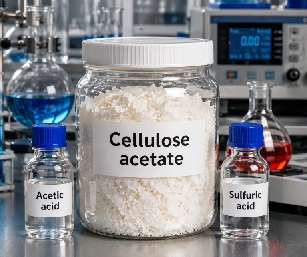
Industrially, cellulose acetate is produced starting from purified cellulose, generally obtained from wood or cotton. The cellulose is first activated and then reacted with acetic anhydride, often in the presence of acetic acid and an acid catalyst, traditionally sulfuric acid. The reaction replaces part of the cellulose -OH groups with acetyl groups.
The most important parameter is the degree of substitution, meaning the average number of acetylated hydroxyl groups for each anhydroglucose unit of cellulose. Since each cellulose unit has three available -OH groups, the degree of substitution can theoretically vary from 0 to 3. When substitution is very high, the material is often referred to as cellulose triacetate, while more common grades may have an intermediate degree of substitution and different properties.
After the reaction, the usual steps include controlled hydrolysis, neutralization, washing, precipitation, purification, drying, and milling or granulation. The final properties depend greatly on the degree of acetylation, molecular weight, chain distribution, presence of plasticizers, and type of application.
Main compounds present
In the pure grade, the main component is cellulose acetate, meaning partially or highly acetylated cellulose. Commercial grades may contain small amounts of incompletely acetylated cellulose, acetate with different degrees of substitution, traces of acetic acid, residual moisture, plasticizers, or technical additives, depending on the intended use.
In cosmetic applications, the material must be distinguished from industrial grades used for plastics, filters, or technical films. The INCI name identifies the ingredient, but actual quality depends on the supplier specification, particle size, purity, solubility, solvent compatibility, and the function required in the formula.
Identification data and specifications
| Characteristic | Value | Note |
|---|
| Common name | Cellulose acetate | common designation |
| INCI name | Cellulose Acetate | cosmetic designation |
| Chemical category | acetylated cellulose ester | semi-synthetic polymer |
| General formula | [C6H7O2(OH)3-x(OCOCH3)x]n | x depends on degree of substitution |
| CAS | 9004-35-7 | most common reference |
| Origin | chemically modified vegetable origin | from wood or cotton cellulose |
| Main cosmetic function | film forming | forms a film on skin, hair, or nails |
| Other cosmetic functions | texturizing, opacifying, binding, mild abrasive | depends on form and grade |
| Food use | non-nutritional | more relevant as a technical/food-contact material |
| Commercial form | powder, granules, fibers, film, or processed plastic | depends on application sector |
Indicative physicochemical properties
| Characteristic | Indicative value | Note |
|---|
| Appearance | powder, granules, fibers, or film | depends on commercial grade |
| Color | white or off-white | in purified grades |
| Odor | slight or absent | acetic odor may indicate degradation or residues |
| Water solubility | insoluble | typical of acetylated grades |
| Solubility in organic solvents | variable; good in some solvents such as acetone for certain grades | depends on degree of acetylation |
| Chemical nature | non-ionic polymer | esterified cellulose derivative |
| Film-forming capacity | high | useful in make-up, nail products, hair styling, and coatings |
| Thermoplasticity | present in many grades | often requires plasticizers |
| Stability | good under normal conditions | sensitive to hydrolysis under unfavorable conditions |
| Typical degradation | release of acetic acid through hydrolysis/deacetylation | known as “vinegar syndrome” |
Food
Cellulose acetate is not a nutritional food ingredient and should not be confused with cellulose E460 or with other cellulose derivatives used as food additives. Its food-related interest concerns mainly food-contact materials, coatings, films, and some technical applications, not direct consumption as an ingredient.
In some regulatory frameworks, such as the United States, cellulose acetate appears in inventories related to food-contact substances or specific regulations. In Europe, practical assessment should instead be based on food contact materials legislation, therefore suitability of the material, overall migration, any specific limits, declaration of compliance, and good manufacturing practice.
From a nutritional standpoint, the judgment is straightforward: it does not provide nutrients and has no health-promoting role as a food. Its possible interest in the food sector is technological, as a material or support, not as an ingredient to be promoted.
Cosmetics
In cosmetics, cellulose acetate is used mainly as a film-forming agent. Its film-forming function allows it to create a thin continuous layer on skin, hair, or nails. This can improve product hold, pigment distribution, transfer resistance, and surface feel.
It is particularly useful in mascara, foundations, sunscreens, make-up products, nail polishes, nail products, hair styling, pressed powders, soft-focus textures, and products where a more uniform or matte effect is desired. In some particulate forms, it can also contribute as a bulking agent, opacifier, binder, or mild abrasive.
It is not a cosmetic active in the dermatological sense: it does not nourish the skin and does not perform a deep biological function. Its value is mainly technical-formulation-related, because it improves film, texture, adhesion, physical stability, and sensory performance.
Pros
It is a film-forming ingredient useful for improving hold, uniformity, and cosmetic wear.
It derives from a vegetable cellulose base, although it is chemically modified.
It can improve texture, matte effect, soft-focus appearance, and cohesion of pigments or powders.
It is insoluble in water, a useful property in formulas requiring greater surface resistance.
In cosmetics it can be useful in make-up, sunscreens, nail products, and hair styling.
It is generally low-reactive and is not among common fragrance allergens.
It can replace some solid microplastics in applications where particles or film-forming materials of modified cellulosic origin are needed.
Cons
It is not a food ingredient and has no nutritional value.
It is not a cosmetic active: its function is mainly technical and sensory.
Quality and formulation behavior vary greatly depending on degree of acetylation, molecular weight, and commercial form.
It may require specific solvents or formulation systems to be dispersed or solubilized correctly.
Not all grades are equivalent: cosmetic, industrial, textile, plastic, and food-contact grades have different specifications.
Biodegradability should not be taken for granted: acetylation makes cellulose less immediately degradable than unmodified cellulose.
In historical materials or old films, it may degrade by releasing acetic acid, a phenomenon known as “vinegar syndrome”.
Safety, regulatory aspects, and environment
From a cosmetic standpoint, cellulose acetate is generally considered a low-concern ingredient when used in suitable cosmetic grades and under normal conditions of use. Its main function is superficial: it forms a film and contributes to texture, with no significant skin penetration expected for the polymer. However, safety must always be assessed on the finished product, especially if the formula contains solvents, plasticizers, pigments, UV filters, or other potentially irritating components.
From a food standpoint, the key point is not to confuse cellulose acetate with food-grade cellulose or other authorized derivatives used as additives. When used in materials intended for food contact, safety depends on material compliance, migration, additives present, and conditions of use: type of food, temperature, contact duration, and exposed surface.
From an environmental standpoint, cellulose acetate is more complex than it may seem. Starting from plant cellulose is a favorable element, but acetylation modifies biodegradability. Degradation often requires an initial deacetylation or hydrolysis step, after which the cellulose backbone can be more easily degraded. This explains why some cellulose acetate products, such as cigarette filters, fibers, or films, may persist in the environment much longer than natural cellulose.
For a correct assessment, therefore, it is not enough to say “derived from cellulose”: one must consider degree of substitution, physical form, presence of plasticizers, particle size, intended use, disposal conditions, and real environmental behavior.
Conclusion
Cellulose acetate is a versatile material, halfway between a modified natural polymer and a semi-synthetic technical plastic. In cosmetics it is useful mainly as a film-forming agent, texturizer, opacifier, and support for pigments or powders. In technical fields it is important for films, fibers, membranes, coatings, packaging, molded objects, and plastic materials.
Its profile is generally favorable when used as a cosmetic ingredient or as a technical material compliant with its intended use. However, assessment must be precise: it is not a nutritional food ingredient, it is not a cosmetic active, and it should not automatically be described as “readily biodegradable” simply because it derives from cellulose. The key points are degree of acetylation, purity, commercial form, formulation compatibility, regulatory compliance, and environmental behavior of the finished product.



 Cellulose acetate