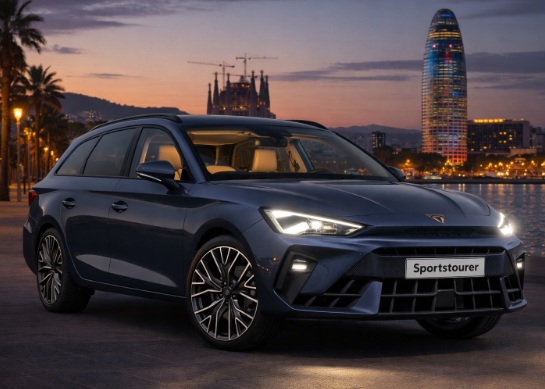
Cupra Leon Sportstourer
Country of production
The Cupra Leon Sportstourer is produced in Spain, at SEAT S.A.’s Martorell plant (Barcelona). It represents the sporty station wagon derivative of the Cupra Leon range, with a focus on performance and cargo capacity.
Model market launch
February 2021: official presentation of the Cupra Leon Sportstourer.
Spring 2021: start of production and order books opened in major European markets.
Summer 2021: start of deliveries in Europe
April 2024: presentation of the mid-cycle refresh (Model Year 2024/2025).
2024–2025: full commercialization of the updated version, with revisions to design, infotainment, and engine lineup.

Facelift and main updates
2024 facelift: new front-end design with updated Cupra styling language, triangular light signature, and illuminated Cupra logo at the rear.
Interior and infotainment: improvements to perceived quality, more stable software, and updated central display.
Revised engine lineup: range rationalization, stronger focus on e-HYBRID, and confirmation of high-performance VZ variants.
Chassis and driver assistance: refinements to adaptive suspension (DCC) and updated ADAS systems aligned with the latest regulations.
The Cupra Leon Sportstourer is a sporty C-segment station wagon, designed for drivers who want high performance without giving up space and versatility. Compared with the standard Leon, it offers a larger trunk and better everyday usability, while retaining a dynamic driving setup and a strongly sporty identity. The lineup includes gasoline, plug-in hybrid, and high-performance VZ versions, including all-wheel drive on the most powerful variants.
Powertrains and performance
| Feature | 1.5 TSI 150 | 1.5 e-HYBRID 204 | 1.5 e-HYBRID VZ 272 | 2.0 TSI 265 VZ | 2.0 TSI 333 VZ 4Drive |
|---|
| Engine / layout | 1.5 turbo gasoline, FWD | PHEV, FWD | PHEV, FWD | 2.0 turbo gasoline, FWD | 2.0 turbo gasoline, AWD |
| Power | 150 hp | 204 hp | 272 hp | 265 hp | 333 hp |
| Max torque | 250 Nm | 350 Nm (system) | 400 Nm (system) | 370 Nm | 420 Nm |
| 0–100 km/h | ~8.7 s | ~7.7 s | ~7.0 s | ~6.3 s | ~4.9 s |
| Top speed | ~215 km/h | ~220 km/h | ~225 km/h | 250 km/h | 250 km/h |
| Battery / electric range | — | ~19.7 kWh / up to ~120 km WLTP* | ~19.7 kWh / up to ~120 km WLTP* | — | — |
| Charging (PHEV) | — | AC + DC up to 50 kW (where available) | AC + DC up to 50 kW (where available) | — | — |
* Indicative values, subject to change depending on version, homologation, and real-world conditions.
Dimensions and capacity
| Specification | Value |
|---|
| Length | 4,657 mm |
| Width (excluding mirrors) | 1,799 mm |
| Height | 1,444 mm |
| Wheelbase | 2,686 mm |
| Trunk | 620 L (up to ~1,600 L with rear seats folded, depending on version) |
Main trims and prices
(Indicative list prices; they may vary due to promotions, options, and registration costs.)
| Version | From (€) |
|---|
| Leon Sportstourer 1.5 TSI 150 | ~38,000 |
| Leon Sportstourer e-HYBRID 204 | ~45,000 |
| Leon Sportstourer e-HYBRID VZ 272 | ~50,000 |
| Leon Sportstourer VZ 2.0 TSI 265 | ~52,500 |
| Leon Sportstourer VZ 2.0 TSI 333 4Drive | ~57,000 |
Practical note: e-HYBRID versions often have variable range structures and incentives; it is advisable to check the latest price list at the time of purchase.
Maintenance and early servicing (indicative costs)
(Estimates for sporty/premium station wagons; significant variability depending on dealer network and usage.)
| Service item | Average cost (€) |
|---|
| Annual service / 15–30,000 km (gasoline) | 300–550 |
| Annual service (e-HYBRID) | 350–650 |
| Brake fluid | 90–180 |
| Cabin filter | 60–140 |
| Front brake pads | 260–540 |
| Front discs + pads | 780–1,450 |
| Tire (each, 18"–20") | 180–380 |
| 12 V battery | 140–260 |
Pros
Excellent space and practicality versus the Leon hatchback (benchmark trunk capacity).
High performance in VZ versions, with all-wheel drive availability.
Distinctive Cupra design, further reinforced by the 2024 facelift.
Improved e-HYBRID: high electric range and DC charging capability (where available).
Cons
Pricing and options: well-equipped configurations can become expensive.
Weight of PHEV and VZ versions, affecting consumption and tire wear.
Firm ride on larger wheels, less oriented toward pure comfort.
Real-world PHEV efficiency depends heavily on daily use and frequent charging.
In summary
The Cupra Leon Sportstourer is one of the few sporty station wagons that genuinely combines class-leading cargo capacity with high-end performance. The 2024 facelift strengthened the model’s identity and improved technology and powertrains, making e-HYBRID versions more convincing in everyday use. It is an ideal choice for those who want a family car without sacrificing character, driving dynamics, and sporty image.
Verdict — Cupra Leon Sportstourer (2026 range)
The Cupra Leon Sportstourer is the most practical choice for anyone who wants a sporty-looking, driver-oriented station wagon without accepting the usual compromises of performance cars in terms of space and everyday versatility. Compared with the 5-door, the Sportstourer adds what matters most in real use: a large boot, stronger “one-car” usability, and a line-up that now covers both the rational purchase (150 hp petrol, 150 hp diesel, 150 hp mild-hybrid) and the more performance/electrified one (e-Hybrid 204/272 and the VZ 333 4Drive).
The key decision at purchase is choosing your priority: range and running costs (TSI/TDI/mild-hybrid), daily EV use (e-Hybrid), or performance and all-wheel drive (VZ 333). The Sportstourer is often the most sensible Leon because it stays “sporty” while remaining a true family estate.
Key technical points
Engine range (Sportstourer 5-door)
Petrol: 1.5 TSI 150 hp (manual), 2.0 TSI 204 hp 4Drive DSG, 2.0 TSI 333 hp 4Drive DSG (VZ)
Diesel: 2.0 TDI DSG 150 hp
Mild-hybrid: 1.5 Hybrid DSG 150 hp
Plug-in hybrid (e-Hybrid): 1.5 e-Hybrid DSG 204 hp and 272 hp
Indicative performance (claimed)
1.5 TSI 150 hp: 0–100 km/h in 9.2 s, top speed 216 km/h
2.0 TDI DSG 150 hp: 0–100 km/h in 8.7 s, top speed 214 km/h
1.5 Hybrid DSG 150 hp: 0–100 km/h in 9.0 s, top speed 216 km/h
2.0 TSI 4Drive DSG 204 hp: 0–100 km/h in 6.7 s, top speed 233 km/h
1.5 e-Hybrid DSG 204 hp: 0–100 km/h in 7.9 s, top speed 220 km/h
1.5 e-Hybrid DSG 272 hp: 0–100 km/h in 7.3 s, top speed 229 km/h
2.0 TSI 4Drive DSG 333 hp (VZ): 0–100 km/h in 4.8 s, top speed 250 km/h
Plug-in hybrid: where it makes the difference
19.7 kWh battery and claimed WLTP electric range:
Charging: AC up to 11 kW (0–100% in about 2 h 30 min) and DC up to 50 kW (10–80% in about 26 min in favourable conditions).
Practical impact: the boot drops from 620 L (ICE/mild-hybrid/diesel) to 470 L on e-Hybrid versions, because the battery changes the packaging of the load area.
Dimensions and cabin space
Estate-sized “large C-segment” footprint: 4,656 mm long, 1,799 mm wide, height around 1,438–1,441 mm (depending on version).
Very good cabin room for four adults; the fifth seat remains a compromise for long trips (typical for the segment).
Boot: the Sportstourer’s main strength:
Technology and daily usability
Facelift: updated infotainment with a 12.9" screen, broader connectivity and a more modern interface.
ADAS: a strong feature set but often package-dependent; it is worth prioritising what genuinely improves long-distance driving (advanced adaptive cruise, full lane support, advanced headlights where available).
Everyday use: this is the Leon that best withstands real life (pushchairs, luggage, long items) while keeping a tighter, sportier driving flavour than the segment average.
Market: launch and mid-cycle update
Market introduction: the Cupra Leon arrived commercially in Europe in autumn 2020, including the Sportstourer body style from the outset.
Facelift/mid-cycle update: facelift orders opened in June 2024, with updates to design and infotainment (12.9") and a strengthened/streamlined e-Hybrid offer.
2026 range status: “Model Year 2026” price list with validity 15.11.2025 for prices and specifications.
| Category | Where it shines | Where it holds up | Where it falls short |
|---|
| Design & image | Distinctive Cupra styling with a more “premium” vibe | Convincing sporty ambience | Polarising look: not “neutral” |
| Comfort & space | Excellent one-car usability | Good for four adults | Big wheels can make it firmer on rough roads |
| Efficiency & consumption | TDI is strong for high mileage; e-Hybrid is efficient if you charge | Mild-hybrid makes sense in town | VZ 333: consumption and tyres rise quickly |
| Driving dynamics | Chassis/steering more driver-oriented than average | Well-balanced in mixed use | Estate mass and compromises remain |
| Practicality | 620 L boot on ICE versions | Cabin is well packaged | e-Hybrid drops to 470 L |
| Infotainment & connectivity | 12.9" screen and more modern system | Full smartphone integration | Fewer physical buttons: not everyone likes it |
| Safety & ADAS | Comprehensive, configurable packages | Helpful assists on long trips | Top functions depend on trims/packages |
| Running costs | 150 hp versions: more manageable | Diesel: excellent for long-distance use | Higher-output versions can trigger super tax; tyres/insurance cost more on VZ |
| Depreciation | Sporty estates can be in demand when well specified | Solid residuals with the right spec | Prices and incentives strongly affect used values |
Who it is for
For anyone who wants a sporty-feeling family estate without giving up space and flexibility. It is especially sensible if you:
cover lots of miles and want a stable, long-legged car (TDI),
can charge regularly and genuinely use EV mode (e-Hybrid 204/272),
want real performance and AWD without moving up a segment (VZ 333 4Drive).
Who should look elsewhere
If your top priority is a soft, comfort-first ride on broken roads, or if you want a more touring-oriented setup rather than a sporty one. Also, if you cannot charge regularly, the e-Hybrid loses much of its economic and practical advantage.
Recommended configuration
1.5 Hybrid DSG 150 hp: the most balanced choice for mixed urban/extra-urban use, with controlled costs and no charging constraints.
2.0 TDI DSG 150 hp: for high-mileage drivers (motorways and main roads) seeking real-world long-term efficiency.
1.5 e-Hybrid DSG 204 hp: for those who charge often and want to maximise EV driving, accepting the smaller boot.
1.5 e-Hybrid DSG 272 hp: for those who want the fuller PHEV option in response and equipment, with DC charging and a sportier flavour.
2.0 TSI 4Drive DSG 333 hp (VZ): for those seeking genuine performance and AWD, aware that taxation, tyres and insurance can become more demanding.



 Cupra Leon Sportstourer