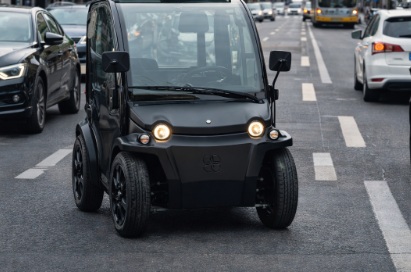
Estrima Birò
Country of production
The Estrima Birò is designed and assembled in Italy, with Estrima headquartered in Pordenone (Friuli-Venezia Giulia) and production carried out within the family group’s facilities (local industrial supply chain).
Market launch date
June 2009: start of series production.
2010: first full year of commercialization and wider rollout (electric urban micro-mobility).
November 2022: presentation of a product update (a “new generation”/evolution phase) at EICMA 2022.
2023–2025: “B2211” range marketed with a clearer split between Small/Big and between L6e and L7e homologations.
Facelifts and key updates
2022 update (EICMA): a significant improvement in ergonomics and everyday usability, with broadly unchanged external footprint: revised controls on the steering wheel, introduction/strengthening of display and connectivity, increased carrying capacity (with emphasis on storage and trunk solutions), and a revision of comfort/use-oriented elements. In this phase, the range also consolidated around Birò Small and Birò Big (focus on load capacity).

The Birò is a two-seat (side-by-side) electric quadricycle designed for the city: extremely compact dimensions, easy parking, and potentially contained running costs versus a conventional car. The current line-up revolves around two bodies (Small and Big) and two homologations: L6e (45 km/h top speed, typically drivable with AM licence within legal limits) and L7e (faster versions up to 60 km/h). A key differentiator is the practical charging approach (including domestic charging) and, depending on the version, the availability of a removable battery (ReMove) to charge wherever it is most convenient.
Powertrain and performance
| Spec | Small 45 maxi (L6e) | Small 45 ReMove (L6e) | Small 60 maxi (L7e) | Big 45 maxi (L6e) | Big 45 ReMove (L6e) | Big 60 maxi (L7e) |
|---|
| Motor / layout | electric, RWD | electric, RWD | electric, RWD | electric, RWD | electric, RWD | electric, RWD |
| Power (indicative) | ~3,5–3,9 kW | ~3,5–3,9 kW | ~5,0–5,5 kW | ~3,5–3,9 kW | ~3,5–3,9 kW | ~5,0–5,5 kW |
| Torque (indicative) | ~311 Nm | ~311 Nm | ~380 Nm | ~311 Nm | ~311 Nm | ~380 Nm |
| Top speed | 45 km/h | 45 km/h | 60 km/h | 45 km/h | 45 km/h | 60 km/h |
| Battery (lithium-ion) | ~5,0 kWh | ~5,5 kWh (nominal, removable) | ~6,4 kWh | ~5,0 kWh | ~5,5 kWh (nominal, removable) | ~6,4 kWh |
| Declared range | up to 100 km | up to 55 km | up to 90 km | up to 100 km | up to 55 km | up to 90 km |
| Charging | 220 V / public sockets (multi-standard cable) | 220 V (removable battery) | 220 V / public sockets | 220 V / public sockets | 220 V (removable battery) | 220 V / public sockets |
| Charging time (indicative) | ~5 h | ~3 h | ~5 h | ~5 h | ~3 h | ~5 h |
Dimensions and capacity
| Specification | Value |
|---|
| Length | ~1.794–1.835 mm (depending on version) |
| Width | ~1.107 mm |
| Height | ~1.565–1.566 mm |
| Turning circle | ~5,5 m (indicative) |
| Seats | 2 |
| Internal trunk (Small) | ~122 L |
| Trunk (Big) | ~300 L (order of magnitude) |
| Kerb weight (indicative) | ~424 kg (varies by configuration and battery) |
Main trims and prices
(Indicative prices; they may vary with promotions, trims, and dealer network.)
| Version | From (€) |
|---|
| Birò B2211 Small Naked 45 maxi | 14.050 |
| Birò B2211 Small Dressed 45 maxi | 15.050 |
| Birò B2211 Small Dressed 45 ReMove | 16.050 |
| Birò B2211 Small Dressed 60 maxi | 17.550 |
| Birò B2211 Big Dressed 45 maxi | 17.050 |
| Birò B2211 Big Dressed 60 maxi | 19.550 |
Maintenance and early service (indicative costs)
(Estimates for electric quadricycles: high variability by network and urban usage.)
| Intervention | Typical cost (€) |
|---|
| Periodic check/service | 120–260 |
| Brake fluid (periodic) | 70–150 |
| Brake pads (front/rear, per axle) | 120–260 |
| Tire (each, 145/60 R13) | 80–160 |
| 12 V battery (if needed) | 120–240 |
| Roadworthiness inspection (legal deadlines) | 45–80 |
Pros
Ultra-reduced footprint: excellent for parking and urban mobility.
Choice between L6e (45 km/h) and L7e (60 km/h): a more flexible range.
ReMove version: charge “anywhere” with a removable battery (apartment/office logic).
Big version: clearly more usable load capacity (order of magnitude ~300 L).
2022 update: improved ergonomics (controls/steering wheel), displays, and day-to-day usability.
Cons
Protection and comfort remain those of a micro-vehicle: it is not a conventional car.
Speed and performance are coherent with the category: be mindful of extra-urban use (especially L6e).
Purchase price is often higher than expected for those comparing it to scooters/used ICE microcars.
Real range is sensitive to temperature, load, and driving style (urban framing).
In summary
The Estrima Birò is an electric micro-mobility solution with a practical setup: maximum urban maneuverability, simple charging, and today a clearer split between Small/Big and L6e/L7e. The update presented in 2022 improved the user experience (ergonomics, controls, storage), making the product more mature for those seeking a “protected” and easy-to-manage urban vehicle even without a wallbox.
Verdict — Estrima Birò (model year 2025)
Ultra-compact 2-seat electric quadricycle · Bodies: Birò Small and Birò Big · Batteries: 45 Maxi, 45 Remove (removable “trolley”), 60 Maxi · Homologations: L6e (45 km/h) and L7e (60 km/h) · Range up to 100 km (45 Maxi) · Full charge in ~3–5 hours (depending on battery) · Indicative dimensions: length ~1.79–1.84 m, width ~1.11 m, height ~1.57 m · Indicative price from ~€14,050 to ~€19,550 (depending on version and battery) · Market launch: model introduced in 2009 (with range updates over the years)
The Estrima Birò is a distinctly “Italian” answer to urban mobility: an essential, tiny electric vehicle engineered to move (and above all, park) where a conventional car struggles. In 2025 its value proposition is more relevant than ever: ZTL/LEZ contexts, repetitive micro-trips, light deliveries, and city commuting. The recipe is simple and works if you use it in the right perimeter: low speeds, urban range, household-socket charging, and the key advantage of a removable battery.
The right decision is not “whether to buy it,” but which Birò: Small for maximum agility and simplicity, Big if you need genuine cargo capability; 45 Maxi if you want maximum range, 45 Remove if you cannot charge where you park, 60 Maxi if you want a bit more speed (with a different homologation class).
Key technical points:
Batteries, homologation and speed:
45 Maxi (L6e): top speed 45 km/h, range up to 100 km, full charge in ~5 hours.
45 Remove (L6e): top speed 45 km/h, range up to 55 km, full charge in ~3 hours; removable battery on wheels like a trolley.
60 Maxi (L7e): top speed 60 km/h, range up to 90 km, full charge in ~5 hours.
Use case and licences (Italy context):
Practicality and payload:
Dimensions and footprint:
Price and positioning:
| Category | Where it shines | Where it holds steady | Where it falls short |
|---|
| Urban mobility | Minimal footprint, extremely easy parking, ideal for ZTL/LEZ | Agile in slow traffic | Limited speed: not suited to fast traffic flows |
| Charging flexibility | Remove battery: you can charge “anywhere” from a socket | Simple household charging | Without a convenient socket, usability suffers (if not using Remove) |
| Range | 45 Maxi up to 100 km: very coherent in the city | 60 Maxi remains viable for commuting | Real range is sensitive to climate, driving style, and routes |
| Practicality | Big: truly useful cargo for work/errands | Two seats side-by-side, easy access | Not a car replacement: space and comfort are micromobility grade |
| Ownership costs | EV: potentially low energy and routine maintenance | Mechanical simplicity | Tires/insurance and residual value depend on local demand |
| Comfort & perceived safety | Enclosed cabin (depending on version) is more protective than a scooter | Essential but functional | Insulation and materials are not “car grade” |
Who it is for
City and inner-suburban users with short, repetitive trips and a strong need for effortless parking: young drivers (for AM-compatible versions), families as a second vehicle, professionals for micro-logistics and light deliveries, fleets for sharing or corporate “last mile” use.
Who should consider alternatives
If you must often use ring roads/motorways or fast-flow routes, if you need a travel car, or if you want city-car comfort and performance, a homologated M1 passenger car is more coherent (or a more “car-like” and faster microcar, with different trade-offs).
Recommended configuration
If you can charge at home/garage and want maximum urban range: 45 Maxi (Small or Big depending on cargo needs).
If you cannot plug in where you park (apartment building/street): 45 Remove is the enabling choice (the removable battery materially changes usability).
If you want a bit more speed margin (more flowing routes, but not “car-like” driving): 60 Maxi (carefully evaluating homologation/licence and your use case).
For work and cargo: Birò Big (because usable volume is the true advantage versus the Small).



 Birò
Birò