

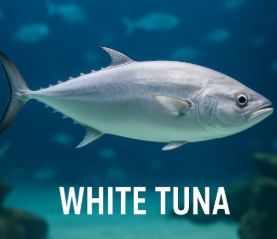
White tuna
Rating : 7
| Evaluation | N. Experts | Evaluation | N. Experts |
|---|---|---|---|
| 1 | 6 | ||
| 2 | 7 | ||
| 3 | 8 | ||
| 4 | 9 | ||
| 5 | 10 |
0 pts from Al222
| Sign up to vote this object, vote his reviews and to contribute to Tiiips.Evaluate | Where is this found? |
| "Descrizione" about White tuna by Al222 (24908 pt) | 2025-Nov-15 12:50 |
| Read the full Tiiip | (Send your comment) |
White tuna
(Thunnus alalunga – albacore/“white meat tuna”, canned or frozen, fillets or chunks in water, brine or oil)
Description
White tuna in food labelling generally refers to albacore tuna, a medium-sized pelagic fish whose flesh is naturally pale, firm and lean, marketed as “white meat tuna” (especially in canned form).
Available as:
canned chunks or solid pack in water, brine or vegetable oil;
frozen or chilled fillets/loins, fresh or previously frozen;
ingredients in ready meals, salads, spreads, sandwich fillings and sauces.
Flesh colour: from off-white to light pink, turning slightly beige after cooking or canning; flavour milder and less “fishy” than many other tuna species.

Indicative nutritional values (per 100 g, drained, canned in water)
(Average values; can vary with species, fatness of the fish, medium – water vs oil – and draining.)
Energy: 110–140 kcal
Water: ≈ 70–75 g
Protein: 23–26 g (high-protein food)
Total fat: 2–4 g
First occurrence: SFA/MUFA/PUFA = saturated/monounsaturated/polyunsaturated fatty acids; in white tuna the total fat is modest but of good quality, with a moderate share of saturates, a relevant share of monoinsaturates and an important proportion of omega-3 PUFA. This profile is generally favourable for cardiovascular health compared with fattier meats, provided intake is kept within mercury-consumption guidance.
Carbohydrates: 0 g (no sugars or starch)
Cholesterol: 30–45 mg
Sodium: 40–80 mg (natural content; much higher if packed in brine or seasoned)
Key micronutrients (approximate ranges):
Selenium: 60–90 µg
Vitamin D: 2–5 µg
Niacin (vitamin B3): 8–15 mg
Vitamin B12: 1–3 µg
Potassium: 250–350 mg
Omega-3 long chain fatty acids (EPA + DHA): roughly 0.8–1.6 g per 100 g depending on fatness and origin.
Key constituents
High-quality proteins:
complete amino acid profile with high biological value (BV); rich in essential amino acids and BCAA (branched chain amino acids).
Lipids:
modest total fat content;
mixture of saturated, mono- and polyunsaturated fatty acids, with notable n-3 PUFA including EPA (eicosapentaenoic acid) and DHA (docosahexaenoic acid);
very low or absent industrial trans fats; small amounts of natural marine trans isomers, generally not considered a major health concern at normal intakes.
Minerals and vitamins:
good source of selenium, vitamin D, B12, niacin and phosphorus;
provides potassium and small amounts of iron and magnesium.
Other components:
naturally present histidine, which can be converted to histamine if the fish is mishandled (relevant for scombroid poisoning risk if cold chain fails).
Production process
(Canned white tuna – simplified)
Fishing and landing
capture of Thunnus alalunga using methods such as pole-and-line, trolling, longline or purse seine;
rapid chilling on board (ice or refrigerated seawater) to limit spoilage and histamine formation.
Reception and preparation
grading by size and quality;
evisceration, heading and washing;
cooking/steaming of whole or dressed fish to set flesh and facilitate skin/bone removal.
Cleaning and packing
removal of skin, dark muscle (partially), bones and bloodline;
cutting into chunks or loins and filling into cans;
addition of covering liquid (water, brine, oil) and, where used, salt or broth.
Seaming and heat treatment
closing cans;
retorting/sterilisation at high temperature and pressure to achieve commercial sterility and long shelf-life.
Cooling, storage and distribution
cooling, labelling, coding and storage at ambient temperature.
For chilled/frozen products: the process stops at trimming and packing, followed by rapid chilling or freezing and cold-chain distribution.
Physical properties
Flesh: firm, flaky once cooked or canned; fibres visible; relatively low free moisture compared with some other fish.
Colour: pale white to light pink in raw or lightly cooked muscle; becomes slightly beige and opaque after retorting.
Odour: mild, marine, slightly meaty; strong fishy or ammoniacal odours indicate quality issues.
Water activity: high in chilled/frozen fish and in canned drained flesh → requires proper storage and/or sterilisation.
Sensory and technological properties
Flavour: mild, clean tuna aroma; less intense and “fishy” than darker tuna species (e.g. skipjack), often preferred for salads and sandwiches.
Texture: firm but tender; holds together in chunks and flakes, which is important for canned products and ready meals.
Technological behaviour:
withstands moderate reheating and incorporation into sauces without disintegrating excessively;
low fat content reduces greasiness but still contributes to mouthfeel;
works well with emulsified dressings (mayonnaise, sauces) and in fillings.
Food applications
Retail & foodservice:
canned white tuna for sandwiches, salads, pasta dishes, rice dishes;
toppings for pizza and baked dishes;
fillings for stuffed vegetables, savoury pastries, wraps.
Industrial:
ingredient in ready-to-eat meals, chilled or frozen;
tuna salads in MAP trays;
tuna spreads, pâtés and mousse;
high-protein convenience products and meal components.
Nutrition & health
White tuna is a high-protein, relatively lean animal food, providing:
complete protein with high BV;
low total fat and a favourable fatty acid profile rich in marine omega-3.
The EPA and DHA content supports:
normal heart function and blood lipid profile;
contribution to maintenance of normal brain function and vision (in the context of an overall balanced diet and adequate intake).
The content of selenium, vitamin D and B12 further adds to potential benefits for immune function, bone health and energy metabolism.
Key caution – mercury and consumption frequency
As a predatory, long-lived tuna species, albacore/white tuna can accumulate methylmercury at levels higher than canned “light” tuna (usually skipjack).
Many authorities classify albacore/white tuna as a “good choice” that should be eaten in moderation, with specific guidance for:
pregnant or breastfeeding individuals,
young children,
and people with high fish consumption.
Typical advice (depending on country) is to limit albacore/white tuna to about one serving per week in sensitive groups, while combining it with lower-mercury fish options.
Food safety – histamine (scombroid) risk
Tuna is naturally rich in histidine; if not kept properly chilled after capture, bacteria can convert it to histamine.
High histamine levels can cause scombroid fish poisoning, with symptoms resembling an allergic reaction (flushing, headache, rash, gastrointestinal upset) shortly after ingestion.
Good practice in the supply chain (rapid chilling, temperature control, good hygiene) is essential; properly handled commercial products are generally safe.
Portion note: a common serving of white tuna as a protein dish is 100–150 g drained (about one small can or a typical cooked portion), providing roughly 25–35 g of protein and 1–2 g of long-chain omega-3.
Allergens and intolerances
White tuna is a fish allergen and must be labelled as such; it can trigger reactions in individuals with fish allergy.
Canned products may also contain:
soy (e.g. in sauces or broths);
milk or egg components in tuna salads and spreads;
other allergens depending on the recipe (mustard, gluten from added ingredients, etc.).
Histamine-related reactions (scombroid) are toxic, not IgE-allergic, but symptoms may resemble an allergic response.
Quality and specifications (typical themes)
Composition
protein, fat, moisture and salt within specified ranges;
low residual liquid in “solid” packs;
correct drained weight in canned products.
Physical / sensory
characteristic colour, odour and flavour;
absence of rancid, metallic or overly fishy notes;
bone and skin content minimized and within spec;
suitable texture (not mushy, not overly dry).
Chemical
histamine below legal limits;
mercury and other heavy metals within regulatory thresholds;
indices of oxidation (e.g. peroxide value in oil media) controlled.
Microbiological
for canned white tuna: commercial sterility after retorting;
for chilled/frozen products: low total counts and absence of pathogens under correct storage.
Storage and shelf-life
Canned white tuna:
ambient storage in a cool, dry place, away from heat and sunlight;
typical shelf-life: 2–5 years unopened, depending on product and packaging;
after opening: transfer unused product to a non-metallic container, refrigerate and consume within 1–3 days.
Chilled/fresh:
store at 0–2 °C, ideally on ice;
short shelf-life (few days), depending on initial freshness and packaging.
Frozen:
store at ≤ −18 °C;
quality shelf-life typically 6–12 months, with gradual loss of sensory quality over time.
Safety and regulatory
White tuna is regulated under fish and fishery product standards and must comply with:
criteria for histamine in scombroid fish;
limits for heavy metals (especially mercury);
microbiological and hygiene requirements;
labelling rules for species identity and catch area where applicable.
Production must follow GMP/HACCP, with critical control points for:
time–temperature management from catch to processing;
retort process control for canned products;
prevention of cross-contamination and correct cleaning/sanitation.
Labeling
Typical names:
“white tuna”, “albacore tuna”, “white meat tuna”, sometimes with indication of catch area (e.g. “Pacific albacore”).
For canned products, labels should state:
packing medium (in water, in brine, in oil);
added ingredients (salt, broth, flavours, seasonings);
net weight and drained weight;
nutrition information and allergen declaration (“fish”).
Mislabel issues exist in some markets (e.g. escolar sold as “white tuna” in sushi); good labelling practice uses scientific names and verified supply chains to reduce substitution risk.
Troubleshooting
Dry, fibrous texture
Cause: overcooking or use of overly lean, over-processed meat.
Action: reduce cooking time/temperature; use sauces or dressings; select products packed in oil or with slightly higher fat for some applications.
Strong fishy or metallic odour
Cause: oxidation of lipids, age, poor storage.
Action: reject product showing pronounced off-odours; review storage conditions (heat, light, oxygen).
Soft or mushy texture in canned tuna
Cause: excessive thermal processing or poor raw material quality.
Action: adjust retort parameters; tighten raw material specifications.
Consumer complaints of “allergic reaction” shortly after eating
Possible cause: histamine (scombroid) rather than true allergy if multiple people are affected.
Action: investigate temperature control, test histamine levels, review HACCP plan.
Sustainability and supply chain
Albacore/white tuna is harvested worldwide; sustainability depends on:
stock status in each ocean;
fishing gear (pole-and-line and troll-caught often have lower bycatch than some longline or purse seine fisheries);
management by regional fisheries organisations.
Many buyers favour:
fish from well-managed stocks,
gear with lower bycatch and habitat impact,
certified or eco-labelled products where available.
Processing plants must also manage:
BOD/COD in effluents from cleaning and waste streams;
by-product valorisation (trimmings for fishmeal, fish oil);
use of recyclable/optimised packaging and FIFO stock rotation to reduce waste.
Main INCI functions (cosmetics)
There is no widely used specific INCI such as “White Tuna Extract”, but related ingredients can include:
Fish Oil, Marine Oil or more specific names based on species where used.
Typical cosmetic functions:
emollient, skin conditioning and occlusive properties thanks to marine lipids, including omega-3 fatty acids;
use in some nutricosmetic or cosmeceutical concepts (often more as a dietary supplement than as a topical ingredient).
Cosmetic-grade materials must comply with stricter limits on oxidation products, contaminants and microbiology.
Conclusion
White tuna (albacore) is a high-quality, lean protein ingredient with valuable marine omega-3 fatty acids, useful vitamins and minerals, and a mild flavour that suits many savoury applications. From a nutritional perspective it can contribute to heart-healthy eating patterns when consumed in appropriate portions and frequency, especially alongside lower-mercury fish choices. Technologically, it offers a good balance of firmness and flake, making it ideal for canned products, salads and ready meals. Robust control of mercury, histamine, hygiene and supply-chain sustainability is essential to ensure safe, high-quality and responsible use in modern food systems.
Mini-glossary
SFA/MUFA/PUFA – Saturated/monounsaturated/polyunsaturated fatty acids; white tuna has relatively low total fat, with a beneficial share of mono- and polyunsaturated fats compared with many red meats, supporting a more favourable lipid profile when part of a balanced diet.
EPA/DHA/ALA – Eicosapentaenoic acid / docosahexaenoic acid / alpha-linolenic acid; EPA and DHA are long-chain marine omega-3 fatty acids abundant in tuna, linked to heart and brain health, while ALA is a plant-derived omega-3 that the body can only partly convert to EPA/DHA.
BV (biological value) – Measure of how efficiently dietary protein can be used for body protein synthesis; tuna proteins have high BV.
BCAA – Branched-chain amino acids (leucine, isoleucine, valine), important for muscle metabolism and common in fish and meat proteins.
GMP/HACCP – Good Manufacturing Practices / Hazard Analysis and Critical Control Points; fundamental systems for hygienic, safe, traceable seafood processing.
BOD/COD – Biochemical/Chemical Oxygen Demand; indicators of organic and oxidisable load in wastewater, important for designing and monitoring treatment of fish-processing effluents.
FIFO – First In, First Out; stock rotation rule ensuring older lots are used before newer ones, reducing spoilage, oxidation and waste.
References__________________________________________________________________________
Dhurmeea Z, Pethybridge H, Appadoo C, Bodin N. Lipid and fatty acid dynamics in mature female albacore tuna (Thunnus alalunga) in the western Indian Ocean. PLoS One. 2018 Apr 2;13(4):e0194558. doi: 10.1371/journal.pone.0194558.
Abstract. Lipid composition in the reproductive and somatic tissues were investigated for female albacore tuna, Thunnus alalunga, in the western Indian Ocean, between latitude 18-21°S and longitude 56-60°E, from January 2014 to March 2015. Highest total lipids (TL) were found in the gonads of spawning-capable females (SCP) (mainly phospholipids, PL, triacylglycerols, TAG and wax esters, WE) and in the liver of females in the late regressing and regenerating ovary phases (mainly TAG, PL and sterols, ST). Muscle TL was low but exhibited high inter-individual variability. Correlations between gonadosomatic and hepatosomatic indices with TL and the lipid classes in albacore gonads and liver describes a pattern of reallocation of energy from the liver to the gonads during SCP. Female albacore were also observed to pursue foraging activities even during this period. Therefore, female albacore can be considered as a capital-income breeder relying mostly on stored lipids before the onset of reproduction and to a lesser extent on energy derived from concurrent feeding during the spawning season. Overall, the three examined tissues had similar general fatty acid profiles with the dominance of 22:6ω3 (docosahexaenoic acid, DHA), 16:0, 18:0 and 18:1ω9. The proportions of fatty acids varied with maturity stage and ovary lobe, with the smaller lobe having significantly higher proportions of essential fatty acids, as well as 16:0 and 18:1n9, compared to the larger one. Our results provide new information on the life-history and energy allocation strategy of albacore which will assist fisheries managers.
Storelli MM, Stuffler RG, Marcotrigiano GO. Total and methylmercury residues in tuna-fish from the Mediterranean sea. Food Addit Contam. 2002 Aug;19(8):715-20. doi: 10.1080/02652030210153569.
Abstract. This study was carried out to determine the current levels of total mercury and methylmercury in the muscle tissue of albacore (Thunnus alalunga) and bluefin tuna (Thunnus thynnus) caught in the Mediterranean sea with the purpose of ascertaining whether the concentrations exceeded the maximum level fixed by the European Commission Decision. Total mercury concentrations ranged from 0.84 to 1.45 mg kg(-1) w.w. (av. 1.17 mg kg(-1) w.w.) and from 0.16 to 2.59 mg kg(-1) (av. 1.18 mg kg(-1) w.w.) in the muscle of albacore and bluefin tuna, respectively. In 78.6% of albacore and in 61.1% of bluefin tuna analysed, total mercury concentrations exceeded the maximum level fixed by the European Commission Decision (Hg = 1 micro g g(-1) wet wt). In the two species, mercury was present almost completely in the methylated form, with percentages between 77 and 100% (av. 91.3%) in albacore and between 75 and 100% (av. 91%) in bluefin-tuna. In order to assess the potential health impact, the estimated weekly intake was calculated. The estimated weekly intake was far above the established Provisional Tolerable Weekly Intake for both species.
Stamatis N, Kamidis N, Pigada P, Stergiou D, Kallianiotis A. Bioaccumulation Levels and Potential Health Risks of Mercury, Cadmium, and Lead in Albacore (Thunnus alalunga, Bonnaterre, 1788) from The Aegean Sea, Greece. Int J Environ Res Public Health. 2019 Mar 6;16(5):821. doi: 10.3390/ijerph16050821.
Abstract. Aegean Sea albacore (T. alalunga), fresh or processed, is marketed locally in Greece or exported, mainly to Japan, Italy, Spain, and France. To provide information for consumers and biomonitoring programs and assess the potential human health risks, concentrations of mercury (Hg), cadmium (Cd) and lead (Pb) were determined in albacore edible muscle samples from two fishing grounds of the Aegean Sea, Greece via graphite furnace atomic absorption spectrometry (GF-AAS). Of the 82 individuals, 28 contained Cd and three contained Pb above the permissible limits set by the European Union (0.1 mg kg-1 wet wt and 0.3 mg kg-1 wet wt, respectively). None of the samples contained mercury above the limit (1.0 mg kg-1 wet wt). Potential health risks to human via dietary intake of albacore were estimated by the total target hazard quotients (TTHQs), which indicated that the consumers could acquire health problems due to consumption of Aegean Sea albacore. Thus consequently, concentrations of toxic heavy metals in albacore, especially mercury, must be monitored regularly and comprehensively with respect to consumer health.
Nikolic N, Montes I, Lalire M, Puech A, Bodin N, Arnaud-Haond S, Kerwath S, Corse E, Gaspar P, Hollanda S, Bourjea J, West W, Bonhommeau S. Connectivity and population structure of albacore tuna across southeast Atlantic and southwest Indian Oceans inferred from multidisciplinary methodology. Sci Rep. 2020 Sep 24;10(1):15657. doi: 10.1038/s41598-020-72369-w.
Abstract. Albacore tuna (Thunnus alalunga) is an important target of tuna fisheries in the Atlantic and Indian Oceans. The commercial catch of albacore is the highest globally among all temperate tuna species, contributing around 6% in weight to global tuna catches over the last decade. The accurate assessment and management of this heavily exploited resource requires a robust understanding of the species' biology and of the pattern of connectivity among oceanic regions, yet Indian Ocean albacore population dynamics remain poorly understood and its level of connectivity with the Atlantic Ocean population is uncertain. We analysed morphometrics and genetics of albacore (n = 1,874) in the southwest Indian (SWIO) and southeast Atlantic (SEAO) Oceans to investigate the connectivity and population structure. Furthermore, we examined the species' dispersal potential by modelling particle drift through major oceanographic features. Males appear larger than females, except in South African waters, yet the length-weight relationship only showed significant male-female difference in one region (east of Madagascar and Reunion waters). The present study produced a genetic differentiation between the southeast Atlantic and southwest Indian Oceans, supporting their demographic independence. The particle drift models suggested dispersal potential of early life stages from SWIO to SEAO and adult or sub-adult migration from SEAO to SWIO.
Dhurmeea Z, Zudaire I, Chassot E, Cedras M, Nikolic N, Bourjea J, West W, Appadoo C, Bodin N. Reproductive Biology of Albacore Tuna (Thunnus alalunga) in the Western Indian Ocean. PLoS One. 2016 Dec 21;11(12):e0168605. doi: 10.1371/journal.pone.0168605.
Abstract. The reproductive biology of albacore tuna, Thunnus alalunga, in the western Indian Ocean was examined through analysis of the sex ratio, spawning season, length-at-maturity (L50), spawning frequency and fecundity. From 2013 to 2015, a total of 923 female and 867 male albacore were sampled. A bias in sex ratio was found in favor of females with fork length (LF) < 100 cm. Using histological analyses and gonadosomatic index, spawning was found to occur between 10°S and 30°S, mainly to the east of Madagascar from October to January. Large females contributed more to reproduction through their longer spawning period compared to small individuals. The L50 (mean ± standard error) of female albacore was estimated at 85.3 ± 0.7 cm LF. Albacore spawn on average every 2.2 days within the spawning region and spawning months, from November to January. Batch fecundity ranged between 0.26 and 2.09 million oocytes and the relative batch fecundity (mean ± standard deviation) was estimated at 53.4 ± 23.2 oocytes g-1 of somatic-gutted weight. The study provides new information on the reproductive development and classification of albacore in the western Indian Ocean. The reproductive parameters will reduce uncertainty in current stock assessment models which will eventually assist the fishery to be sustainable for future generations.
Laconcha U, Iriondo M, Arrizabalaga H, Manzano C, Markaide P, Montes I, Zarraonaindia I, Velado I, Bilbao E, Goñi N, Santiago J, Domingo A, Karakulak S, Oray I, Estonba A. New Nuclear SNP Markers Unravel the Genetic Structure and Effective Population Size of Albacore Tuna (Thunnus alalunga). PLoS One. 2015 Jun 19;10(6):e0128247. doi: 10.1371/journal.pone.0128247.
Abstract. In the present study we have investigated the population genetic structure of albacore (Thunnus alalunga, Bonnaterre 1788) and assessed the loss of genetic diversity, likely due to overfishing, of albacore population in the North Atlantic Ocean. For this purpose, 1,331 individuals from 26 worldwide locations were analyzed by genotyping 75 novel nuclear SNPs. Our results indicated the existence of four genetically homogeneous populations delimited within the Mediterranean Sea, the Atlantic Ocean, the Indian Ocean and the Pacific Ocean. Current definition of stocks allows the sustainable management of albacore since no stock includes more than one genetic entity. In addition, short- and long-term effective population sizes were estimated for the North Atlantic Ocean albacore population, and results showed no historical decline for this population. Therefore, the genetic diversity and, consequently, the adaptive potential of this population have not been significantly affected by overfishing.
| Sign up to vote this object, vote his reviews and to contribute to Tiiips.EvaluateClose | (0 comments) |
Read other Tiiips about this object in __Italiano (1)
Last update:   2025-11-15 12:39:59 |

