

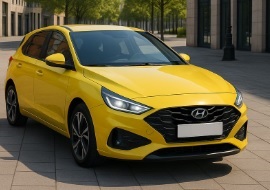
Hyundai i30 – Model Year 2025

Country of Manufacture
The Hyundai i30 MY2025 for Europe is produced at the Hyundai plant in Nošovice, Czech Republic.
Brief Description
The Hyundai i30 MY2025 is a compact five-door hatchback, also available as a wagon, designed for those who value comfort, solidity, and technology in a versatile car suitable for both city and long-distance driving. The design is elegant and understated, with a bold front, full LED headlights, and harmonious lines. The interior is spacious and well-finished, with quality materials, a 10.25" central touchscreen display, digital cluster, Apple CarPlay/Android Auto, automatic climate control, plenty of storage compartments, and one of the largest boots in its segment. The engine range includes efficient petrol units (including mild hybrid) and diesel, with manual or DCT automatic transmissions. Safety features include the latest generation ADAS systems.
2025 Powertrains
| Version | Power / Torque | Engine | Drivetrain | Transmission | 0–100 km/h | Avg. Consumption* |
|---|
| 1.5 MPI | 110 hp / 144 Nm | 1.5 4-cylinder | FWD | 6-speed manual | 11.3 s | 5.7 l/100 km |
| 1.0 T-GDi 48V | 120 hp / 172 Nm | 1.0 Turbo 3-cylinder | FWD | 6-speed manual/DCT | 10.6 s | 5.3 l/100 km |
| 1.6 CRDi | 115 hp / 280 Nm | 1.6 Diesel 4-cylinder | FWD | 6-speed manual/DCT | 10.2 s | 4.5 l/100 km |
*WLTP combined cycle data.
Dimensions and Capacity
| Length | Width | Height | Boot Capacity |
|---|
| 4,340 mm | 1,795 mm | 1,455 mm | 395–1,301 liters |
Main Trims
i30: 15” steel wheels, manual air conditioning, 8" touchscreen display, emergency braking, lane keeping assist, rear parking sensors.
i30 Business: 16” alloy wheels, 10.25" touchscreen display, navigation, rearview camera, automatic climate control, Apple CarPlay/Android Auto, cruise control.
i30 Prime: 17” alloy wheels, premium interiors, heated seats, leather steering wheel, keyless entry, advanced ADAS package, panoramic roof (on wagon).
PROS
| PRO | Why it stands out |
|---|
| Space and boot capacity | Excellent passenger space and one of the largest boots in the category. |
| On-road comfort | Balanced suspension, comfortable seats even for long trips. |
| Onboard technology | Large central display, modern infotainment, advanced ADAS. |
| Efficient engines | Low fuel consumption, choice of petrol, mild hybrid, and diesel. |
| Build quality | Solid materials and good assembly. |
CONS
| CONS | Noted detail |
|---|
| Basic entry-level trim | The entry-level version is rather simple in terms of equipment. |
| Less distinctive styling | Understated design, less eye-catching than some rivals. |
| Engines not sporty | Performance is more focused on efficiency than dynamism. |
| Hard plastics in lower cabin | Some less refined materials in the lower interior areas. |
| Slightly higher price | Prices have increased compared to previous generations. |
Indicative Prices
| Version | List Price* |
|---|
| 1.5 MPI i30 | €22,500 |
| 1.0 T-GDi Business | €24,900 |
| 1.6 CRDi Prime | €27,800 |
*VAT included; registration tax and delivery fees excluded.
Summary
The Hyundai i30 MY2025 remains one of the most rational and complete compacts in its class, ideal for those who want comfort, practicality, technology, and a wide, efficient engine range. Perfect for families and high-mileage drivers, it’s a solid and reliable choice, with only minor limitations in styling and entry-level material quality.
Verdict — Hyundai i30 (Model-Year 2025)
Hyundai i30 1.0 T-GDi 120 hp (Mild Hybrid) · 1.5 T-GDi 160 hp (Mild Hybrid) · N Line
The Hyundai i30 is the compact hatchback from the Korean brand, designed for those seeking understated style, advanced technology, upper-class comfort, and balanced driving. Its design stands out with elegant lines, a wide front grille, LED lighting front and rear, 16" to 18" alloy wheels, and sporty N Line details. The interior focuses on quality and rationality: soft-touch materials, a large 10.25" touchscreen, digital cluster, physical climate controls, comfortable seats, and ample space for four adults and luggage.
On the technical side:
1.0 T-GDi Mild Hybrid: 3-cylinder turbo petrol engine with 120 hp, 6-speed manual or 7-speed DCT, 5.4 l/100 km WLTP, front-wheel drive.
1.5 T-GDi Mild Hybrid: 4-cylinder turbo petrol engine with 160 hp, manual or DCT, 5.7 l/100 km WLTP, lively performance.
Comfort-oriented suspension, precise steering, excellent soundproofing, balanced setup between comfort and driving dynamics.
| Aspect | Where it excels | Where it matches | Where it lags |
|---|
| Design & Image | Elegant lines, mature look, sporty N Line trim, LED front/rear lights, wheels up to 18". | Wide grille, metallic paints. | Less distinctive than Peugeot 308 or Mazda3, less premium badge than Golf. |
| Comfort & NVH | Spacious cabin, comfortable seats, excellent insulation, dual-zone auto climate, soft suspension. | USB ports, heated seats, soft-touch materials. | Rear bench less comfy for 3 adults, soft setup in corners. |
| Real-world Efficiency | Low consumption (1.0/1.5 Mild Hybrid), low running costs, Start&Stop. | Clear scheduled maintenance, Euro 6e compliance. | No full hybrid or diesel version, higher consumption in town with 1.5. |
| Dynamics | Balanced handling, precise steering, secure setup, stable at high speed. | Responsive manual/DCT, effective brakes. | Not as sporty as Ford Focus or Seat Leon FR, not overly firm. |
| Practicality | 5 doors, 395–1,301 L boot, folding rear seats, flat load bay, numerous compartments. | Wide tailgate, low loading lip. | Boot not the biggest in class, center rear seat is firm. |
| HMI / Infotainment | 10.25" touchscreen, wireless Apple CarPlay/Android Auto, navigation, digital cluster, rear camera. | Bluetooth, physical climate controls, multiple USBs. | Infotainment slower than some rivals, simple graphics. |
| ADAS & safety | Auto emergency braking, lane keep assist, Blind Spot, adaptive cruise, traffic sign recognition. | Parking sensors, hill start assist, eCall. | Advanced ADAS only on higher trims, no Level 2 autonomous driving. |
| Running Costs | 16–18" tyres (from €80 each), 5-year/unlimited mileage warranty, low insurance, clear servicing. | Affordable maintenance, mild hybrid tax benefits. | Residual value below Golf, DCT pricier to maintain. |
| Depreciation | Stable demand, great value-for-money, ideal for rational buyers. | — | Entry trims depreciate faster, badge less desired in the segment. |
Who it’s for
Families and commuters seeking comfort and efficiency — i30 1.0/1.5 Mild Hybrid: reliability, space, low costs.
Those wanting a complete, versatile hatchback — lively engines, rich infotainment, full safety equipment.
Anyone after sober yet modern style — i30 N Line: discreet sportiness, enjoyable drive, distinctive look.
Who should look elsewhere
Anyone wanting a distinctive design or premium finish → Peugeot 308, Mazda3, Volkswagen Golf.
Those seeking true sporty driving → Ford Focus ST-Line, Seat Leon FR.
Anyone needing more cargo capacity → Skoda Scala, Honda Civic.
Recommended configuration
Hyundai i30 1.5 T-GDi Mild Hybrid N Line + 10.25" display + dual-zone climate + ADAS pack + 18" wheels: the ideal choice for those seeking a balanced, high-tech, and well-finished hatchback.
Avoid the entry trim if you want advanced infotainment, superior comfort, or top ADAS features.