

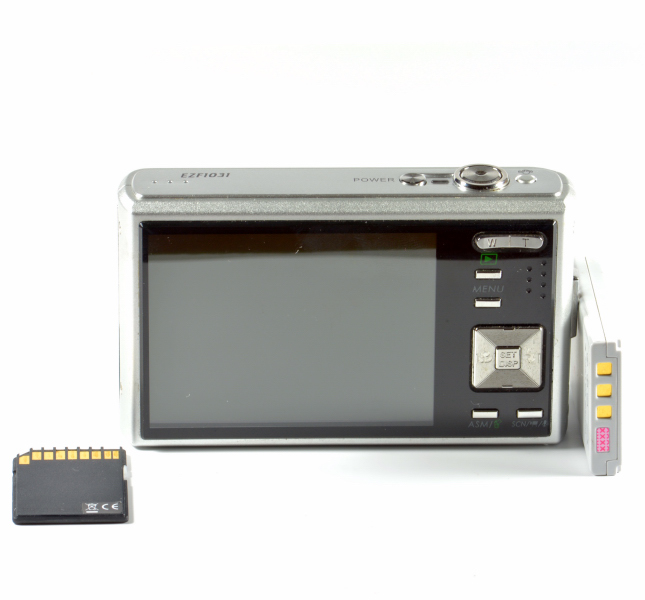
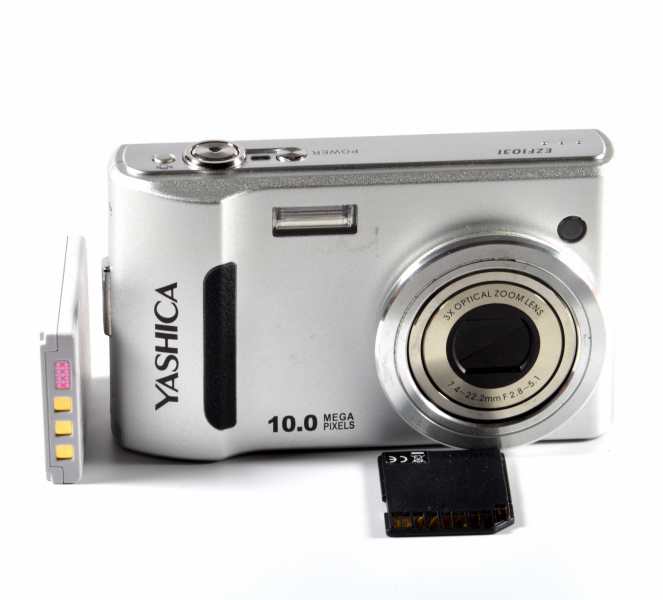
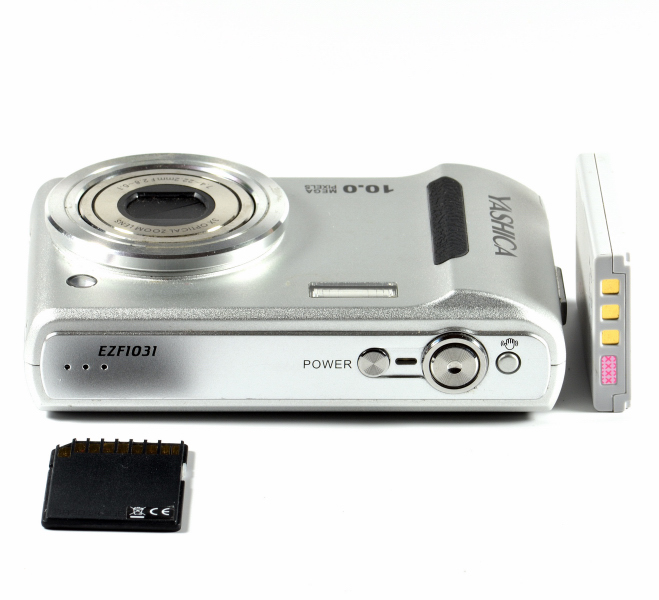
Yashica EZF1031
Type: Low-cost digital compact camera
Reference period for reviews: Approximately 2009 (still referenced online)
Category: Point-and-shoot / entry-level
Market segment: Amateur users and beginners

2. Main technical specifications
| Parameter | Reported value |
|---|
| Sensor | 1/1.8″ CMOS (small-sized sensor) |
| Maximum photo resolution | Approximately 10 megapixels |
| Optical zoom | Approximately 3× |
| Lens aperture | f/2.8 (wide) – f/5.1 (tele) |
| ISO | From 100 to 6400 (reported maximum) |
| LCD display | Approximately 3″ (size) |
| Video | Not specified by primary source; likely VGA or 480p typical of the era |
| Stabilization | Possible user-activatable stabilizer (software/mechanical) indicated in menus |
| Battery | Rechargeable NP-900 type (small Li-Ion) |
| Weight | Approximately 0.18 kg (180 g) |
Key technical notes:
A 1/1.8″ sensor is typical of budget compacts and usually delivers modest image quality, with more visible digital noise in low light compared to larger sensors.
A 3× zoom range is functional but limited for telephoto use, mainly suitable for basic urban or landscape photography.
Variable apertures in low-end compacts generally imply compromises in bokeh rendering and depth-of-field control.
3. Detailed technical assessment
3.1 Sensor and image quality
Pros:
Cons:
Relatively small sensor → less effective noise management in low light and limited dynamic range.
Nominal resolution does not necessarily translate into real optical quality, especially with budget lenses.
3.2 Lens and zoom
Pros:
Cons:
3.3 Operational performance
Pros:
Cons:
Slow operation reported by users (startup and focus response).
Likely dated UI and non-instant menu navigation.
Autofocus and shutter responsiveness not suitable for fast-moving subjects or dynamic shooting scenarios.
3.4 Battery and autonomy
Pros:
Cons:
Small-capacity compact batteries usually mean modest autonomy; a spare is advisable for longer outings.
USB charging and/or charger availability cannot be assumed, depending on the kit configuration.
4. Comparison with other compacts from the same era
| Aspect | Yashica EZF1031 | Typical 2008–2011 compacts |
|---|
| Sensor | 1/1.8″ ~10 MP | 1/2.3″ ~10–12 MP |
| Optical zoom | 3× | 3×–5× |
| LCD | 3″ | 2.7–3″ |
| Burst/speed | slow | variable, often better |
| Usability | simple | varies by tier |
| Image quality | standard | generally more consistent |
Interpretation: The EZF1031 sits in the lower end of consumer compact cameras: acceptable for basic shooting, but typically weaker than more advanced compacts—even from the same era—especially in autofocus, speed, and integrated optics.
5. Pros and cons – Technical summary
Main pros
Often very low price on the used market.
Adequate performance for basic amateur photography.
Simple handling and easy operation for beginners.
Main cons
Slow operational speed (startup and focusing), which reduces effectiveness in dynamic situations.
Image quality constrained by the small sensor and budget optics.
Lacks modern features such as Wi-Fi, GPS, advanced stabilization, or clearly stated HD video capabilities.
Likely limited video versatility (no explicit 720p/1080p indication in the available references).
6. Conclusion
The Yashica EZF1031 is a low-end digital compact camera, primarily suitable for casual users, collectors, or anyone looking for a simple device for occasional photos. It does not compete with modern smartphones or mid-range compacts in terms of image quality or operational performance, but it can still be considered a low-cost option when high technical requirements are not a priority.
A certain slowness when turned on and in focus, but then the images are sharp and bright.
It has a button at the top, next to the shutter button, which activates the image stabilizer.