

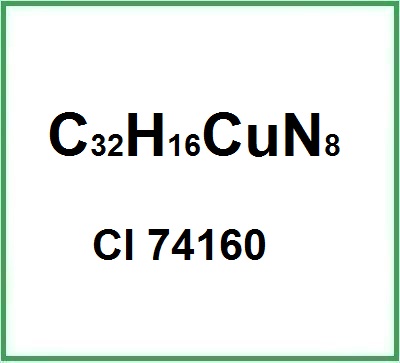
CI 74160
Rating : 4.8
| Evaluation | N. Experts | Evaluation | N. Experts |
|---|---|---|---|
| 1 | 6 | ||
| 2 | 7 | ||
| 3 | 8 | ||
| 4 | 9 | ||
| 5 | 10 |
Cons:
Cosmetics Regulation provisions (1)10 pts from A_Partyns
| Sign up to vote this object, vote his reviews and to contribute to Tiiips.Evaluate | Where is this found? |
| "Descrizione" about CI 74160 Review Consensus 10 by A_Partyns (13046 pt) | 2026-Jan-11 10:12 |
| Read the full Tiiip | (Send your comment) |
CI 74160 (Copper Phthalocyanine): properties, uses, INCI functions, safety, alternatives
CI 74160 (Copper Phthalocyanine) is a chemical compound, it belongs to the sulfonated Metal phthalocyanines family with the name copper phthalocyanine-3,4′,4″,4″′-tetrasulfonic acid tetrasodium salt.
Chemical Composition and Structure
Copper Phthalocyanine is an organic compound in which a central copper atom is surrounded by a phthalocyanine ring. This structure gives the pigment its characteristic intense blue color. Its chemical formula is C32H16CuN8, comprising copper, carbon, hydrogen, and nitrogen, and its highly conjugated structure provides the pigment with remarkable stability and resistance to degradation from environmental factors.
Physical Properties
CI 74160 appears as a bright blue powder, insoluble in water but dispersible in oils and organic solvents. It is known for its excellent resistance to heat, sunlight, and chemicals, making it a stable and long-lasting pigment. It disperses well in various formulations without losing color intensity.

The name describes the structure of the molecule:
Production Process
Copper Phthalocyanine is synthetically produced through the condensation of phthalonitriles with copper. The result is a stable, durable compound that can be further processed to achieve pigments of various particle sizes, depending on the requirements of the industry in which it is used.
What it is for and where
It is a fairly discussed chemical dye, used in
Cosmetics
It is a restricted ingredient as IV/105 a Relevant Item in the Annexes of the European Cosmetics Regulation 1223/2009. Sostanza o ingrediente a rischio: (29H,31H-Phthalocyaninato(2-)-N29,N30,N31,N32)copper
The CI 74160 also called Copper phthalocyanine and it is used in tattoo, cleaning products and various other applications to give a blue color.
Below are some interesting studies.
Tattoos
Warnings
Potential Acute Health Effects: Hazardous in case of skin contact (irritant), of eye contact (irritant), of ingestion, of inhalation (2).
Safety. Environmental pollution
Commercial applications
Cosmetics. CI 74160 is used as a pigment in various cosmetic products like eyeshadows, nail polishes, and lipsticks to impart a blue hue.
Personal Care Products. It can be found in toothpastes, soaps, and other personal care products to color the product.
Plastic and Rubber Industry. Used as a dye for plastics and rubber.
Inks and Paints. Used as a pigment in inks and paints to give a deep blue color.
Food. In some regions, it might be used as a food dye, though its use in foods varies based on local regulations.
Alternatives
| Option (INCI) | Product type | Key advantages |
|---|---|---|
| CI 77007 (Ultramarines) | Mineral/inorganic pigment (blue) | Good light/heat stability, reliable coverage, widely used in color cosmetics; strong base for blues and blue-violets (typically less “cyan” than copper phthalocyanine). |
| CI 77288 (Chromium Oxide Greens) | Mineral/inorganic pigment (green) | High stability and durability, good coverage; useful for solid greens and for shifting blues toward teal via blends. |
| Mica (CI 77019) + CI 77007 (Ultramarines) | Effect/pearlescent system | Enables brighter, more luminous blues, improves slip and payoff; helpful for teal/turquoise effects when blended with mineral greens. |
| Phycocyanin | Natural pigment (from spirulina) | Strong natural-origin positioning and a cleaner blue than whole extracts; needs stability validation (pH, light, temperature, preservation). |
| Clitoria Ternatea Flower Extract | Botanical colorant (anthocyanins) | Tunable blue-to-violet hue with strong natural positioning; often pH/light sensitive, so robust stability testing and appropriate packaging are needed. |
Synonyms :
Pigment Blue 15
Copper phthalocyanine
Aqualine Blue
Fastogen Blue
Heliogen Blue
Cyanine Blue
References____________________________________________________________________
(1) Ines Schreiver, Christoph Hutzler, Peter Laux, Hans-Peter Berlien, Andreas Luch Formation of highly toxic hydrogen cyanide upon ruby laser irradiation of the tattoo pigment phthalocyanine blue Sci Rep. 2015
Abstract. Since laser treatment of tattoos is the favored method for the removing of no longer wanted permanent skin paintings, analytical, biokinetics and toxicological data on the fragmentation pattern of commonly used pigments are urgently required for health safety reasons. Applying dynamic headspace-gas chromatography with mass spectrometric detection (DHS-GC/MS) and comprehensive two-dimensional gas chromatography coupled to time-of-flight mass spectrometry (GCxGC-ToF-MS), we identified 1,2-benzene dicarbonitrile, benzonitrile, benzene, and the poisonous gas hydrogen cyanide (HCN) as main fragmentation products emerging dose-dependently upon ruby laser irradiation of the popular blue pigment copper phthalocyanine in suspension. Skin cell viability was found to be significantly compromised at cyanide levels of ≥1 mM liberated during ruby laser irradiation of >1.5 mg/ml phthalocyanine blue. Further, for the first time we introduce pyrolysis-GC/MS as method suitable to simulate pigment fragmentation that may occur spontaneously or during laser removal of organic pigments in the living skin of tattooed people. According to the literature such regular tattoos hold up to 9 mg pigment/cm(2) skin.
(2) http://www.sciencelab.com/msds.php?msdsId=9923554
(3) Oliveira GAR, Leme DM, de Lapuente J, Brito LB, Porredón C, Rodrigues LB, Brull N, Serret JT, Borràs M, Disner GR, Cestari MM, Oliveira DP. A test battery for assessing the ecotoxic effects of textile dyes. Chem Biol Interact. 2018 Aug 1;291:171-179. doi: 10.1016/j.cbi.2018.06.026. Epub 2018 Jun 22.
| Sign up to vote this object, vote his reviews and to contribute to Tiiips.EvaluateClose | (0 comments) |
Read other Tiiips about this object in __Italiano (2)
Component type:   Chemical Main substances:  
Last update:   2023-06-22 17:00:27 | Chemical Risk:   |

