



FIAT is an Italian “mainstream” automotive brand with very high recognition, built around city cars and compact models focused on ease of use, relatively contained running costs, and often iconic design. Today it operates within Stellantis, and its role within the group is mainly to cover urban mobility and more accessible price bands, with a strongly identity-driven product language.
A historic strength is the ability to design “smart” cars for cities: small footprints, good interior usability, practical solutions, and an offer that tends to prioritize the essentials. This approach remains consistent with European markets, where size, costs, and ease of parking matter a lot.
On the industrial and product-range side, FIAT is going through a major reorganization phase: on one hand it retains urban, symbolic pillars; on the other, it is introducing models that expand coverage toward B-SUVs/crossovers. In this logic sits Fiat Grande Panda, presented as a “volume” product intended to bring FIAT back to a strong presence in the core of the European market, with production linked to the plant in Kragujevac.
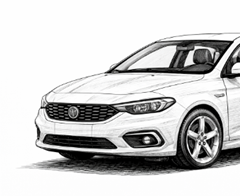
In parallel, launching the Fiat 500 Hybrid at Mirafiori signals a pragmatic strategy: placing alongside EVs a more accessible hybrid solution to support volumes and real demand, especially in a context where prices and charging infrastructure are not uniform.
From a positioning standpoint, FIAT tends to play on three main levers:
Price/value: targeted equipment and content, trying to offer the “right essentials” for the average customer.
Identity: recognizable styling and often very strong communication (the 500 family is the clearest example).
Urban use: setups and engineering choices that prioritize maneuverability and everyday ease.
The brand’s typical trade-offs, especially in the most accessible segments, concern perceived quality of some finishes and the technological gap versus premium brands on aspects such as sound insulation, chassis refinement, or top-tier ADAS performance. In return, the user experience can feel more immediate and less “complex” than highly digitalized products.
On electrification, FIAT is trying to find a balance: offering BEVs where they make sense (city use, fleets, second-car role) without giving up hybrid and combustion solutions where the market still asks for them. Within this frame, models such as Fiat 600 Hybrid and the evolution of the Panda/Grande Panda line indicate a range aiming to cover practical needs before “ideological” ones.
At brand-management level, the figure of Olivier François is relevant because FIAT relies heavily on positioning, storytelling, and image coherence: when that coherence is strong, the brand can “be worth more than the sum” of purely measurable technical content.
In summary, FIAT is most credible today when it stays true to its DNA: urban, smart, accessible cars with distinctive design. The biggest challenge is making that identity compatible with three simultaneous pressures: rising industrial costs, growing expectations for connectivity/ADAS, and the energy transition. Recent signals (Grande Panda as a return to “volume” and 500 Hybrid as a pragmatic mix choice) point toward a more concrete FIAT, oriented to real market demand.

