



Tapioca starch
(Food-grade starch from cassava roots – native and modified forms)
Description
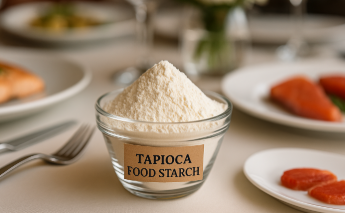
Tapioca starch is a purified starch powder obtained from cassava roots (Manihot esculenta), used as a neutral-tasting thickener, texturiser and binder in many foods.
Commercially it appears as a fine, white, odourless powder (native starch) or as tailored modified tapioca starches (chemically/physically treated to improve stability, freeze–thaw performance, etc.).
It is naturally gluten-free, virtually protein- and fat-free, and almost entirely composed of digestible carbohydrate (starch).
Indicative nutritional values (per 100 g, dry native tapioca starch)
(Typical commercial values; may vary slightly by producer.)
Energy: ~345–360 kcal
Water: ~10–13 g
Protein: 0–0.3 g
Total fat: 0–0.3 g
first occurrence: SFA/MUFA/PUFA = saturated/monounsaturated/polyunsaturated fatty acids; in tapioca starch, total fat and all three fractions are close to zero, so the ingredient is nutritionally “fat-neutral”.
Total carbohydrate: 86–90 g (almost all starch, minimal sugars)
Dietary fibre: 0–1 g (trace)
Sodium: typically 0–30 mg
Minerals (approximate): small amounts of calcium (≈ 10–40 mg) and iron (≈ 0.2–0.5 mg)
(“Resistant” tapioca starches specially processed to increase RS behave more like fibre and contribute less digestible carbohydrate per 100 g than native starch.)
Key constituents
Starch fraction
Mostly amylopectin, with amylose typically in the 18–24% range depending on variety and processing.
This relatively low–medium amylose content contributes to high viscosity, clarity and a soft gel compared with higher-amylose cereal starches.
Minor non-starch components
Traces of protein (≈ 0.1–0.5%), lipids (≈ 0.1–0.5%), minerals and residual fibre, usually removed as far as technologically and economically feasible.
Properly refined tapioca starch is practically free of cyanogenic compounds originally present in raw cassava, which are removed by washing and separation steps.
No gluten
Tapioca starch contains no gluten-forming proteins and is widely used in gluten-free formulations as a structure-building and texturising agent.
Production process
(Outline for native food-grade tapioca starch from cassava roots.)
Raw material & preparation
Fresh cassava roots are washed and peeled soon after harvest to minimise microbial spoilage and loss of starch yield.
Peeling and inspection steps also remove peel tissue with higher levels of cyanogenic glycosides.
Disintegration and extraction
Peeled roots are rasped or ground into a slurry.
The slurry is washed and passed through screens / centrifuges to separate fibre and cell debris from the starch-rich milk.
Purification and de-watering
Starch milk is clarified to remove soluble impurities and fine particles, often via multi-stage sedimentation or centrifugation.
The purified starch slurry is de-watered using filters, centrifuges or presses to form a moist starch cake.
Drying and milling
Starch cake is dried (flash dryer, fluidised-bed, tunnel dryer) to a safe moisture level (~11–13%).
Dried starch is milled and sieved to uniform particle size, then packaged as native tapioca starch (food grade).
Modified tapioca food starches (optional)
Native starch may undergo physical, enzymatic or mild chemical modification (e.g. cross-linking, acetylation, pregelatinisation) to improve shear resistance, freeze–thaw stability, clarity, or instant-thickening properties, remaining food-safe and regulated as modified starch (E14xx series in many jurisdictions).
Physical properties
Appearance: fine, white to off-white powder, free-flowing, odourless and neutral-tasting.
Granule size: generally small to medium starch granules with smooth surfaces, contributing to a silky mouthfeel in many applications.
Gelatinisation: typically in the low–medium temperature range (around 60–70 °C for native starch, depending on system), producing a clear, glossy paste.
Viscosity & clarity: high peak viscosity with good clarity and sheen in gels; modified variants can offer higher stability under heat, shear and acid.
Solubility: native granules are insoluble in cold water, swelling and solubilising only on heating; pregelatinised products hydrate in cold systems.
Sensory and technological properties
Flavour & colour
Neutral flavour and white colour, so it does not interfere with taste or appearance of finished products.
Thickening and texture
Provides smooth, creamy viscosity in soups, sauces, gravies, dairy desserts and fruit fillings.
Can create soft, elastic or chewy textures in products such as tapioca pearls, Asian desserts and some snack bases.
Freeze–thaw and stability
Native tapioca starch has relatively good freeze–thaw stability compared with some cereal starches, though it may still show syneresis in harsh conditions.
Modified tapioca starches can be designed for very high freeze–thaw stability, shear and acid resistance, reducing water separation in frozen/reheated foods.
Food applications
Home and foodservice
Thickener for soups, sauces, gravies, stews and fruit compotes.
Used in gluten-free baking (breads, cakes, cookies, pizza bases) to improve volume, softness and chew.
Preparation of puddings and tapioca-style desserts, often combined with milk/sugar.
Food industry
Bakery & snacks: improves volume, crispness or chewiness in gluten-free breads, cakes, biscuits, crackers and extruded snacks.
Dairy & desserts: stabiliser and texturiser in yogurts, ice cream, custards and puddings, contributing to creamy body and reduced ice crystal growth.
Meat and analogues: binder and water-retention agent in sausages, meatballs, poultry rolls, vegetarian burgers and meat analogues.
Soups, sauces & ready meals: provides viscosity, gloss and stable reheating/freezing characteristics in canned, chilled and frozen products.
Beverages & fruit preparations: stabilises fruit fillings, pie fillings, syrups and bubble-tea pearls (often using modified tapioca starch).
Speciality products: resistant tapioca starches (high RS) used as fibre-enriched ingredients or to reduce net digestible carbohydrates in formulated foods.
Nutrition & health
Native tapioca food starch is essentially a concentrated energy source from starch, with:
high caloric density (~350 kcal/100 g);
negligible fat and protein;
virtually no micronutrients, aside from small amounts of minerals.
As a result, its nutritional role is mainly to provide energy and texture, not vitamins, minerals or protein.
Because the starch is rapidly digestible, native tapioca starch has a high glycaemic index (GI) and can raise blood glucose relatively quickly when used in large amounts.
Resistant tapioca starches (physically or chemically modified to increase RS) behave partly like dietary fibre, leading to:
lower glycaemic impact per gram,
potential benefits for colonic fermentation and microbiota.
Tapioca starch is naturally gluten-free and, in pure form, free from the main priority allergens, making it useful in gluten-free and allergen-managed formulations (subject to cross-contact control).
Portion note:
As a functional ingredient, tapioca food starch is usually used at 3–10% of recipe weight for thickening and 10–30 g per portion in puddings or starch-based desserts.
In gluten-free bakery, it may represent 10–40% of the flour blend, depending on the desired texture.
Allergens and intolerances
Pure tapioca food starch is not a recognised major allergen and is considered gluten-free.
Possible issues:
Cross-contact with gluten or other allergens in shared facilities if controls are inadequate.
In sensitive individuals, large amounts of rapidly digestible starch may aggravate postprandial hyperglycaemia or digestive discomfort.
Certified gluten-free versions are often used in products for coeliac consumers or those with non-coeliac gluten sensitivity.
Quality and specification (typical themes)
Compositional parameters
Moisture, ash, protein, fat and fibre within tight limits (high-purity starch).
Starch content typically ≥ 83–85% (dry basis).
Very low cyanide residues, within safety standards for cassava-derived ingredients.
Physical–functional parameters
Whiteness index and particle size distribution.
Granule damage, gelatinisation temperature, viscosity profile (e.g. RVA curve).
Paste clarity and stability, freeze–thaw performance (for specific grades).
Microbiological criteria
Low total aerobic count, moulds and yeasts, absence of pathogens.
Water activity low enough to ensure dry shelf-stable conditions.
Contaminants
Heavy metals and mycotoxins within legal limits.
Process contaminants (e.g. residual reagents for modified starches) controlled within specification and regulations.
Storage and shelf-life
Store in a cool, dry place, in sealed packaging to protect from humidity, odours and pests.
Recommended conditions: ambient temperature, relative humidity < 65%.
Typical unopened shelf-life: 18–36 months for native and many modified tapioca food starches.
After opening, keep tightly closed and protected from moisture; lumping and microbial growth can occur if starch absorbs water.
Safety and regulatory aspects
Native and modified tapioca food starches are generally recognised as safe food ingredients when produced in accordance with good manufacturing practices.
Regulatory frameworks typically cover:
cassava detoxification and limits for hydrogen cyanide in cassava-derived products;
compositional and purity requirements for modified starches (E14xx where applicable);
quality, contaminants and labelling obligations.
Manufacturers implement GMP/HACCP systems, focusing on:
root intake quality and timing post-harvest;
control of washing, rasping and refining steps;
drying conditions and dust management (explosion risk mitigation);
packaging integrity and contamination avoidance.
Labelling
On retail and industrial packaging, tapioca food starch may appear as:
“tapioca starch”,
“tapioca flour” (terminology varies by market),
“modified tapioca starch” (when altered), sometimes with specific function (e.g. “acetylated distarch adipate”).
Labels typically include:
ingredient name, net weight;
nutritional information where required;
allergen statement (often “gluten-free” if validated);
origin or manufacturer, batch/lot number, best-before date;
storage instructions (keep in a cool, dry place).
Troubleshooting (formulation & processing)
Lumping in sauces or desserts
cause: adding starch directly to hot liquid;
solution: disperse in cold liquid or oil first (slurry), or use pregelatinised starch.
Weak or unstable thickening
cause: under-dosing, excessive shear/acid, prolonged high temperature with native starch;
solution: adjust dosage, control process conditions, or select an appropriate modified tapioca starch with higher stability.
Syneresis (water separation) after freezing/thawing
cause: retrogradation and freeze–thaw stress;
solution: choose freeze–thaw-stable modified tapioca starch or combine with other hydrocolloids.
Too soft/chewy or rubbery texture
cause: high tapioca starch level in gels, noodles or pearls;
solution: partially replace with other starches/flours, adjust solids or cooking time.
Sustainability and supply chain
Tapioca food starch depends on cassava production, which is:
a major staple in tropical regions, often grown by smallholder farmers;
relatively drought-tolerant and able to grow on marginal soils, supporting food security.
Environmental and social aspects:
potential issues with land-use change and deforestation in expanding cassava areas;
large volumes of effluent rich in organic matter from starch extraction, requiring treatment (high BOD/COD);
energy consumption in drying and milling.
Best practices:
integrating cassava cultivation into sustainable farming systems;
improving effluent treatment (anaerobic digestion, biogas) and water reuse;
using by-products (peels, fibre) as animal feed, compost or bioenergy;
applying FIFO stock rotation and robust logistics to limit waste and quality loss.
Main INCI functions (cosmetics & personal care)
Cosmetics
In cosmetics, it is used in powders, deodorants, and skincare products for its ability to absorb sebum and moisture.
INCI Functions
Viscosity control agent. It controls and adapts, Increasing or decreasing, viscosity to the required level for optimal chemical and physical stability of the product and dosage in gels, suspensions, emulsions, solutions.
CAS 9005-25-8
EC number 232-679-6
In cosmetic ingredient lists, tapioca starch typically appears as “Tapioca Starch”.
Key roles:
absorbent (sebum/oil uptake in powders and dry shampoos),
bulking and slip agent in face/body powders,
texture modifier in creams and lotions (silky, non-greasy feel),
component in “natural” or plant-based cosmetic formulations replacing talc or synthetic powders.
Conclusion
Tapioca starch is a highly versatile, gluten-free carbohydrate ingredient derived from cassava roots. Nutritionally, it functions mainly as a source of energy and texture, with negligible fat and protein and little micronutrient contribution, while technologically it offers clean flavour, smooth viscosity, clarity and adaptable functionality across baked goods, dairy, sauces, meat systems and gluten-free products. By choosing the appropriate native or modified grade, formulators can fine-tune viscosity, stability and texture. When produced under robust GMP/HACCP conditions and within a well-managed cassava supply chain, tapioca food starch combines functional performance, safety and broad dietary compatibility, making it a cornerstone ingredient in many modern foods.
Mini-glossary
SFA/MUFA/PUFA – saturated/monounsaturated/polyunsaturated fatty acids; in tapioca food starch all three are near zero because total fat is negligible, so the ingredient does not materially affect dietary fat balance.
BV (biological value) – measure of how efficiently dietary protein can be used for body protein synthesis; tapioca starch has essentially no protein, so BV is not relevant but is important when comparing with protein-rich ingredients.
RS (resistant starch) – fraction of starch that resists digestion in the small intestine and behaves like fibre in the colon; specially processed tapioca “resistant starch” delivers energy reduction and possible gut-health benefits compared with native starch.
GMP/HACCP – good manufacturing practices / hazard analysis and critical control points; management systems that ensure hygienic, controlled and traceable production of tapioca food starch and related products.
BOD/COD – biochemical/chemical oxygen demand; indicators of organic and oxidisable load in cassava-starch factory effluents, used to design and monitor wastewater treatment and reduce environmental impact.
FIFO – first in, first out; inventory-rotation principle in which older lots are used or shipped first, limiting quality loss, infestation risk and waste in starch storage.

