



Peter F. Hamilton, complete biography, British space opera, narrative cycles, shared universes and bibliography
Profile
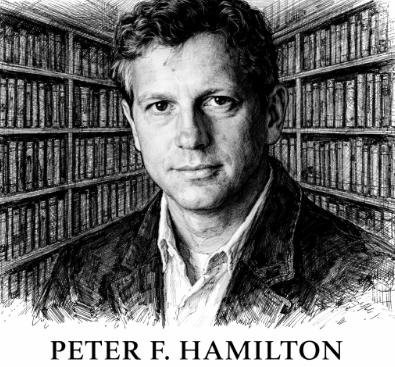
Peter F. Hamilton (1960) is a British science-fiction writer and one of the leading contemporary representatives of Anglophone space opera. His work is characterized by large-scale novels and serial cycles constructed as coherent “future histories,” with sustained attention to technological infrastructures, political dynamics, interstellar economics, and civilization-level conflict.
Hamilton is also known for a strongly architectural approach to storytelling: multi-thread plots, large ensembles of characters, long-range temporal arcs, and shared universes that allow him to articulate—in novelistic form—questions of identity, power, and the transformation of the human in post-terrestrial contexts.
From 1960 to 1989: context, education, and the beginning of narrative activity
Born in 1960 in the county of Rutland, England, Hamilton begins writing professionally in the second half of the 1980s. His background does not follow a university academic track, a fact that does not prevent him, in his mature work, from displaying notable command of technical-scientific vocabularies and an ability to build technologically plausible systems within narrative terms.
The start of his career is tied to the publication of short stories in genre magazines in the late 1980s and early 1990s. This phase functions as a laboratory for themes that remain central: technology as a social environment, the moral consequences of choices, and an interest in the systemic dimension of conflict.
From 1990 to 1995: novel debut and the Greg Mandel cycle
His first consolidation comes with the Greg Mandel trilogy, launched with Mindstar Rising (1993) and developed as a narrative framework combining investigative elements with socio-technological speculation. In this phase Hamilton defines a signature that remains recognizable: the character as an access point to complex systems, and plot as a device for revealing structures of power and collective vulnerability.
The cycle also serves as a bridge toward larger modes of world-building, preparing the ground for the season of large-scale serial space opera.
From 1996 to 2000: expansion of space opera and the construction of “total” universes
With the Night’s Dawn trilogy (published between 1996 and 1999), Hamilton achieves international recognition as an author capable of managing narratives on a vast scale. In this phase several structural traits of his poetics emerge clearly: dense world-building, multiple narrative lines, and a “big event” logic that reorganizes societies and individuals.
Alongside the novels, his shorter fiction remains significant as a space for experimentation and condensation, with texts that contribute to his reputation within the British science-fiction circuit.
From 2001 to 2010: maturity, the Commonwealth universe, and long-form seriality
In the early 2000s Hamilton further broadens his scope with standalone works and, above all, with the launch of the Commonwealth universe. The Commonwealth Saga (with Pandora’s Star, 2004, and Judas Unchained, 2005) is one of the central pillars of his output for systemic ambition and for the construction of a human future articulated through colonization networks, mobility infrastructures, and new forms of conflict.
Within the same universe, the Void Trilogy (2007–2010) extends both temporal and thematic horizons, showing that Hamilton’s seriality is not merely continuation of plot but also a reconfiguration of registers: from techno-political epic toward more hybrid modes, where myth and collective perception enter into tension with the rational scaffolding of space opera.
From 2011 to 2016: universe ramification and The Chronicle of the Fallers
In subsequent years Hamilton consolidates his tendency toward “constellation” world-building, in which individual works connect in non-linear ways. In this context sits The Chronicle of the Fallers, a duology set in the Commonwealth universe, published as The Abyss Beyond Dreams (2014) and A Night Without Stars (2016).
The duology strengthens a typical feature of the author: the use of extreme environments and conditions of isolation as tools to make hierarchies, collective fears, and forms of social adaptation visible, while keeping epic scale as the operational background of the action.
From 2017 to today: new settings, the Salvation sequence, and audience expansion
From 2018 onward Hamilton launches the Salvation sequence (2018–2020), a cycle not tied to the Commonwealth universe, confirming his ability to reinvent the space opera framework in a new context while retaining consistent management of long narrative arcs and the intersection of politics, technology, and collective destiny.
In parallel he develops projects aimed also at younger readers, such as the Arkship trilogy (2021–2022), and continues to publish new works in the most recent decade, confirming stable productivity and significant editorial continuity in the Anglophone market.
Narrative style and universe construction (discursive analysis)
Hamilton’s writing stands out for a “systemic” realism: credibility arises not only from technical detail but from the coherence of institutions, economic constraints, and mechanisms of collective decision-making. Plots are often polyphonic, alternating viewpoints and parallel progressions that converge in high-spectacle nodes.
Another notable feature is his handling of temporality: the narrative tends to integrate slow transformations (technological developments, social change, redefinition of the human) with sudden accelerations (crises, invasions, equilibrium breaks). The result is a space opera in which epic scale does not erase the moral dimension, but rather complicates it by situating it within vast and often opaque systems.
Themes and system of ideas
Among the most recurrent themes are the relationship between technology and power, the transformation of subjectivity in post-terrestrial contexts, the tension between individual freedom and systemic governance, and the idea of the “future” as a space of conflict among civilizational models. In his fiction, the alien tends to function not only as an external threat but as a stress test of human structures: institutions, languages, civil religions, economies, and collective imaginaries.
On an anthropological level, Hamilton often treats the human as an evolving category: biology, identity, and memory become manipulable elements, and ethical questions shift from individual intentions to large-scale consequences of technological and political choices.
Bibliography (main)
Series and cycles
Greg Mandel trilogy: Mindstar Rising (1993), A Quantum Murder (1994), The Nano Flower (1995)
Night’s Dawn trilogy: The Reality Dysfunction (1996), The Neutronium Alchemist (1997), The Naked God (1999)
Commonwealth saga: Pandora’s Star (2004), Judas Unchained (2005)
Void trilogy: The Dreaming Void (2007), The Temporal Void (2008), The Evolutionary Void (2010)
The Chronicle of the Fallers: The Abyss Beyond Dreams (2014), A Night Without Stars (2016)
Salvation sequence: Salvation (2018), Salvation Lost (2019), The Saints of Salvation (2020)
Arkship trilogy: A Hole in the Sky (2021), The Captain’s Daughter (2022), Queens of an Alien Sun (2022)
Standalone novels and other relevant titles
Fallen Dragon (2001)
Misspent Youth (2002)
Great North Road (2012)
Legacy and recognition
Hamilton is regarded as a reference author of contemporary space opera for his ability to combine high-intensity entertainment with complex narrative structures and systematic world-building. His influence can be seen in the normalization—within the genre’s mainstream—of long novels and extended serialities that treat future history as a coherent ecosystem in which technology, politics, and culture are inseparable.
In terms of recognition, his reception includes awards and nominations within the Anglophone science-fiction circuit, as well as editorial stability that positions him among the most published and widely read authors in the large-scale space opera segment.
Conclusion
Peter F. Hamilton has built an authorial trajectory centered on space opera as a modern form of the systemic novel: a device capable of representing complex societies, human transformation, and conflict on an interstellar scale. From his early cycles to the vast architectures of the Commonwealth universe and his more recent series, his work maintains a consistent core: using technological epic as a tool to interrogate power, identity, and the ethical consequences of modernity projected into the future.

