



Johann Wolfgang von Goethe, complete biography, Sturm und Drang, Weimar Classicism, Faust and bibliography
Profile
Johann Wolfgang von Goethe (1749–1832) is one of the central figures of European culture between the eighteenth and nineteenth centuries. A writer, poet, and dramatist, but also a statesman, critic, and author of scientific studies, Goethe decisively shaped the formation of modern German literature and the very idea of the “classic” in the modern age.
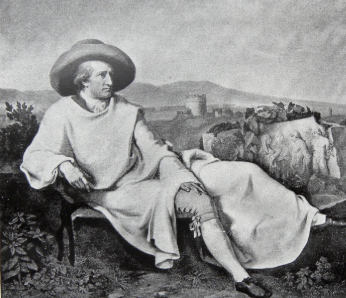
His intellectual trajectory spans distinct phases and movements, from the youthful impulse of Sturm und Drang to the subsequent elaboration of Weimar Classicism, and finally to the monumental synthesis of the Faust project, conceived as a long-term poetic, philosophical, and anthropological laboratory. His work unites attention to form, reflection on experience, and a constant search for order among nature, the individual, and history.
From 1749 to 1770: cultural context and education
Goethe is born in Frankfurt am Main in 1749, into a cultivated bourgeois milieu that encourages broad education and early familiarity with languages, literature, and the arts. Germany at the time is politically fragmented and culturally in transition, with an expanding debate between Enlightenment models, new sentimental sensibilities, and pressures toward freer expressive forms.
His law studies, pursued between Leipzig and Strasbourg, prove decisive not only for professional preparation but also for exposure to different intellectual environments and for engagement with aesthetic and philosophical questions. In these years, interests that will remain structural take shape: the relationship between nature and culture, the centrality of individual experience, and attention to form as a vehicle of knowledge.
From 1771 to 1775: Sturm und Drang and the surge of success
Between the early 1770s and 1775 Goethe becomes a leading figure of the new sensibility of Sturm und Drang, which values creative energy, conflict, inwardness, and criticism of convention. Success arrives through works that impose a new literary language and a new model of subjectivity.
In particular, The Sorrows of Young Werther (1774) helps define a European imaginary of passion and the crisis of the modern self, while his early theatre experiments with historical and conflict-driven drama. This phase establishes Goethe’s reputation as an author capable of capturing, with formal power, the anthropological transformation of modernity.
From 1775 to 1786: Weimar, public office, and cultural reorientation
In 1775 Goethe moves to Weimar at the court’s invitation, beginning a long residence that intertwines artistic production and institutional responsibilities. He soon assumes significant roles in the duchy’s administration, serving on commissions and in functions that place him at the center of local political and cultural life.
The governmental experience acts as a force of discipline and reorientation: Goethe consolidates an idea of culture linked to formation, institutions, and long duration. In these years he works on dramatic and poetic texts in which youthful tension is progressively reformulated in a more controlled and structured key, foreshadowing the subsequent classicist season.
From 1786 to 1788: the Italian journey and the classicist turn
The Italian journey (1786–1788) is a decisive threshold in Goethe’s aesthetic development. Direct encounter with the art and archaeology of the classical world and with the Mediterranean landscape strengthens an ideal of formal measure, balance, and clarity, reshaping his artistic priorities.
His reflection on the “classical” does not amount to imitation but to a program of rigor: form becomes a method of knowledge and an instrument for ordering experience. From this phase derives an important part of Goethe’s image as a cultural architect of Weimar Classicism.
From 1794 to 1805: friendship with Schiller and Weimar Classicism
From 1794 onward Goethe’s intellectual relationship with Friedrich Schiller takes shape and becomes a motor of exchange and production. In this period Weimar Classicism defines itself as a cultural project: not only a style, but an idea of literature as a space of education and the foundation of shared criteria.
Goethe develops narrative and poetic works in which the formation of the individual, responsibility, and mediation between impulse and norm acquire structural value. Collaboration and dialogue with Schiller reinforce a model of literature oriented toward integrating modern sensibility with the search for formal order.
From 1806 to 1832: maturity, final synthesis, and disciplinary breadth
In his last decades Goethe continues literary activity with an idea of the oeuvre as a long-term construction. This phase includes the progressive configuration of Faust as a comprehensive project, in which questions of knowledge, desire, ethics, power, and the limits of human experience converge.
In parallel, Goethe consistently cultivates scientific interests, including studies on plant morphology and the theory of color. These investigations are not a mere “interlude” from literature: they reflect the same need to interpret reality through forms and structures, linking observation, perception, and the construction of knowledge.
Style and architecture of the oeuvre (discursive analysis)
Goethe’s writing displays a marked ability to traverse genres and registers while maintaining high formal control. In the youthful phase, emotional intensity and rupture prevail, with a language aimed at representing urgency and conflict; in maturity, a tendency toward composition, measure, and the construction of exemplary figures dominates.
Narratively, Goethe develops models centered on formation and transformation: the individual is observed over time, in choices and consequences, with attention to how experience produces identity. In theatre and poetry, form tends to function as a device of concentration: the issue is not only to “say” a content, but to configure it so that structure itself becomes knowledge.
Themes and system of ideas
Among the most recurrent themes are the relationship between nature and culture, dynamics of formation, the tension between desire and norm, individual responsibility, and the role of art as mediation. Goethe confronts modernity without reducing it to mere crisis: he registers its contradictions, but also seeks criteria of balance and instruments of understanding.
In Faust these nuclei take on paradigmatic form: the drive toward knowledge and mastery of the world intertwines with the problem of limits, error, and ethical consequences. The work thus becomes a complex picture of the modern condition, in which aspiration and risk proceed together.
Bibliography (main)
Novels and narrative
The Sorrows of Young Werther (1774)
Wilhelm Meister’s Apprenticeship (1795–1796)
Elective Affinities (1809)
Italian Journey (published in several stages, 1816–1817)
Theatre
Götz von Berlichingen (1773)
Iphigenia in Tauris (versions between 1779 and 1787)
Egmont (published 1788)
Torquato Tasso (1790)
Faust. Part One (1808)
Faust. Part Two (posthumous, 1832)
Poetry and other texts
Roman Elegies (composed in the late eighteenth century, published later)
Hermann and Dorothea (1797)
Scientific and essayistic writings
The Metamorphosis of Plants (1790)
Theory of Colours (1810)
Legacy and recognition
Goethe is regarded as a reference author for European literature because he combines breadth of competence with project continuity, offering formal and conceptual models that shaped Romanticism, modernism, and theories of culture. Weimar Classicism, of which he is a protagonist, is not reducible to a school: it is a program of stabilization and construction, founded on the idea that literary form can help organize historical and individual experience.
His influence is also evident in his ability to make literature a site of dialogue among disciplines: poetry, theatre, criticism, science, and reflection on education converge into an integrated image of knowledge that remains relevant today for literary studies, philosophy of culture, and theories of modernity.
Conclusion
Johann Wolfgang von Goethe represents an emblematic case of an author in whom intellectual biography, institutional responsibilities, and artistic project intertwine organically. From Sturm und Drang to Weimar Classicism, and finally to the synthesis of Faust, his work constructs a vision of modernity grounded in form, experience, and a search for order, maintaining a stable centrality in the history of European thought and literature.

