



Friedrich Maximilian Klinger, complete biography, Sturm und Drang, eighteenth-century German theatre, Russian service and bibliography
Profile
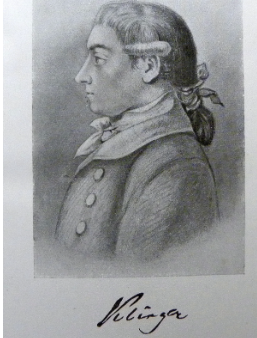
Friedrich Maximilian von Klinger (1752–1831) is a German writer and dramatist and one of the most representative names of Sturm und Drang. His position in literary history is linked above all to his early theatrical production and, in particular, to the fact that the movement takes its name from one of his plays, Der Wirrwarr, oder Sturm und Drang (1776).
Alongside his German period, Klinger built a long and atypical career within the Russian Empire, holding military and institutional posts. In that context he developed a narrative and philosophical-novelistic output that shows an evolution from the dramatic conflict of Sturm und Drang toward more reflective and systematic forms.
From 1752 to 1775: context, education, and early orientations
Born in Frankfurt am Main on 17 February 1752, Klinger grows up in a non-aristocratic social environment, a factor often invoked to explain the strong sensitivity to status tensions, dependence, and conflict that permeates his early drama. He studies at the University of Gießen, entering the pre-classical German cultural sphere in which criticism of rationalist Enlightenment translates into new forms of emotional expressivity.
In this phase he also develops generational proximity to authors such as Goethe and Lenz, which places him within the historical core of Sturm und Drang, understood as a literary and anthropological revolt against normative models perceived as restrictive.
From 1776 to 1780: Sturm und Drang affirmation and the centrality of theatre
The year 1776 marks a decisive turning point: with Der Wirrwarr, oder Sturm und Drang Klinger provides the movement with the designation that will become canonical. The same season includes plays in which dramatic energy is built on moral and familial collisions, intensified language, and figures driven toward extreme choices, according to an anti-conciliatory model.
Among the most frequently cited texts of his youthful phase is Die Zwillinge (1776), often associated with the “high” and conflict-driven profile of Sturm und Drang theatre. More broadly, this phase establishes his reputation as an author of strong impact, oriented toward staging the fracture between individual impulse and social constraints.
From 1780 to 1799: move to Russia, career, and a reorientation of writing
In 1780 Klinger relocates to St Petersburg and embarks on a career in the Russian Empire, progressively integrating into military and court roles. Accounts frequently mention his closeness to Grand Duke Paul and positions of responsibility connected with the education of military and aristocratic elites.
This displacement produces a transformation in his writing. Without abandoning drama, Klinger increasingly develops narrative and “philosophical novels,” in which the conflictual energy of Sturm und Drang is reworked in a more discursive and speculative form. This period includes Fausts Leben, Taten und Höllenfahrt (1791), part of a group of works that signal the transition toward a more meditative architecture.
From 1800 to 1817: institutional posts and mature synthesis
In the early nineteenth century Klinger assumes prominent posts within Russian cultural administration. He is commonly recorded as having been appointed curator of the University of Dorpat (today Tartu) in 1803, an office he holds until 1817, indicating his full institutionalization within the imperial apparatus.
In this season his authorial identity stabilizes into a “long-duration” position: on the one hand, the memory of his youthful production as a historical reference point of Sturm und Drang; on the other, a body of narrative and reflective works that dialogues with the evolution of German culture toward classicism and, more generally, toward a literature of greater formal self-control.
From 1818 to 1831: final years and consolidation of reception
Klinger dies on 9 March 1831 in Dorpat, within the Russian Empire. Modern reception tends to distinguish between his “historical-naming” relevance within Sturm und Drang and the broader, more discontinuous but significant, later production, which is often less familiar to general readers than his 1770s plays.
Dramaturgical and narrative style (discursive analysis)
In his early drama, Klinger favors a high-pressure conflict model: family, authority, and moral legitimacy become testing grounds in which speech is action and action is a clash between incompatible principles. The emotional dimension is not ornamental, but structures the architecture of the stage, often with unresolved outcomes.
In the Russian period, his writing tends to expand toward the novel and reflective prose. The focus shifts toward building ideas in narrative form, with greater investment in argumentation and in the representation of moral and intellectual trajectories, while retaining a core tension characteristic of his Sturm und Drang origins.
Themes and system of ideas
The most recognizable thematic nucleus concerns criticism of rigid forms of rationalism and social normativity, replaced by a representation of the human as a field of forces: desire, ambition, guilt, and conflict between self-determination and constraint. In the theatre, these elements appear most clearly in the dialectic between authority and subjectivity; in mature narrative, they become tools for reflecting on responsibility, formation, and the legitimation of power.
The overall trajectory therefore shows continuity of problems more than continuity of style: how to represent the human when traditional structures—social, moral, institutional—are contested or prove insufficient.
Bibliography (main)
Theatre
Der Wirrwarr, oder Sturm und Drang (1776)
Die Zwillinge (1776)
Medea in Korinth (1787)
Medea auf dem Kaukasus (1791)
Narrative and philosophical-novelistic prose
Fausts Leben, Taten und Höllenfahrt (1791)
Legacy and recognition
Klinger is a key figure in the history of German literature primarily because he embodies, paradigmatically, the rupture phase of Sturm und Drang and even bequeaths its name. His historical importance, however, is not reducible to a single title: his long Russian experience and institutional appointments show an author able to traverse different political and cultural contexts, transforming a poetics of conflict into a broader production, sometimes less canonized but relevant for understanding continuities and metamorphoses between the late eighteenth and early nineteenth centuries.
Conclusion
Friedrich Maximilian von Klinger represents a significant case of an author whose historical-literary impact arises from a strong identification with a generational season, yet later develops into a long and institutionally complex cultural biography. From Sturm und Drang dramaturgy to the narrative production of the Russian period, his work makes it possible to observe how the conflict between individual and order changes over time from a radical theatrical gesture to a problem of form and thought.

