



François-René de Chateaubriand, complete biography, French Romanticism, Génie du christianisme, Mémoires d’outre-tombe and bibliography
Profile
François-René, vicomte de Chateaubriand (1768–1848) is a foundational figure of French Romanticism and, more broadly, of European sensibility from the late eighteenth century to the first half of the nineteenth. A writer, memoirist, polemicist, and diplomat, he decisively reshaped modern literary prose through a language of high figurative intensity, a vision of nature as moral space, and a representation of the self marked by melancholy, restlessness, and the search for meaning.
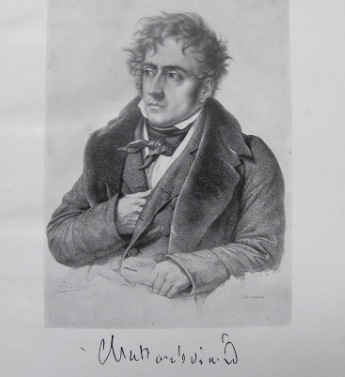
His importance stems from the interweaving of historical experience and literary construction. The French Revolution, exile, the Napoleonic age, and the Restoration are not merely biographical frames, but materials his work reprocesses as problems of political legitimacy, spiritual crisis, and the formation of modern consciousness. In this perspective, Chateaubriand functions as a “threshold” author, poised between Enlightenment and Romantic modernity, between classicism and new forms of feeling, between active politics and memorial retreat.
From 1768 to 1792: education, aristocratic milieu, and a first cultural horizon
Born in Saint-Malo in 1768, Chateaubriand grows up in an aristocratic environment marked by a strong traditional imprint and an intense relationship with the places of childhood, above all Brittany. The landscape dimension and the experience of hierarchical social life, together with a sense of isolation and “estrangement,” form a matrix that will re-emerge as style and theme: nature not as decoration, but as a device of inwardness.
With the outbreak of the Revolution, Chateaubriand confronts a historical rupture that affects his social identity and his imagination. The instability of the period accelerates the transition from a traditional aristocratic horizon to a more modern condition defined by uncertainty, the experience of uprooting, and the need to transform life into narrative.
From 1791 to 1800: the American journey, exile, and first recognition
In 1791 Chateaubriand undertakes a journey to North America, an experience that becomes a symbolic reservoir for his future “American” narratives. Encounter with territories perceived as primordial and with Indigenous peoples is reworked literarily as a contrast between nature and civilization, innocence and guilt, freedom and constraint.
After revolutionary events intensify, he joins the émigré milieu and spends difficult years in England. In this period he begins a project of historical and moral interpretation of revolutions that culminates in the Essai sur les révolutions (1797). Writing starts to function as an instrument of material survival and, at the same time, as the construction of intellectual authority. In 1800 he returns to Paris, entering the journalistic and literary circuits of post-revolutionary France.
From 1801 to 1811: literary turning point, Christian apologetics, and consecration
Literary success is secured with Atala (1801), a tale set in an idealized and tragic America, in which the sentimental plot is structured as a conflict between desire and religion. Shortly thereafter, with Le Génie du christianisme (1802), Chateaubriand produces an apologetic work that defends Christianity not so much on the terrain of theological proof as on that of its cultural, aesthetic, and moral power. The book exerts major influence because it helps legitimize a new alliance between Romantic sensibility and religious tradition, transforming religion into an object of poetic imagination and a source of artistic languages.
In the same context stands René, a text that constructs a model of modern subjectivity marked by restlessness, dissatisfaction, and melancholy, becoming emblematic of the nineteenth-century generational malaise. The “René-like” figure functions as a paradigm: it represents not only an individual story, but an existential posture characterized by indefinite aspiration and an inability to find stable order in experience.
In public life, the author enters institutional relations with the Napoleonic regime but breaks decisively after the execution of the Duke of Enghien (1804), an episode that strengthens his image as a morally oppositional intellectual. The phase closes with cultural consecration: works such as Les Martyrs (1809) and the Itinéraire de Paris à Jérusalem (1811), a travel account of the Mediterranean and the East, consolidate his reputation and contribute to his election to the Académie française (1811).
From 1814 to 1830: Restoration, diplomacy, and political role
With Napoleon’s fall, Chateaubriand assumes a prominent role in the Restoration climate. He intervenes with a decisive pamphlet against the emperor, De Buonaparte et des Bourbons (1814), positioning himself as an influential voice in the political transition. In subsequent years he combines a diplomatic career with an ideological stance: he is active both as a statesman and as an author able to interpret monarchical legitimacy and its fragilities within the new European landscape.
His career reaches its high point in the early 1820s: representative posts abroad, participation in negotiations, and above all his service as foreign minister (1822–1824). In this role he supports the French intervention in Spain in 1823, intended to restore the Bourbon monarchy, an episode that reveals his conception of politics as projection of international prestige and reaffirmation of a legitimate order. After 1824 his position becomes more complex and conflictual with respect to the balance of power, and he gradually shifts toward opposition and withdrawal.
From 1830 to 1848: withdrawal, memory, and the construction of the autobiographical monument
After the political turning point of 1830, Chateaubriand withdraws from public life and concentrates his energies on memoir writing. In this phase the great project of the Mémoires d’outre-tombe—begun earlier and conceived as a work for posterity—takes definitive shape. The Mémoires are not a simple autobiographical narrative: they construct a representation of the age as a theatre of historical transformations and, at the same time, a history of the author’s sensibility, perceptions, passions, and melancholy.
The work thus becomes a device of literary and political legitimation: Chateaubriand positions himself as a privileged witness to an epochal transition, while transforming his own life into narrative architecture. He dies in 1848 in Paris; the Mémoires d’outre-tombe are published posthumously, definitively consolidating his centrality within the Romantic tradition.
Style and poetics (discursive analysis)
Chateaubriand’s prose is characterized by a strong investment in description as moral experience: landscapes, ruins, forests, and seascapes are not neutral backgrounds, but places where memory, desire, and loss are deposited. Nature is often constructed as the great interlocutor of the self, and the writing proceeds through dense imagery, expansive rhythms, and a syntax able to alternate solemnity and intimacy.
On the historical-literary plane, Chateaubriand plays a mediating role: he introduces into French discourse an imagination of the “savage” and the exotic that is not merely decorative, but functions as an implicit critique of European modernity. In parallel, he establishes a model of modern memoir writing in which public history and inner life are rendered inseparable, anticipating a significant portion of nineteenth-century autobiographical narrative.
Themes and system of ideas
Among his most consistent thematic cores are nostalgia as a mode of knowledge, melancholy as a historical posture, tension between faith and doubt, and the search for legitimacy in a world shaken by revolutions. Christianity, in his work, is at once an object of cultural defense and a symbolic grammar: it becomes the language of art, memory, suffering, and hope.
Travel, both real and literary, plays a structural role: from America to the Mediterranean East, geographic movement becomes experimentation with identity, confrontation with otherness, and the construction of a European vision of the self. In this sense, Chateaubriand is not only an author of “Romantic” texts, but an interpreter of how modernity elaborates its relationship with the past, the sacred, nature, and politics.
Bibliography (main)
Essays and pamphlets
Essai sur les révolutions (1797)
Le Génie du christianisme (1802)
De Buonaparte et des Bourbons (1814)
Narrative and prose
Atala (1801)
René (1802; later separate publication)
Les Martyrs (1809)
Itinéraire de Paris à Jérusalem (1811)
Les Natchez (1825–1826)
Mémoires d’outre-tombe (posthumous publication, 1849–1850)
Legacy and recognition
Chateaubriand is a decisive figure because he inaugurates a French Romanticism centered on the power of prose, the authority of the self, and the aesthetic valorization of Christianity as a cultural source. His influence concerns both form and imagination: landscape as a mirror of consciousness, travel as a narrative device, and melancholy as historical interpretation become structural elements for subsequent generations.
Over the long term, the Mémoires d’outre-tombe stand as one of the great monuments of European memoir literature, capable of holding together historical testimony and self-interpretation, and of proposing a model of writing in which individual experience is transformed into a cultural category.
Conclusion
François-René de Chateaubriand unites literature and history in a coherent project: to construct a modern form of the self and, at the same time, to interpret an age of rupture. From the “American” tales to the aesthetic defense of Christianity, from diplomacy to the monumental scope of the Mémoires d’outre-tombe, his work defines a cultural threshold in which Romanticism becomes not only style, but a mode of knowing the world and oneself.

