



Tartrates
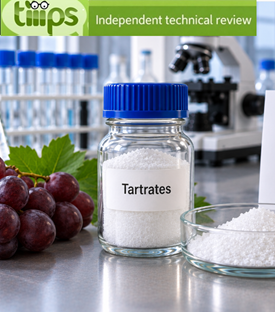
Tartrates are the salts of tartaric acid, an organic acid naturally present particularly in grapes, wine, and other plant-derived foods.
The main tartrates used in food include sodium, potassium, and calcium tartrates, as well as mixed salts such as sodium potassium tartrate.
Chemically, they are formed through the partial or complete neutralisation of tartaric acid with bases containing specific mineral elements.
In foods, tartrates are mainly used for technological purposes as acidity regulators, stabilisers, and sequestrants, and some forms may also play a role in leavening systems.
Potassium hydrogen tartrate, commonly known as cream of tartar, is one of the best-known tartaric acid derivatives and is widely used in baking and in the preparation of raising agents.
Tartrates do not represent a single substance: their nutritional and technological properties depend on the associated mineral ion, the amount used, and the specific formulation.
At the quantities normally used in food, they serve mainly technological functions rather than acting as significant sources of nutrients.
Calories
Tartrates make a negligible contribution to energy intake at the amounts normally used in foods.
They are not used as sources of carbohydrates, fats, or proteins and therefore do not contribute significantly to the calorie content of the final product.
The calories in a food containing tartrates come essentially from the other ingredients in the formulation.
Uses in Food
Tartrates are used in various foods as acidity regulators and stabilisers.
They may be found in baked goods, confectionery, beverages, sweets, desserts, and processed foods.
Potassium hydrogen tartrate is frequently combined with sodium bicarbonate in chemical raising agents, where the acid-base reaction releases carbon dioxide and helps doughs and batters rise.
It can also help stabilise whipped egg whites and regulate acidity in certain confectionery and baking preparations.
Some tartrates may be used to control pH, improve product stability, or bind certain metal ions.
Their role is primarily technological, and the quantities used are normally much smaller than those of the main food ingredients.
Uses in Cosmetics
Tartaric acid and some of its salts may also be used in cosmetics.
They can be employed as pH regulators, buffering agents, or components of formulation systems.
Tartaric acid derivatives may occur in creams, cleansers, hair-care products, and skin-care preparations.
Tartaric acid itself belongs to the alpha-hydroxy acid (AHA) family and may be used in some exfoliating formulations, whereas its salts have different properties and are used mainly for technological purposes.
Food-grade tartrates should not be considered equivalent to cosmetic formulations containing tartaric acid or its derivatives at specific concentrations.
Allergens
Tartrates are not among the major food allergens subject to mandatory declaration in the European Union, United Kingdom, or United States.
True allergic reactions specifically to tartrates are considered uncommon.
As with other mineral salts and food additives, however, high amounts may cause gastrointestinal discomfort in susceptible individuals, particularly when exposure is substantially greater than that normally obtained from food.
In compound products, allergens present in the other ingredients should be assessed separately.
Evaluation
Tartrates are primarily technological ingredients, useful for regulating acidity, stabilising formulations, and participating in certain leavening systems.
At the amounts normally used in food, they are generally well tolerated and do not represent a nutritionally significant ingredient.
Their specific evaluation nevertheless depends on the type of tartrate and the amount used, since different salts may provide sodium, potassium, or calcium.
Ingredient verdict: generally well-tolerated food additives and technological ingredients, useful mainly for acidity regulation, stabilisation, and certain leavening processes.
Cons: high doses may cause gastrointestinal discomfort; composition and mineral contribution depend on the specific type of tartrate

