



Non-hydrogenated palm oil
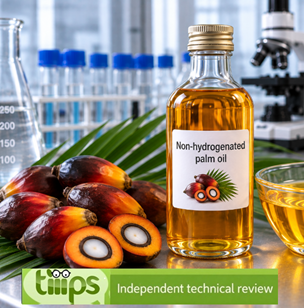
Non-hydrogenated palm oil is a vegetable oil obtained mainly from the pulp of the fruits of the oil palm (Elaeis guineensis, family Arecaceae) that has not undergone hydrogenation.
It is naturally semi-solid at room temperature because of its fatty acid composition, so it can be used in many food products without requiring hydrogenation.
From a nutritional point of view, it consists almost entirely of lipids.
It contains a relatively high proportion of saturated fatty acids, particularly palmitic acid, together with significant amounts of oleic acid, a monounsaturated fatty acid, and smaller amounts of linoleic acid and other fatty acids.
Its typical composition is approximately half saturated fats and half unsaturated fats, although the exact proportions vary according to variety and processing.
Crude palm oil naturally contains substantial amounts of carotenoids and vitamin E, particularly tocotrienols and tocopherols. Refining, however, reduces some of these compounds and produces a lighter-coloured, more neutral-tasting oil that is better suited to industrial food applications.
The term “non-hydrogenated” means that the oil has not been subjected to partial hydrogenation and therefore does not contain the industrially produced trans fats typically associated with that process.
This does not, however, change its naturally high content of saturated fat.
Calories
Non-hydrogenated palm oil provides approximately 880–900 kcal per 100 g.
One tablespoon of about 10 g provides approximately 90 kcal.
Like all oils and fats, it therefore has a very high energy density.
Uses in Food
Palm oil is widely used in the food industry because of its stability, semi-solid consistency, and relatively neutral flavour after refining.
It may be found in biscuits, baked goods, spreads, snacks, fillings, coatings, confectionery products, and processed foods.
Its natural structure allows manufacturers to obtain texture and creaminess without necessarily using partially hydrogenated vegetable fats.
It is also used in margarines, bakery fats, shortenings, and preparations requiring a stable fat structure.
Its relatively good oxidative stability is supported by its higher proportion of saturated and monounsaturated fats, making it more resistant to oxidation than many oils that are very rich in polyunsaturated fatty acids.
Refined palm oil may also be used for frying and other high-temperature cooking applications.
From a nutritional perspective, however, the total amount consumed should be considered because its relatively high saturated fat content can make a significant contribution to overall daily saturated fat intake.
Uses in Cosmetics
Palm oil and palm-derived ingredients are also widely used in the cosmetics industry.
They may be found in creams, soaps, cleansers, balms, hair-care products, lipsticks, and emollient formulations.
Palm oil mainly acts as an emollient, helping to improve skin softness and providing a protective feel.
Numerous palm-derived fatty acid ingredients are also used as surfactants, emulsifiers, thickeners, and structuring agents.
These may include derivatives of palmitic, stearic, and oleic acids, which are used in a wide range of cosmetic formulations.
Food-grade palm oil should not, however, be considered equivalent to purified or chemically modified cosmetic derivatives produced industrially.
Allergens
Palm oil is not among the major food allergens subject to mandatory declaration in the European Union, United Kingdom, or United States.
Specific allergic reactions to palm oil are considered uncommon.
Highly refined palm oil generally contains very low amounts of residual protein.
As with other vegetable oils, individual reactions are more likely to depend on residual components or on other ingredients present in the final product.
In processed foods, any additional allergens in the formulation should therefore also be considered.
Evaluation
Non-hydrogenated palm oil has good technological and oxidative stability and can provide structure without the need for partial hydrogenation.
The absence of hydrogenation avoids the production of industrially produced trans fats associated with that process, but the oil remains naturally rich in saturated fatty acids, particularly palmitic acid.
From a nutritional perspective, it should therefore be considered in the context of the overall diet and total saturated fat intake.
Ingredient verdict: a technologically stable vegetable fat that avoids trans fats produced by partial hydrogenation, but is naturally rich in saturated fatty acids; moderate consumption is therefore preferable as part of a balanced diet.
Cons: high in saturated fat and highly calorie-dense

