



Non-hydrogenated sunflower oil
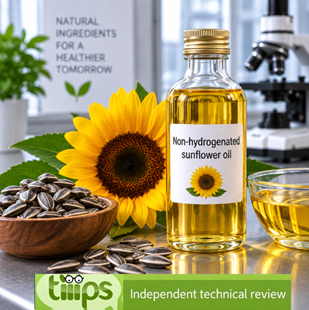
Non-hydrogenated sunflower oil is a vegetable oil obtained from the seeds of the sunflower (Helianthus annuus, family Asteraceae) that has not undergone hydrogenation to alter its consistency or artificially increase its saturated fat content.
The term “non-hydrogenated” therefore indicates that the oil retains its natural lipid structure without being modified through a hydrogenation process.
From a nutritional point of view, it consists almost entirely of fat and contains predominantly unsaturated fatty acids.
In conventional sunflower oil, the predominant fatty acid is generally linoleic acid, an omega-6 fatty acid, while certain selected varieties, known as high-oleic sunflower oil, contain much higher proportions of oleic acid.
It also contains vitamin E, mainly in the form of tocopherols, although the amount may vary depending on the variety, processing method, and degree of refining.
The absence of hydrogenation is relevant because it avoids the formation of industrially produced trans fats associated with partial hydrogenation of oils.
A distinction should nevertheless be made between conventional sunflower oil and high-oleic sunflower oil: the former is richer in polyunsaturated fats and therefore more susceptible to oxidation, whereas the latter generally has greater stability at high temperatures.
Calories
Non-hydrogenated sunflower oil provides approximately 880–900 kcal per 100 g.
One tablespoon of about 10 g provides approximately 90 kcal.
Like all oils, it therefore has a very high energy density because it consists almost entirely of lipids.
Uses in Food
Non-hydrogenated sunflower oil is used as a dressing and as an ingredient in a wide variety of foods.
It can be used in salads, sauces, mayonnaise, marinades, and emulsified dressings.
It is also widely used in baked goods, biscuits, crackers, creams, snacks, preserves, and processed foods because of its relatively neutral flavour.
Refined versions may also be used for cooking, while high-oleic sunflower oil is particularly suitable for prolonged use at higher temperatures because it is more resistant to oxidation than varieties rich in linoleic acid.
The term “non-hydrogenated” is particularly relevant in processed foods because it indicates that the oil has not been converted into a more solid fat through hydrogenation.
From a nutritional perspective, it is still advisable to use it as part of a varied fat intake, avoiding an excessive overall imbalance toward omega-6 fatty acids compared with other sources of unsaturated fats.
Uses in Cosmetics
Sunflower oil is also widely used in cosmetics for its emollient and conditioning properties.
It may be found in creams, lotions, body oils, cleansers, balms, and hair-care products.
Because of its content of linoleic acid, oleic acid, and vitamin E, it can help improve skin softness and support the skin barrier.
It is also used as a carrier oil for plant extracts and fat-soluble ingredients.
High-oleic versions are generally more resistant to oxidation and may be preferred in some cosmetic formulations requiring greater stability.
Food-grade and cosmetic-grade sunflower oils may originate from the same raw material, but their requirements for refining, purity, and formulation may differ.
Allergens
Sunflower oil is not among the major food allergens subject to mandatory declaration in the European Union, United Kingdom, or United States.
Allergy to sunflower seeds is possible but relatively uncommon.
Highly refined oils generally contain very low amounts of residual protein, whereas cold-pressed or less-refined oils may retain greater amounts of seed proteins.
People with a specific sunflower seed allergy should therefore consider the type of oil being used.
Evaluation
A vegetable oil characterised by a predominance of unsaturated fats and generally a low content of saturated fat.
The absence of hydrogenation is a favourable feature because it avoids the production of trans fats resulting from partial hydrogenation.
Its nutritional characteristics and stability depend, however, on the type of oil: conventional sunflower oil is generally rich in linoleic acid, while high-oleic sunflower oil contains a higher proportion of oleic acid and is more resistant to oxidation.
Ingredient verdict: a good non-hydrogenated vegetable oil, rich in unsaturated fats and vitamin E; the high-oleic version offers greater stability at high temperatures, while linoleic-rich varieties require more care with storage and prolonged heating.
Cons: high energy density; linoleic-rich varieties are more susceptible to oxidation

