



Inactivated yeast
Inactivated yeast consists of yeast cells, generally Saccharomyces cerevisiae, that have been rendered non-viable by heat treatment or other technological processes.
Unlike active baker’s yeast, it cannot ferment sugars or make dough rise.
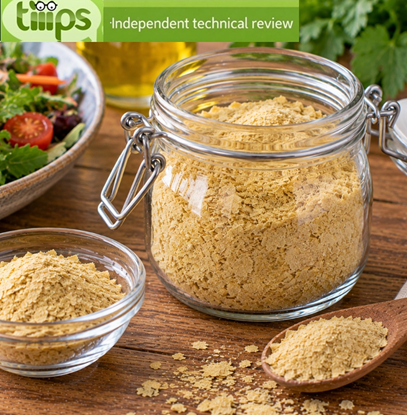
It may be sold as flakes, granules, powder, or a dried ingredient and is mainly used for its nutritional value and its characteristic savoury, umami flavour.
Inactivated yeast generally contains a significant amount of protein, together with amino acids, dietary fibre, and cell-wall components such as beta-glucans and mannans.
It is naturally a source of several B vitamins, although the actual amounts vary considerably depending on the strain and manufacturing process.
Vitamin B12 requires particular clarification: it should not be assumed to be naturally present in nutritionally significant amounts in all inactivated yeast products. Many products sold as nutritional yeast are fortified with vitamin B12, so the actual content should be checked on the label.
Processing may also release naturally occurring amino acids and nucleotides, which contribute to its intense savoury taste and flavour-enhancing properties.
Calories
Dried inactivated yeast generally provides approximately 330–400 kcal per 100 g.
The actual value varies depending on the content of protein, carbohydrates, fibre, and fat and on the manufacturing process.
Because it is usually consumed in relatively small amounts, such as a few grams per serving, its actual contribution to total calorie intake is generally moderate.
Uses in Food
Inactivated yeast is widely used as a flavouring and seasoning ingredient.
In flake or powder form, it can be added to pasta, risotto, vegetables, soups, salads, and dishes based on legumes or cereals.
It is particularly popular in vegetarian and vegan foods, where it provides a savoury flavour that may resemble aged cheese in certain preparations.
It can also be used in sauces, plant-based creams, seasonings, savoury baked goods, and snacks.
Inactivated yeast may also be used as a raw material for the production of yeast extracts, in which cellular components are further released and concentrated.
It should not be confused with chemical raising agents or active baker’s yeast, as it has no leavening activity.
When fortified, it may contribute significantly to the intake of B vitamins, but the actual amount depends on the specific product.
Uses in Cosmetics
Yeast derivatives and fermentation products obtained from Saccharomyces may also be used in cosmetics.
They may be found in creams, serums, masks, cleansers, and hair-care products.
Fermentation extracts and filtrates can contain amino acids, peptides, polysaccharides, and other metabolites, mainly used for conditioning and moisturising purposes.
Some yeast-derived ingredients may also contribute to the film-forming, humectant, and sensory properties of cosmetic formulations.
Food-grade inactivated yeast should not, however, be considered equivalent to standardised cosmetic yeast extracts, lysates, or fermentation products.
Allergens
Inactivated yeast is not among the major food allergens subject to mandatory declaration in the European Union, United Kingdom, or United States.
However, rare individual reactions to yeast proteins are possible.
Yeast itself does not necessarily contain gluten, but gluten content may depend on the production process, growth substrate, and possible cross-contamination.
This can be particularly relevant for products derived from brewing or manufactured in facilities handling gluten-containing cereals.
People with coeliac disease should therefore choose products specifically labelled gluten-free when necessary.
Evaluation
A nutritionally interesting ingredient providing protein, B vitamins, and yeast cell-wall components, while also contributing flavour without fermentative activity.
Its composition can vary considerably between products, particularly with regard to vitamin fortification and vitamin B12 content.
Ingredient verdict: a versatile and nutritionally useful ingredient, especially as a savoury flavour enhancer and source of protein and B vitamins; vitamin B12 content and gluten-free status should be checked on the specific product.
Cons: rare individual reactions are possible; vitamin B12 content and possible gluten contamination depend on the product and manufacturing process

