



Molasses syrup
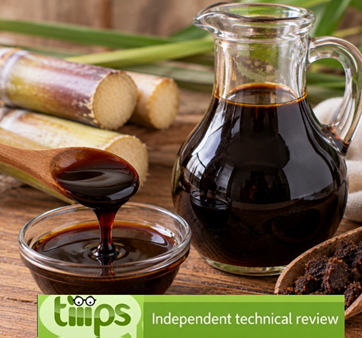
Molasses syrup is a thick, viscous sweetening product obtained mainly from the processing of sugar cane (Saccharum officinarum) or, in some cases, sugar beet (Beta vulgaris).
Molasses is formed during sugar extraction and crystallisation. After sucrose crystals are removed, a dark liquid phase remains containing residual sugars, water, minerals, and numerous compounds responsible for its characteristic colour and flavour.
Different types of molasses exist depending on the raw material and on how many times sugar has been extracted. Lighter molasses is generally sweeter, while later-stage products such as blackstrap molasses are darker, less sweet, and more concentrated in certain minerals.
Molasses syrup contains mainly sucrose, glucose, and fructose, in proportions that vary according to the product.
Compared with refined white sugar, it retains higher amounts of potassium, calcium, magnesium, and iron, although the actual nutritional contribution depends strongly on the type of molasses and the quantity consumed.
It also contains compounds formed or concentrated during processing that contribute to its typical dark colour and caramelised, malty, slightly bitter flavour.
Despite its mineral content, molasses syrup remains primarily a source of simple sugars and should therefore be considered mainly as a sweetener.
Calories
Molasses syrup generally provides approximately 280–320 kcal per 100 g.
The exact value varies according to water content and sugar concentration.
One tablespoon of about 20 g may provide approximately 55–65 kcal, mainly from simple carbohydrates.
Its energy density is slightly lower than that of crystalline sugar because of its water and mineral content, but it is still relatively high.
Uses in Food
Molasses syrup is used as a sweetener and flavouring ingredient in many foods.
It may be used in biscuits, cakes, bread, baked goods, cereal bars, and desserts.
It is particularly characteristic of certain gingerbread, spiced biscuit, and traditional British and North American recipes.
It can also be added to sauces, marinades, glazes, and sweet-and-savoury preparations, where it contributes both sweetness and a dark colour.
Molasses is also used in some types of wholemeal bread, cereals, malt-based products, and fermented preparations.
In barbecue sauces and similar condiments, it contributes a sweet, toasted, and caramelised flavour.
It may also be used in fermentation processes as a source of sugars for yeasts and microorganisms.
From a nutritional perspective, its mineral content does not remove the need for moderation, because it remains a concentrated source of free sugars.
Uses in Cosmetics
Molasses and some of its derivatives may also have limited use in cosmetic formulations.
Because of its sugar content, it can have humectant properties, helping to retain water in formulations and on the skin surface.
Derivatives or extracts may be included in masks, cleansers, hair-care products, and conditioning formulations.
Its sugars and mineral components may contribute to the sensory and moisturising characteristics of specific formulations.
Molasses may also be used as a raw material in biotechnological fermentation processes for the production of other cosmetic ingredients.
Food-grade molasses syrup should not, however, be considered equivalent to a standardised cosmetic extract or fermentation-derived ingredient.
Allergens
Molasses syrup is not among the major food allergens subject to mandatory declaration in the European Union, United Kingdom, or United States.
Specific allergic reactions to molasses are uncommon.
In compound foods, however, any allergens present in the other ingredients must also be considered.
Composition may also vary according to the raw material and manufacturing process, so people with particular sensitivities should check the specific product label.
Evaluation
An aromatic sweetener containing more minerals than refined white sugar.
Blackstrap molasses and other concentrated forms can provide appreciable amounts of certain minerals, but this does not change the fact that the ingredient consists mainly of simple sugars.
Ingredient verdict: an aromatic sweetener with a higher mineral content than refined sugar, mainly useful for its distinctive flavour and technological properties; it should still be consumed in moderation because of its high sugar content.
Cons: high in simple sugars and relatively calorie-dense; excessive consumption increases overall sugar intake

