



Grapeseed oil
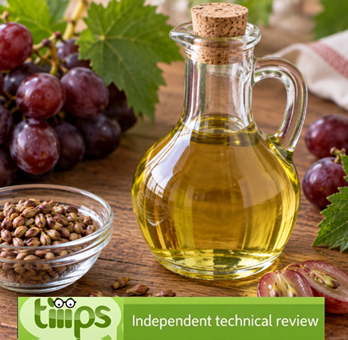
Grapeseed oil is a vegetable oil obtained from the seeds of grapes (Vitis vinifera, family Vitaceae), which are generally recovered as a by-product of grape processing and winemaking.
It may be produced by mechanical pressing or through extraction processes followed by refining. Its sensory characteristics and content of minor compounds may therefore vary considerably between cold-pressed oil and refined products.
It consists almost entirely of lipids and is particularly rich in unsaturated fatty acids.
The predominant fatty acid is generally linoleic acid, an omega-6 fatty acid, accompanied by smaller amounts of oleic acid. Saturated fatty acids usually account for a relatively small proportion.
Grapeseed oil may also contain vitamin E, phytosterols, and phenolic compounds, although their concentrations depend strongly on the extraction method and degree of refining.
Less-refined oils tend to retain larger amounts of bioactive compounds, while refining generally produces an oil with a more neutral flavour, lighter colour, and greater consistency.
Its high proportion of polyunsaturated fatty acids makes it nutritionally interesting, but also more susceptible to oxidation than oils particularly rich in oleic acid.
Calories
Grapeseed oil provides approximately 880–900 kcal per 100 g, similar to other vegetable oils.
One tablespoon of about 10 g provides approximately 90 kcal.
Because it consists almost entirely of fat, even relatively small amounts make a significant contribution to total energy intake.
Uses in Food
Grapeseed oil can be used as a dressing for salads, vegetables, and other foods.
Its generally mild and neutral flavour, especially in refined versions, makes it suitable for sauces, marinades, mayonnaise, and emulsified dressings.
It may also be used in baked goods, doughs, creams, and other food preparations where a relatively neutral-tasting oil is desired.
Refined versions may also be suitable for various types of cooking, while for particularly high temperatures the specific characteristics and recommendations provided by the manufacturer should be considered.
Its high linoleic acid content contributes polyunsaturated fatty acids to the diet, although it is best used as part of a varied dietary fat intake including different lipid sources.
As with all oils, the amount consumed is important because of its high energy density.
Uses in Cosmetics
Grapeseed oil is also widely used in cosmetics for its emollient and conditioning properties.
Its relatively light texture and high content of unsaturated fatty acids make it suitable for creams, lotions, body oils, serums, and facial products.
It is also used in massage oils, balms, hair-care products, and formulations intended for dry or dehydrated skin.
Its lipid content can help temporarily improve skin softness and suppleness and reduce water loss through the skin surface.
It is also valued as a carrier oil for other fat-soluble ingredients and aromatic substances.
Its cosmetic characteristics depend on the degree of refining, oxidative stability, and quality of the raw material.
Allergens
Grapeseed oil is not among the major food allergens subject to mandatory declaration in the European Union, United Kingdom, or United States.
Allergic reactions to grapes or grape seeds are possible but relatively uncommon.
Highly refined oils generally contain very little residual protein, while less-refined oils may theoretically retain larger amounts of seed-derived components.
People with a specific allergy to grapes or grape-derived products should therefore consider the type of oil being used.
Evaluation
A vegetable oil characterised by a high proportion of unsaturated fatty acids, particularly linoleic acid, and a relatively low content of saturated fat.
It may also provide vitamin E, phytosterols, and phenolic compounds, especially in less-refined products, although the actual amounts can vary considerably.
Its high polyunsaturated fatty acid content means that it should be stored carefully away from light, heat, and oxygen to limit oxidation.
Ingredient verdict: a useful vegetable oil rich in unsaturated fats, particularly linoleic acid; it can form part of a balanced diet, while its high energy density and greater susceptibility to oxidation should be taken into account.
Cons: high energy density; its high polyunsaturated fatty acid content makes it relatively susceptible to oxidation

