



Citron peel
Citron peel is the outer part of the fruit of the citron (Citrus medica, family Rutaceae), a citrus fruit characterised by a particularly thick and aromatic rind.
The peel includes an outer layer rich in essential oils and aromatic compounds and a white, spongy inner layer known as the albedo, which is particularly rich in fibre and pectin.
Compared with the pulp, citron peel contains higher concentrations of flavonoids, phenolic compounds, and aromatic substances responsible for its characteristic citrus fragrance.
Its essential oil may contain compounds such as limonene, citral, and other terpenes, with proportions varying according to cultivar, ripeness, and processing.
The peel also provides dietary fibre and pectin, while the amount of naturally occurring sugars is relatively low in the fresh product.
When candied, however, it absorbs considerable amounts of sugar and therefore has a very different nutritional profile from fresh peel.
Calories
Fresh citron peel has a relatively low energy density, although the exact value may vary depending on the amount of white pith and the composition of the fruit.
Candied citron peel may provide approximately 280–350 kcal per 100 g, mainly because of the large amount of sugar absorbed during candying.
The appropriate calorie value therefore depends strongly on the form in which the ingredient is used.
Uses in Food
Citron peel is used mainly for its intense and characteristic aroma.
Fresh or grated peel can be used to flavour cakes, creams, biscuits, baked goods, and desserts.
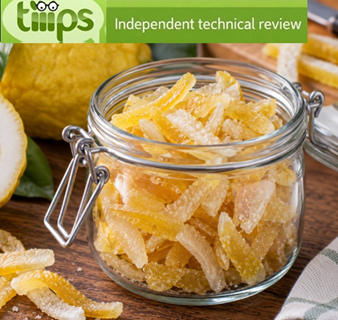
Candied citron peel is traditionally used in panettone, colomba, cassata, nougat, confectionery products, and other pastries.
It can also be used in marmalades, preserves, syrups, and liqueurs.
The peel may also be used to flavour drinks, herbal infusions, sauces, and savoury preparations, particularly when a pronounced citrus note is desired.
In candied products, the higher intake of sugars and calories should be taken into account.
Uses in Cosmetics
Citron peel and its essential oil may also be used in cosmetics and perfumery.
Extracts and oils obtained from the peel may be found in perfumes, soaps, cleansers, creams, lotions, and hair-care products.
The essential oil is used mainly for its fragrance and aromatic properties.
Peel extracts may also be included in cosmetic formulations because of their content of flavonoids and antioxidant compounds.
As with other citrus essential oils, appropriate concentrations should be used because some aromatic components may cause irritation or sensitisation in susceptible individuals.
Food-grade citron peel should not be considered equivalent to a standardised essential oil or cosmetic extract.
Allergens
Citron peel is not among the major food allergens subject to mandatory declaration in the European Union, United Kingdom, or United States.
However, individual allergic reactions to citrus fruits are possible.
The essential oils naturally present in the peel may also cause irritation or sensitisation in susceptible individuals.
In candied or processed products, any additional ingredients or allergens introduced during processing should also be considered.
Evaluation
An aromatic plant-derived ingredient containing fibre, pectin, flavonoids, and aromatic compounds, particularly useful for adding fragrance and flavour to foods.
Its nutritional profile changes considerably when the peel is candied, because the sugar content increases substantially.
Ingredient verdict: a useful aromatic plant ingredient with interesting natural components, especially when used fresh or in small amounts; in candied versions, the high sugar content should be taken into account.
Cons: candied versions may contain high amounts of sugar; possible individual reactions to citrus fruits

