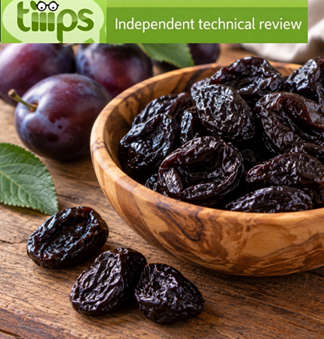
Pitted prunes are generally dried plums with the stone removed, obtained from the fruit of the European plum tree Prunus domestica, family Rosaceae.
Drying removes a substantial proportion of the water and concentrates sugars, fiber, minerals and plant compounds compared with fresh plums.
They consist mainly of carbohydrates, particularly glucose and fructose, and provide a significant amount of dietary fiber.
They also contain potassium, copper, vitamin K and smaller amounts of B-group vitamins.
Prunes naturally contain sorbitol, a sugar alcohol which, together with their fiber content, contributes to their well-known effect on bowel regularity.
They also provide polyphenols, including various phenolic acids, which contribute to the fruit’s antioxidant activity.
Removing the stone makes them easier to use as an ingredient but does not substantially alter the nutritional profile of the flesh.
Because drying concentrates the naturally occurring sugars, prunes have a much higher sugar and energy density than fresh plums.
High intake may cause bloating, gas, abdominal cramps or a laxative effect, particularly in people sensitive to sorbitol.
Calories
Pitted prunes generally provide approximately 235–250 kcal per 100 g.
The actual value may vary slightly depending on residual moisture and any additional ingredients.
Uses in Food
They are eaten directly as dried fruit or added to muesli, breakfast cereals, yogurt and snacks.
They can be used in cakes, biscuits, bread, bars, fillings and desserts.
Because of their natural sweetness and soft texture, they are also used in fruit purées and pastes, sometimes as a partial substitute for sugar or fat in certain recipes.
They are also used in savory preparations, particularly with meat, cheese, cereals and sweet-and-sour sauces.
Their fiber and sorbitol content makes them particularly well known for supporting bowel regularity, although large amounts may produce a pronounced laxative effect.
Uses in Cosmetics
Plum extracts and derivatives of Prunus seeds may be used in cosmetics for their antioxidant, emollient and conditioning properties.
They may occur in creams, serums, masks, balms and hair-care products.
Oils rich in fatty acids can also be obtained from the seeds of some Prunus species and used as emollient cosmetic ingredients.
Food-grade pitted prunes should not, however, be considered equivalent to a standardized cosmetic extract or oil.
Allergens
Prunes are not among the major food allergens requiring mandatory declaration in the European Union.
Rare individual reactions may nevertheless occur, including possible cross-reactivity with other fruits in the Rosaceae family.
Commercial dried prunes should also be checked for the possible presence of sulfites when used as preservatives and present at levels requiring declaration.
Assessment
A dried fruit valued for its content of fiber, potassium, polyphenols and sorbitol, but with a high concentration of naturally occurring sugars compared with fresh fruit.
Ingredient verdict: a nutritious dried fruit rich in fiber and useful for supporting bowel regularity, but best consumed in moderate amounts because of its high sugar concentration and possible laxative effect.
Cons: high natural sugar content; possible laxative effect and gastrointestinal discomfort with high intake
Studies
Plum contains anthocyanins, flavonoids, polyphenols, chlorogenic acid, neoclorogenic acid, caffeic acid, rutin, all natural components very interesting from the health point of view and some with a strong antioxidant and neuroprotective activity. However, it contains many sugars.(1).
The anabolic activity of the bones decreases in old age. Contrast therapies are rather limited and the only effective proanabolic regimen currently available to restore bone is intermittent treatment with teriparatide (parathyroid hormone 1-34). A diet containing dried plums can definitely help to increase and recover the aged bone volume (2).
The quantity and type of polyphenols, and the synergistic action of other components such as sorbitol, quinic acid, chlorogenic acid, vitamin K, boron, copper and potassium, contained in a plum extract, as well as having properties of bone preservation, have been shown to protect muscles and exert an anti-tumor activity on colon cancer (3).
The leaves of the plum, in the form of essential oil obtained by hydrodistillation, have demonstrated an interesting activity of contrast to free radicals exerting an antioxidant and neuroprotective action (4).
A four-week diet that included 20% dried plums was able, in an animal model, to alleviate the symptoms of inflammatory arthritis by virtue of its polyphenolic content (5).
The most relevant studies on this ingredient have been selected with a summary of their contents:
Plum studies
References________________________________________________________________________
(1) Alsolmei FA, Li H, Pereira SL, Krishnan P, Johns PW, Siddiqui RA. Polyphenol-Enriched Plum Extract Enhances Myotubule Formation and Anabolism while Attenuating Colon Cancer-induced Cellular Damage in C2C12 Cells. Nutrients. 2019 May 15;11(5):1077. doi: 10.3390/nu11051077. .
Abstract. Preventing muscle wasting in certain chronic diseases including cancer is an ongoing challenge. Studies have shown that polyphenols derived from fruits and vegetables shows promise in reducing muscle loss in cellular and animal models of muscle wasting. We hypothesized that polyphenols derived from plums (Prunus domestica) could have anabolic and anti-catabolic benefits on skeletal muscle. The effects of a polyphenol-enriched plum extract (PE60) were evaluated in vitro on C2C12 and Colon-26 cancer cells. Data were analyzed using a one-way ANOVA and we found that treatment of myocytes with plum extract increased the cell size by ~3-fold (p < 0.05) and stimulated myoblast differentiation by ~2-fold (p < 0.05). Plum extract induced total protein synthesis by ~50% (p < 0.05), reduced serum deprivation-induced total protein degradation by ~30% (p < 0.05), and increased expression of Insulin-Like Growth Factor-1 (IGF-1) by ~2-fold (p < 0.05). Plum extract also reduced tumor necrosis factor α (TNFα)-induced nuclear factor κB (NFκB) activation by 80% (p < 0.05) in A549/NF-κB-luc cells. In addition, plum extract inhibited the growth of Colon-26 cancer cells, and attenuated cytotoxicity in C2C12 myoblasts induced by soluble factors released from Colon-26 cells. In conclusion, our data suggests that plum extract may have pluripotent health benefits on muscle, due to its demonstrated ability to promote myogenesis, stimulate muscle protein synthesis, and inhibit protein degradation. It also appears to protect muscle cell from tumor-induced cytotoxicity.
(2) Halloran BP, Wronski TJ, VonHerzen DC, Chu V, Xia X, Pingel JE, Williams AA, Smith BJ. Dietary dried plum increases bone mass in adult and aged male mice. J Nutr. 2010 Oct;140(10):1781-7. doi: 10.3945/jn.110.124198.
Abstract. Bone is progressively lost with advancing age. Therapies are limited and the only effective proanabolic regimen presently available to restore bone is intermittent treatment with teriparatide (parathyroid hormone 1-34). Recent evidence suggests that dietary supplementation with dried plum (DP) can prevent bone loss due to estrogen deficiency. To determine whether dietary DP supplementation can prevent the loss of bone with aging and whether bone that has already been lost can be restored, adult (6 mo) and old (18 mo) male mice were fed a normal diet or isoenergetic, isonitrogenous diets supplemented with DP (0, 15, and 25% DP by weight) for 6 mo. MicroCT analysis and bone histomorphometry were used to assess bone volume, structure, and metabolic activity before, during, and after dietary supplementation. Mice fed the 0% DP diet (control diet) lost bone, whereas both adult and old mice fed the 25% DP-supplemented diet gained bone. Adult but not old mice fed the 15% diet also gained bone. Cancellous bone volume in mice receiving 25% DP exceeded baseline levels by 40-50%. Trabecular structure varied with diet and age and responses in old mice were generally blunted. Trabecular, but not cortical, mineral density varied with age and measures of bone anabolic activity were lower in aged mice. Our findings suggest that DP contains proanabolic factors that can dramatically increase bone volume and restore bone that has already been lost due to aging. In turn, DP may provide effective prophylactic and therapeutic agents for the treatment of osteoporosis.
(3) Fujii T, Ikami T, Xu JW, Ikeda K. Prune extract (Prunus domestica L.) suppresses the proliferation and induces the apoptosis of human colon carcinoma Caco-2. J Nutr Sci Vitaminol (Tokyo). 2006 Oct;52(5):389-91. doi: 10.3177/jnsv.52.389.
Abstract. Prunes are the dried fruits of certain cultivars of Prunus domestica L., and are recognized as a health food. The separated ethanol fraction from concentrated prune juice by DIAION HP-20 (PE) was investigated for cytotoxic effects on two different cancer cell lines in vitro. PE dose-dependently reduced the viable cell number of Caco-2, KATO III, but does not reduce the viable cell number of human normal colon fibroblast cells (CCD-18Co) used as a normal cell model. PE treatment for 24 h led to apoptotic changes in Caco-2 such as cell shrinkage and blebbed surfaces due to the convolutions of nuclear and plasma membranes and chromatin condensation, but this was not observed in CCD-18Co. PE induced nucleosomal DNA fragmentation typical of apoptosis in Caco-2 after 24 h of treatment. These results show that PE induced apoptosis in Caco-2. Furthermore, by Caco-2 treatment with H2O2 chelator catalase and Ca2+-chelator BAPTA/AM, the PE-induced cytotoxic pathway was completely blocked, and the viable cell number of Caco-2 was not affected.
(4) Bonesi M, Tenuta MC, Loizzo MR, Sicari V, Tundis R. Potential Application of Prunus armeniaca L. and P. domestica L. Leaf Essential Oils as Antioxidant and of Cholinesterases Inhibitors. Antioxidants (Basel). 2018 Dec 21;8(1):2. doi: 10.3390/antiox8010002.
Abstract. The aim of this work is to investigate the in vitro acetylcholinesterase (AChE) and butyrycholinesterase (BChE) inhibitory activities of essential oils obtained by hydrodistillation from the leaves of Prunus armeniaca and P. domestica in relation to their composition, analysed by Gas Chromatography⁻Flame Ionization Detector (GC-FID) and Gas Chromatography-Mass Spectrometry (GC-MS) analyses, at different times. Moreover, considering the role of free radicals in the progression of neurodegenerative disorders, the antioxidant properties of essential oils were investigated by using, 2'-azino-bis(3-ethylbenzothiazoline-6-sulphonic acid) (ABTS), 2,2-diphenyl-1-picrylhydrazyl (DPPH), and β-carotene bleaching tests. The relative antioxidant capacity index (RACI) was used to achieve more comprehensive comparison between analysed antioxidant effects of essential oils. P. armeniaca oils were more active than P. domestica oils against AChE. Against BChE, the most active was the essential oil from P. domestica leaves collected in August with an IC50 value of 95.80 μg/mL. This oil exerted the highest inhibitory activity of lipid peroxidation with IC50 values of 11.15 and 11.39 μg/mL after 30 and 60 min of incubation, respectively. All samples demonstrated a remarkable ABTS radicals scavenging activity, with IC50 values in the range 0.45⁻0.57 μg/mL in comparison to the positive control, ascorbic acid.
(5) Dried plum alleviates symptoms of inflammatory arthritis in TNF transgenic mice. Mirza F, Lorenzo J, Drissi H, Lee FY, Soung DY. J Nutr Biochem. 2018 Feb;52:54-61. doi: 10.1016/j.jnutbio.2017.10.002.




