



Whole grain KAMUT khorasan wheat flour
Whole grain KAMUT® khorasan wheat flour is obtained by milling the entire khorasan wheat kernel, including the endosperm, bran and germ.
Khorasan wheat is botanically classified as Triticum turgidum subsp. turanicum, family Poaceae; Triticum turanicum is considered a botanical synonym.
KAMUT® is not the name of a species or a generic type of wheat, but a registered trademark used for a specific khorasan wheat that must meet defined production and quality requirements, including certified organic cultivation.
Because it is whole grain, the flour retains more dietary fiber, vitamins, minerals and germ components than the corresponding refined flour.
It is primarily a source of complex carbohydrates, while also providing a significant amount of protein.
It also contains minerals such as magnesium, phosphorus, zinc, iron, manganese and selenium, in amounts that vary according to soil, cultivation conditions and processing.
The germ provides small amounts of unsaturated fats and vitamin E, while the outer layers of the grain contribute mainly fiber and minerals.
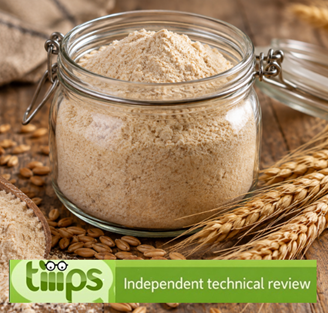
Its flavor is generally described as sweet, cereal-like and slightly nutty, making it suitable for many baked preparations.
Like other types of wheat, it contains gluten. Being a different type of wheat from many modern varieties does not make it suitable for people with celiac disease.
The greater presence of bran and germ may also result in a somewhat shorter shelf life than refined flour because of the higher content of lipids susceptible to oxidation.
Calories
Whole grain khorasan wheat flour provides approximately 330–360 kcal per 100 g.
The actual value depends on the flour composition, moisture content and characteristics of the grain used.
Because it retains the bran, it generally contains more fiber than refined flour made from the same cereal.
Uses in Food
It is used to prepare bread, focaccia, pizza, pasta, biscuits, cakes, crackers and other baked goods.
It may be used alone or blended with other flours to modify the flavor, texture and fiber content of doughs.
The presence of bran tends to increase water absorption and may make doughs denser and less extensible than those made exclusively with refined flour.
It is particularly appreciated in whole grain bread, whole grain pasta, organic products and whole-grain cereal preparations.
Its fiber content may contribute to greater satiety and a generally slower glycemic response than highly refined flour, although the actual effect depends on the complete recipe and processing method.
Uses in Cosmetics
Whole grain khorasan wheat flour is not a particularly common cosmetic ingredient.
Wheat-derived ingredients such as hydrolyzed proteins, starch, wheat germ and related extracts may instead be used in skin- and hair-care products.
They may occur in creams, masks, cleansers, shampoos and conditioners for conditioning, film-forming or absorbent functions.
Food-grade khorasan wheat flour should not be considered equivalent to a purified and standardized cosmetic wheat derivative.
Allergens
Khorasan wheat is a type of wheat and contains gluten.
It therefore belongs to the category of gluten-containing cereals requiring mandatory allergen declaration in the European Union.
It is not suitable for people with celiac disease or wheat allergy.
Assessment
A nutritionally valuable whole grain flour providing fiber, protein and micronutrients, with a characteristic flavor and a more complete composition than the corresponding refined flour.
Ingredient verdict: a useful whole grain khorasan wheat flour that provides more fiber and retains a greater proportion of the grain’s natural components; KAMUT® identifies a specific trademarked product rather than a separate botanical species.
Cons: Allergen

