



Guar seed flour
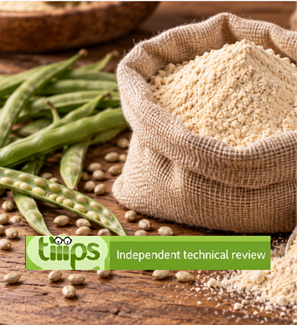
Guar seed flour is obtained by grinding the seeds of guar (Cyamopsis tetragonoloba, family Fabaceae), a leguminous plant cultivated mainly in warm and semi-arid regions.
The seed consists of endosperm, germ and seed coat. The endosperm is particularly rich in galactomannan, a soluble polysaccharide capable of absorbing large amounts of water, while the germ contains a relatively high proportion of protein. In whole seeds, the protein content may exceed 20–25%.
Flour obtained from the whole seed therefore contains carbohydrates, fiber, protein and small amounts of fat, with a composition different from purified guar gum.
It should not automatically be confused with guar gum (E412): the latter is obtained mainly from the seed endosperm and is much richer in galactomannan, whereas seed flour may also contain germ and seed coat.
The fiber fraction, particularly galactomannan, has a high capacity to bind water and increase viscosity.
The seed also naturally contains compounds such as phytates, tannins, saponins and protease inhibitors; their amounts and relevance depend on processing and can be reduced through appropriate technological treatments.
High consumption of products very rich in guar fiber may cause bloating, flatulence and intestinal discomfort, especially if fiber intake is increased rapidly.
Calories
Guar seed flour may provide approximately 300–360 kcal per 100 g, although the actual value varies considerably depending on the proportions of endosperm, germ and seed coat and on the effective fiber content.
The energy contribution of the fiber fraction is lower than that of fully digestible carbohydrates.
Uses in Food
Guar seed flour may be used to increase the fiber and protein content of certain food formulations.
Its water-binding properties can contribute to texture, viscosity and moisture retention.
It may be used in controlled amounts in baked goods, cereal-based preparations, high-fiber foods and plant-based formulations.
In the food industry, however, the purified endosperm fraction, namely guar gum, is much more widely used as a thickener, stabilizer and water-retention agent.
The presence of proteins and germ components makes whole guar seed flour nutritionally different from purified guar gum.
Uses in Cosmetics
Guar gum and its derivatives are used in cosmetics more frequently than whole seed flour.
They may be used as thickeners, stabilizers, film-forming agents and conditioning ingredients, especially in shampoos, conditioners, cleansers, creams and gels.
Cationic guar derivatives are particularly used in hair-care products to improve combing and softness.
Food-grade guar seed flour should not be considered equivalent to a purified or modified cosmetic guar derivative.
Allergens
Guar is not among the major food allergens requiring mandatory declaration in the European Union.
However, since it is a legume containing proteins, individual allergic reactions are possible, although relatively rare.
Assessment
A plant ingredient rich in fiber and protein, characterized especially by the presence of galactomannan and by its considerable water-binding properties.
Ingredient verdict: a functional flour derived from guar seeds, interesting for its fiber and protein content and its technological properties; it should be distinguished from purified guar gum and used in appropriate amounts.
Cons: possible gastrointestinal discomfort with high intake; possible rare sensitivities

