



Heavy whipping cream or cream: properties, uses, advantages, disadvantages, safety
Cream is a dairy product consisting of the fat-rich fraction of milk, normally separated from milk by centrifugation.
When “cream” appears in the ingredient list of a food product, it generally refers to a milk-derived ingredient in which milk fat is present at a substantially higher concentration than in the original milk.
In the European Union and United Kingdom, the designation “cream” is reserved for dairy products derived from milk. In the United States, cream and the various recognised cream categories are likewise dairy products defined primarily according to their milk-fat content and processing characteristics.
Cream does not have one universal composition. Different products can have very different fat levels, including cooking cream, whipping cream, heavy cream, single cream and UHT cream. Therefore, the word “cream” alone does not establish the exact calorie, total-fat or saturated-fat content without information on the specific product used.
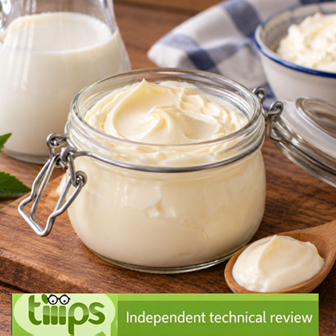
Description
Milk is a natural emulsion in which small fat globules are dispersed through an aqueous phase containing proteins, lactose, minerals and vitamins.
Because the fat globules are less dense than the aqueous phase, they can be separated and concentrated. Modern dairy processing normally uses centrifugal separation for this purpose.
Cream therefore retains the principal constituents of milk but in different proportions:
considerably more fat;
less water;
modest amounts of protein;
lactose;
minerals;
fat-soluble vitamins;
cholesterol.
Its colour is generally white to cream-coloured, sometimes slightly yellow because of fat-soluble pigments naturally present in milk fat.
Consistency depends strongly on fat concentration. A cream containing about 20–25% fat is generally more fluid than whipping or heavy cream containing around 35% fat or more.
Production process
Production normally starts with cow's milk, although cream can also be obtained from the milk of other mammals.
Typical stages include:
reception and quality control of the milk;
filtration;
refrigeration;
centrifugal separation of the fat-rich fraction;
standardisation of milk-fat content;
optional homogenisation;
pasteurisation or UHT treatment;
optional addition of technological ingredients permitted for the specific formulation;
packaging;
refrigerated or ambient storage depending on the heat treatment.
Centrifugal separation makes it possible to adjust the fat content with considerable precision.
The cream may subsequently be pasteurised or subjected to UHT treatment.
Pasteurisation significantly reduces pathogenic microorganisms while attempting to preserve the sensory characteristics of the product. UHT treatment uses very high temperatures for a short time and, together with aseptic packaging, allows unopened cream to remain commercially stable for much longer periods without refrigeration.
Fresh pasteurised cream normally requires a continuous cold chain, whereas unopened UHT cream can generally be stored at room temperature until opening.
Main substances contained
Cream is a complex food matrix.
Milk fat
Milk fat is the component that most clearly distinguishes cream from ordinary milk.
It consists predominantly of triacylglycerols containing many different fatty acids.
The fatty acid fraction includes:
saturated fatty acids;
monounsaturated fatty acids;
small amounts of polyunsaturated fatty acids;
short- and medium-chain fatty acids.
Important individual fatty acids include:
palmitic acid;
stearic acid;
myristic acid;
oleic acid;
short-chain fatty acids including butyric acid.
In conventional cream, saturated fatty acids represent a substantial proportion of total milk fatty acids.
Milk proteins
Cream contains both major classes of milk protein:
caseins;
whey proteins.
The protein concentration is generally lower, proportionally, than in milk because the higher fat fraction reduces the percentage contribution of the other milk constituents.
Lactose
Cream naturally contains lactose, the characteristic sugar of milk.
Conventional cream is therefore not automatically suitable for people with lactose intolerance.
Commercial lactose-free cream is available. It is normally produced by enzymatically hydrolysing lactose into glucose and galactose.
Cholesterol
Because cream contains animal fat, it also naturally contains cholesterol.
The amount increases broadly with the milk-fat content of the cream.
Minerals
Cream contains minerals including:
calcium;
phosphorus;
potassium;
sodium;
magnesium.
However, it should not normally be considered one of the principal dietary sources of calcium because it is generally consumed in smaller quantities than milk or yogurt and has a much higher fat content.
Vitamins
Fat-soluble vitamins are associated with the milk-fat fraction, particularly vitamin A, together with variable amounts of vitamin E and other vitamins.
Identification data and characteristics
| Characteristic | Value / note |
|---|---|
| Name | Cream |
| Category | Dairy product |
| Typical origin | Cow's milk |
| Characterising component | Milk fat |
| Structure | Fat-in-water emulsion |
| Fat content | Highly variable according to cream type |
| Protein | Present in modest quantities |
| Lactose | Naturally present unless lactose-free |
| Cholesterol | Naturally present |
| Dietary fibre | Absent |
| Gluten | Naturally absent in plain cream |
| Major allergen | MILK and milk products |
| E-number | None for cream itself |
| Possible treatments | Pasteurisation, sterilisation, UHT |
| Possible additional ingredients | Stabilisers/thickeners in some commercial preparations |
The term cream therefore describes a dairy ingredient, rather than a standardised chemical substance with one fixed composition.
Indicative nutritional values
There is no single nutritional profile for all cream.
A cooking cream containing about 23% fat may provide approximately:
| Nutrient | Indicative amount per 100 g |
|---|---|
| Energy | about 230–235 kcal |
| Water | about 69 g |
| Fat | about 23 g |
| Protein | about 2.5–3 g |
| Carbohydrates | about 4 g |
| Sugars | about 4 g |
| Dietary fibre | 0 g |
| Cholesterol | about 80 mg |
A whipping cream containing around 35% fat may instead provide approximately:
335–340 kcal per 100 g;
35 g fat;
about 2–3 g protein;
about 3–4 g carbohydrates;
approximately 120 mg cholesterol.
This difference shows why the actual milk-fat percentage of the cream used in a food formulation is essential for nutritional assessment.
Cooking cream
Cooking cream often contains approximately 20–25% milk fat, although there is no universal composition internationally.
It may be:
pasteurised;
sterilised;
UHT-treated.
Some products consist essentially of cream alone, while others contain stabilisers or thickeners.
Possible additional ingredients can include:
carrageenan;
guar gum;
locust bean gum;
other permitted stabilising systems.
These substances are not intrinsic components of cream.
If a food product uses a formulated cooking cream, its complete sub-ingredient specification should therefore be checked rather than assuming that the word “cream” describes only milk and milk fat.
Whipping cream
To whip successfully, cream generally requires a relatively high fat content.
Depending on the market, products intended for whipping often contain approximately 30–40% milk fat.
During whipping, mechanical agitation incorporates air and causes partial destabilisation of the milk-fat globules.
Partially aggregated fat globules then form a network around the air bubbles, producing a stable foam.
If the fat content is too low, this structure is much more difficult to form.
Technological properties
Cream is a particularly versatile ingredient because it combines fat, water, proteins and naturally occurring milk emulsifying components.
Fat contribution
Milk fat:
increases creaminess;
improves mouthfeel;
contributes softness;
carries fat-soluble flavours;
can reduce the perception of acidity or bitterness;
contributes to texture.
Emulsion
Cream is itself a natural emulsion.
It can therefore be incorporated effectively into:
sauces;
creams;
fillings;
desserts;
soups;
other emulsified foods.
Reduction
During cooking, part of the water evaporates.
Cream therefore becomes progressively:
thicker;
richer;
more concentrated.
This property is widely used in sauces and savoury preparations.
Whipping
High-fat cream can incorporate and stabilise air, producing foams for pastry and dessert applications.
Sauce stabilisation
Fat and milk proteins can help produce a smooth, rich texture.
However, strong acidity, excessive heat or unsuitable processing conditions can destabilise the emulsion or cause protein aggregation.
Food uses
Cream is widely used in:
sauces;
pasta dishes;
soups;
purées;
fillings;
meat dishes;
desserts;
ice cream;
mousses;
pastry creams;
cakes;
ganache;
bakery products;
confectionery;
chocolate preparations.
It can simultaneously function as:
fat ingredient + structural ingredient + flavour carrier + source of creaminess.
Calories
Cream is an energy-dense food, especially when its fat content is high.
Indicatively:
23% fat cooking cream → about 233 kcal/100 g
35% fat whipping cream → about 337 kcal/100 g
A 30 g portion of a 35% whipping cream can therefore provide approximately 100 kcal.
Most of the energy comes from fat, which provides approximately 9 kcal per gram.
Saturated fat
One of the principal nutritional considerations is the significant proportion of saturated fatty acids in milk fat.
In a conventional cream, saturated fatty acids can represent roughly 60–65% of total fatty acids, although the actual profile varies with the milk and production system.
Consequently, high-fat cream can make a substantial contribution to saturated-fat intake even when the serving size is relatively modest.
The correct evaluation should nevertheless consider the amount actually present in the finished food, rather than treating the mere presence of cream as nutritionally decisive.
Advantages
It is a traditional dairy ingredient.
Provides creaminess and softness.
Improves mouthfeel.
Efficiently carries fat-soluble flavour compounds.
Can enrich and stabilise sauces and creams.
High-fat cream can be whipped.
Naturally contains vitamin A and other fat-associated micronutrients.
Provides small amounts of protein and minerals.
Plain cream is naturally gluten-free.
Plain cream does not necessarily require additives.
Can be used in both sweet and savoury foods.
UHT treatment allows a long unopened shelf life without refrigeration.
Disadvantages
High-fat varieties have a high energy density.
Contains a significant proportion of saturated fat.
Naturally contains cholesterol.
Contains lactose, unless specifically lactose-free.
Contains milk proteins and is therefore unsuitable for people with milk allergy.
Large amounts can substantially increase the calorie content of a formulation.
The generic word “cream” does not reveal the exact fat content.
Some commercial creams contain stabilisers or thickeners.
Cooking cream and whipping cream are not nutritionally equivalent.
UHT cream and fresh pasteurised cream can have different sensory characteristics.
Milk allergen
Cream contains milk proteins and must therefore be treated as containing the major allergen MILK.
In the EU and UK, milk and products thereof are among the allergens requiring specific declaration and emphasis in ingredient information.
In the United States, milk is likewise a major food allergen under federal allergen-labelling requirements.
Separation of the cream from milk does not eliminate allergenic milk proteins.
Cream is therefore unsuitable for individuals with cow's milk protein allergy.
Milk allergy and lactose intolerance are not the same
This distinction is essential.
Milk allergy
Milk allergy is an immune reaction to milk proteins such as:
caseins;
beta-lactoglobulin;
alpha-lactalbumin.
Even small amounts can trigger a reaction in susceptible individuals.
Lactose intolerance
Lactose intolerance results from reduced ability to digest lactose because of insufficient lactase activity.
Tolerance depends on:
dose;
individual lactase activity;
the rest of the meal;
individual sensitivity.
Conventional cream contains lactose and should not automatically be considered suitable for lactose-intolerant consumers.
Lactose-free cream
Lactose-free cream is usually produced by adding lactase, which splits lactose into:
glucose;
galactose.
It still contains milk proteins.
Therefore:
lactose-free cream may be suitable for some lactose-intolerant consumers
but
it is not suitable for people with milk-protein allergy.
Microbiological safety
Cream is rich in water and nutrients and can support microbial growth if it is not adequately processed and stored.
Commercial cream is therefore normally:
pasteurised;
sterilised;
or UHT-treated.
Pasteurisation substantially reduces pathogenic microorganisms but does not make the product sterile.
UHT treatment is more severe and, combined with aseptic packaging, is designed to achieve commercial stability of the unopened product at room temperature.
After opening, even UHT cream normally requires refrigeration and should be consumed within the period specified by the manufacturer.
UHT cream
Ultra High Temperature (UHT) processing exposes cream to very high temperatures for a very short time.
The purpose is to destroy microorganisms capable of growing in the packaged product while minimising prolonged heat exposure.
The main advantage is a long unopened shelf life at ambient temperature.
However, UHT treatment can cause some changes in:
flavour;
protein structure;
colour;
sensory characteristics
compared with fresh pasteurised cream.
Stabilisers and thickeners
Some cooking creams contain stabilisers such as:
carrageenan;
guar gum;
locust bean gum;
other hydrocolloids.
Their purpose may be to:
increase viscosity;
improve physical stability;
reduce separation;
maintain a creamy texture throughout shelf life;
improve behaviour during cooking.
These ingredients are not inherently part of cream.
A distinction should therefore be made between:
plain cream
and
a formulated cream preparation containing stabilisers or thickeners.
Cream and vegetable fats
A product in which milk fat is partly or completely replaced by vegetable fat is not compositionally equivalent to conventional dairy cream.
Cream analogues may contain vegetable oils and can have a very different:
fatty acid profile;
saturated-fat content;
flavour;
technological behaviour;
allergen profile.
In the EU and UK, dairy terms such as cream receive specific protection for milk-derived products, subject to defined exceptions.
In the United States, cream categories are likewise defined around milk fat, whereas non-dairy creamers and imitation products represent separate product types.
This distinction is important when analysing a food label: a vegetable cream or non-dairy creamer should not be nutritionally or technologically assumed to be equivalent to dairy cream.
Storage
Storage depends on processing.
Fresh pasteurised cream
Normally requires:
continuous refrigeration;
intact packaging;
use within the stated shelf life;
rapid consumption after opening.
UHT cream
Can generally be stored unopened at room temperature.
After opening it should be refrigerated.
The exact use-after-opening period varies between products and should always be taken from the manufacturer's instructions rather than assuming one universal number of days.
European Union
Within the EU framework, cream is a reserved dairy designation.
Food-information and hygiene legislation additionally governs:
milk-allergen declaration;
processing hygiene;
pasteurisation/UHT treatment;
ingredient declaration;
any additives present in formulated cream products.
The exact fat percentage of the cream used therefore remains a product-specific characteristic rather than something determined by the generic word “cream”.
United Kingdom
In the UK, cream categories are traditionally differentiated according to milk-fat content, for example:
single cream;
whipping cream;
double cream.
The exact fat specifications and commercial terminology differ from continental European systems, which is why a generic international ingredient name such as “cream” should not automatically be translated into one specific UK commercial cream category without additional information.
Milk remains a regulated allergen and must be identified accordingly.
United States
In the United States, FDA standards distinguish dairy cream categories according to milk-fat content, including products such as:
light cream;
heavy cream;
heavy whipping cream.
Terminology and percentage ranges are not identical to those used in the UK or EU.
Therefore, when the ingredient list states only “cream”, the actual technical specification should be consulted before assigning a precise fat percentage or nutritional composition.
Milk is a major US food allergen and must be managed accordingly.
Environment
The environmental impact of cream is closely linked to the dairy supply chain.
Relevant factors include:
feed production;
livestock farming;
enteric emissions;
manure management;
land and water use;
milking;
refrigeration;
transport of milk;
cream separation;
thermal treatment;
packaging.
Because cream, skimmed milk, butter and other dairy products are obtained from the same raw milk, environmental impacts have to be allocated across several co-products of dairy processing rather than assigning the entire impact of milk production to cream alone.
Farming system, animal feed, production efficiency, energy use and packaging can substantially influence the overall result.
Conclusion
Cream is a dairy product obtained by concentrating the fat-rich fraction of milk, normally through centrifugal separation.
Its composition depends strongly on the milk-fat percentage. A cooking cream containing around 23% fat may provide approximately 230–235 kcal and 23 g of fat per 100 g, whereas a whipping cream containing around 35% fat can provide approximately 335–340 kcal and 35 g of fat per 100 g.
Milk fat contains a substantial proportion of saturated fatty acids, which may account for approximately 60–65% of the total fatty-acid fraction depending on the specific cream.
From a technological standpoint, cream is particularly valuable because it combines fat, water, proteins and natural milk components, providing creaminess, flavour-carrying capacity, structure and, in sufficiently high-fat products, whipping properties.
Cream may be marketed as fresh pasteurised or UHT. UHT treatment allows prolonged unopened storage at room temperature, whereas refrigeration is normally required after opening.
Plain cream does not necessarily contain additives. Some commercial cooking creams contain carrageenan, guar gum, locust bean gum or other stabilisers, while others consist essentially of cream alone.
The main safety consideration is the MILK allergen. Cream contains milk proteins and is unsuitable for people with milk-protein allergy. It also naturally contains lactose unless specifically treated to remove or hydrolyse it; lactose-free cream still contains milk proteins and therefore remains unsuitable for people with milk allergy.
Overall, cream is a traditional, energy-dense and technologically versatile food ingredient. A proper assessment should consider the actual fat percentage, amount used, saturated-fat content, lactose, milk allergen, heat treatment and any stabilisers or thickeners present in the specific commercial ingredient.
Disadvantages: high energy density in high-fat varieties; significant saturated-fat and cholesterol content; naturally contains lactose; mandatory consideration of the MILK allergen.
Studies
Regular consumption of cream can cause inflammation and problems in the cardiovascular system and increase the values of LDL cholesterol.
Why's that?
Because the cream content is about 70% saturated fat, 28% unsaturated fat, 2% protein and zero carbohydrates.
This other study clarifies the risks associated with a consumption of cream:
48 healthy, normal-weight people between the ages of 25 and 47 were given 75 grams of glucose (300 calories), 33 grams of cream (300 calories) and orange juice (300 calories) daily. At the end of the study, orange juice had not produced any change in the inflammatory indices, while glucose had increased some indices and cream had increased them all (2).
Limiting intake of full-fat dairy products especially butter, cream and dairy based desserts should be considered for those at high-risk of cardiovascular disease (2).

