



Beeswax, white and yellow
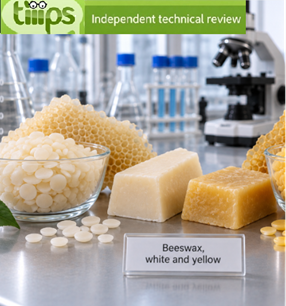
Beeswax, white and yellow is a natural substance produced by the honey bee (Apis mellifera, family Apidae) to build the walls of honeycombs.
Yellow beeswax is obtained by melting the honeycomb and removing impurities, while white beeswax is produced from yellow beeswax through a decolorization or bleaching process. In the European Union, both are identified as the food additive E901 – Beeswax, white and yellow.
Chemically, beeswax is a complex mixture composed mainly of esters of fatty acids and long-chain fatty alcohols, together with hydrocarbons, free fatty acids and smaller amounts of other lipid compounds.
It is insoluble in water, has hydrophobic properties and typically melts at approximately 62–65 °C.
Yellow beeswax retains more of the characteristic color, aroma and natural components of the honeycomb, while white beeswax has a more neutral color and odor, making it particularly useful when the appearance of the final product should not be altered.
Unlike ordinary dietary fats, its components are poorly absorbed by the gastrointestinal tract.
Calories
For beeswax, it is not appropriate simply to apply the approximately 9 kcal/g value used for triglycerides, because waxes consist mainly of long-chain esters that are poorly digested and absorbed.
At the very small amounts used in foods as a glazing or coating agent, the effectively available caloric contribution is negligible.
Uses in Food
White and yellow beeswax is used as the food additive E901, mainly as a glazing and coating agent.
It may be applied to the surface of confectionery, fruit, nuts and other authorized foods to create a protective and glossy film.
The coating may help reduce moisture loss, improve surface appearance and protect the product during storage.
It may also be used as a technological carrier for flavorings and in certain food formulations where hydrophobic and structuring properties are required.
The amount actually consumed through these uses is generally very small.
Uses in Cosmetics
Beeswax is widely used in cosmetics under names such as Beeswax and Cera Alba.
It acts as an emollient, film-forming agent, emulsion stabilizer and consistency regulator.
It is particularly common in lip balms, lipsticks, creams, ointments, sticks, mascaras, hair-care products and protective skincare formulations.
It forms a hydrophobic film on the skin surface that may help reduce water loss and improve softness and texture.
White beeswax is particularly suitable for formulations requiring a neutral color and odor, while yellow beeswax retains more of the natural characteristics of the original wax.
Allergens
Beeswax is not among the major food allergens requiring mandatory declaration in the European Union.
Purified beeswax is generally well tolerated, although rare individual reactions may occur, particularly with topical use or if traces of other bee-derived substances are present.
Assessment
A mainly technological natural ingredient, with virtually no nutritional relevance at the amounts normally used in foods, but highly useful for its protective, film-forming and structuring properties.
Ingredient verdict: a natural bee-derived wax useful as a food coating agent and as an emollient and structuring ingredient in cosmetics; at normal use levels, it presents no particular concerns.
Cons: possible rare individual sensitivities

